5+3+3+4 Education System Explained with Examples
Published: 8 Sep 2026
The 5+3+3+4 Education System is the new curricular and pedagogical structure introduced under India’s National Education Policy (NEP) 2020. It replaces the earlier 10+2 school structure with four stages designed around the developmental needs, learning abilities, and educational requirements of children from ages 3 to 18.
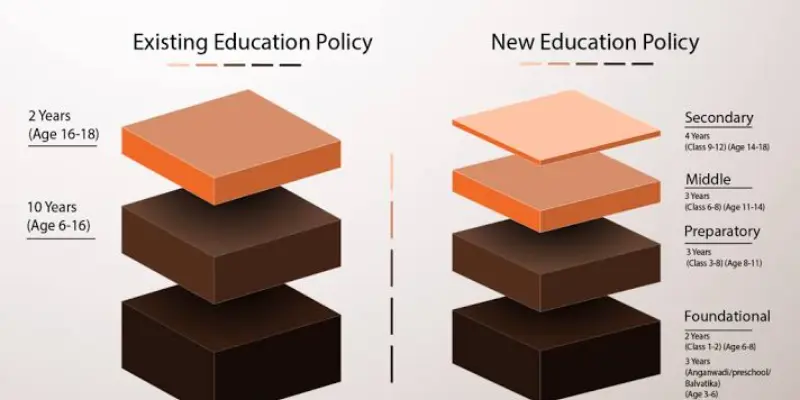
The four stages are Foundational, Preparatory, Middle, and Secondary. The structure includes three years of preschool or Anganwadi education, Classes 1 and 2, Classes 3 to 5, Classes 6 to 8, and Classes 9 to 12.
The model places greater emphasis on foundational literacy and numeracy, conceptual understanding, experiential learning, critical thinking, multidisciplinary education, practical skills, and flexibility in learning.
The official National Education Policy 2020 describes the 5+3+3+4 design as covering the age groups of 3–8, 8–11, 11–14, and 14–18 years.
This guide explains the 5+3+3+4 Education System with examples, class levels, age groups, learning approaches, major features, benefits, and differences from the old 10+2 system.
What Is the 5+3+3+4 Education System?
The 5+3+3+4 Education System divides school education into four developmental stages instead of treating schooling mainly as a 10+2 structure.
The numbers represent the number of years included in each stage:
- 5 years – Foundational Stage
- 3 years – Preparatory Stage
- 3 years – Middle Stage
- 4 years – Secondary Stage
The structure covers education from approximately age 3 to age 18.
| Stage | Years | Classes / Level | Approx. Age |
|---|---|---|---|
| Foundational | 5 | 3 years preschool + Classes 1–2 | 3–8 |
| Preparatory | 3 | Classes 3–5 | 8–11 |
| Middle | 3 | Classes 6–8 | 11–14 |
| Secondary | 4 | Classes 9–12 | 14–18 |
The official National Education Policy states that the Foundational Stage includes three years of Anganwadi, preschool, or Balvatika followed by two years of primary school in Grades 1 and 2. The Preparatory Stage covers Grades 3–5, the Middle Stage covers Grades 6–8, and the Secondary Stage covers Grades 9–12. (National Education Policy 2020)
Why Was the 5+3+3+4 Structure Introduced?
The earlier 10+2 structure was largely organized around formal schooling beginning with Class 1. The NEP 2020 structure gives greater importance to the years before Class 1 and recognizes early childhood as an important period for learning and development.
The 5+3+3+4 Education System connects curriculum and teaching methods with different stages of child development.
Early learners need play-based and activity-based experiences. Students in the Preparatory Stage need stronger language, numeracy, and conceptual foundations. Middle-stage students can engage with more abstract concepts and subject-specific learning. Secondary students need greater depth, critical thinking, multidisciplinary learning, and subject flexibility.
The National Curriculum Framework for School Education 2023 identifies the four stages as Foundational, Preparatory, Middle, and Secondary, corresponding broadly to ages 3–8, 8–11, 11–14, and 14–18.
For a broader understanding of the policy, readers can also explore Key Features of the National Education Policy 2020.
5+3+3+4 Education System Structure Explained
1. Foundational Stage – 5 Years
The Foundational Stage is the first part of the 5+3+3+4 Education System.
It covers approximately ages 3 to 8 and consists of:
- 3 years of preschool, Anganwadi, or Balvatika
- Class 1
- Class 2
The focus is on building strong foundations for future learning.
Children at this stage can learn through play, activities, stories, conversations, movement, music, art, observation, and hands-on experiences.
The National Curriculum Framework for Foundational Stage identifies ages 3–8 as the Foundational Stage and supports developmentally appropriate, play-based and activity-based learning.
Example:
A child learning numbers should not only memorize numbers from 1 to 20. The teacher can use blocks, toys, pictures, objects, and simple games to help the child count objects and understand quantity.
A language lesson can involve storytelling, conversation, picture reading, rhymes, and vocabulary activities.
A science-related concept can begin with observing plants, animals, water, weather, or objects around the classroom.
The objective is to build early communication, literacy, numeracy, social interaction, and learning habits.
2. Preparatory Stage – 3 Years
The Preparatory Stage covers:
- Class 3
- Class 4
- Class 5
The approximate age range is 8 to 11 years.
Students gradually move from play-based early learning toward more structured classroom learning.
The curriculum can include language, mathematics, science, arts, physical education, and other areas of learning.
The NEP 2020 describes this stage as building on the play, discovery, and activity-based approach of the Foundational Stage while introducing more formal but interactive classroom learning.
Example:
A mathematics lesson about fractions can involve dividing a pizza illustration into equal parts.
A science lesson about plants can involve observing a real plant and identifying roots, stems, leaves, and flowers.
A language lesson can involve reading a short story and asking students to explain the characters and events in their own words.
A social science activity can ask students to prepare a simple map of their local area.
The focus remains on understanding concepts rather than memorizing textbook statements.
3. Middle Stage – 3 Years
The Middle Stage covers:
- Class 6
- Class 7
- Class 8
The approximate age range is 11 to 14 years.
Students begin studying more abstract concepts and encounter more specialized subject learning.
The NEP 2020 states that subject teachers are introduced at this stage and that experiential learning should remain an important part of education.
Example:
In science, students can conduct experiments and interpret observations.
In mathematics, students can solve multi-step problems involving algebra, geometry, percentages, or data.
In social science, students can examine historical sources or interpret maps and demographic information.
In computer education, students can learn programming concepts through practical exercises.
A teacher can connect classroom knowledge with real-world situations instead of limiting learning to textbook questions.
The Middle Stage can also provide students with opportunities to explore vocational skills and different areas of interest.
4. Secondary Stage – 4 Years
The Secondary Stage covers:
- Class 9
- Class 10
- Class 11
- Class 12
The approximate age range is 14 to 18 years.
This stage provides greater depth, critical thinking, multidisciplinary learning, and subject choice.
The NEP 2020 describes secondary education as a four-year stage organized in two phases, Grades 9–10 and Grades 11–12.
Example:
A student interested in technology may combine mathematics, computer-related subjects, and other relevant areas.
A student interested in the humanities may study history, political science, economics, languages, or related subjects.
A student interested in science may select appropriate science and mathematics subjects according to the available curriculum and school or board requirements.
The policy aims to reduce rigid separation between different areas of learning and provide students with greater flexibility.
For a detailed discussion of how these reforms affect students, see NEP 2020 Benefits for Students Across Different Education Levels.
5+3+3+4 Education System With Examples
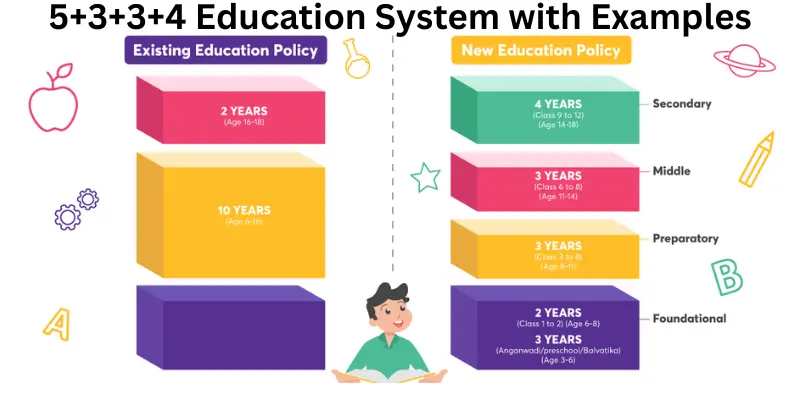
Understanding the numbers becomes easier through a practical example.
Consider a child who enters preschool at age 3.
Age 3–5: The child spends three years in preschool, Anganwadi, or Balvatika-level education.
Age 6–7: The child enters Classes 1 and 2.
These five years form the Foundational Stage.
Age 8–10: The child studies Classes 3, 4, and 5.
These three years form the Preparatory Stage.
Age 11–13: The child studies Classes 6, 7, and 8.
These three years form the Middle Stage.
Age 14–17: The student studies Classes 9, 10, 11, and 12.
These four years form the Secondary Stage.
The complete pathway is therefore:
3 years preschool + 2 years Classes 1–2 + 3 years Classes 3–5 + 3 years Classes 6–8 + 4 years Classes 9–12.
That is the basic meaning of 5+3+3+4.
5+3+3+4 Education System vs 10+2 Structure
The biggest structural difference is the way early childhood education is treated.
| 10+2 Structure | 5+3+3+4 Structure |
|---|---|
| 10 years school + 2 years senior secondary | 5+3+3+4 developmental stages |
| Formal structure mainly begins with Class 1 | Includes preschool/Anganwadi years |
| Less emphasis on developmental stages in the structure | Four stages based on learner development |
| Conventional subject progression | Stage-specific curriculum and pedagogy |
| Greater historical emphasis on conventional schooling | Greater focus on foundational and competency development |
| Separate treatment of early childhood education | Early childhood education becomes part of the overall structure |
The 5+3+3+4 design is not simply a mathematical rearrangement of 10+2. It represents a different way of organizing curriculum and pedagogy around developmental stages.
The Ministry of Education’s NEP 2020 framework describes the new structure as a major restructuring of school curriculum and pedagogy.
Key Features of the 5+3+3+4 Education System
Focus on Foundational Literacy and Numeracy
Foundational literacy and numeracy are central to early schooling.
Children need the ability to read with understanding, write effectively, and work with basic mathematical concepts before progressing successfully through later education.
The Ministry of Education’s Foundational Literacy and Numeracy resources provide resources connected with implementation of NEP 2020’s foundational learning priorities.
For teachers, this means early assessment should identify learning gaps and classroom activities should provide additional support where needed.
Experiential Learning
The structure encourages learning through activities, practical experiences, experiments, projects, observation, discussion, and application.
A science concept can be connected with an experiment.
A mathematics lesson can use real-life calculations.
A social science lesson can use local examples.
A language lesson can use storytelling, presentations, and communication activities.
The National Curriculum Framework for Foundational Stage emphasizes learning approaches that are appropriate to children’s developmental stages.
Conceptual Understanding
The 5+3+3+4 model supports a move away from excessive rote memorization.
Students should understand why something works, how a concept can be applied, and how different ideas connect.
The National Curriculum Framework for School Education 2023 emphasizes deeper learning, critical thinking, and educational experiences suited to different stages.
This approach is closely related to the broader NEP 2020 emphasis on conceptual understanding, critical thinking, creativity, and problem-solving.
Multidisciplinary Learning
The Secondary Stage gives students greater flexibility and encourages broader learning.
The policy aims to reduce hard separations between arts and sciences, curricular and extracurricular activities, and vocational and academic streams.
A student should not be defined only by one academic stream when educational interests and career paths can involve multiple disciplines.
Vocational Exposure
The NEP 2020 also emphasizes vocational education and practical skills.
Students can receive exposure to work-related skills and different occupations.
Vocational learning can help students understand the connection between education, skills, employment, and entrepreneurship.
Multilingual Education
Language learning is another important part of NEP 2020.
The policy places strong emphasis on Indian languages and recommends that, wherever possible, the medium of instruction until at least Grade 5, and preferably beyond Grade 8, should be the home language, mother tongue, local language, or regional language.
Language policies can vary according to state, school, board, and implementation conditions.
Role of Teachers in the 5+3+3+4 Education System
Teachers have an important role in implementing the new structure.
Teaching methods need to match the developmental stage of students.
A Foundational Stage teacher may use stories, games, activities, songs, movement, and visual materials.
A Preparatory Stage teacher can combine textbook learning with experiments, activities, discussions, and projects.
A Middle Stage teacher can introduce more subject-specific concepts, practical work, analytical questions, and project-based learning.
A Secondary Stage teacher can encourage deeper subject understanding, research, critical thinking, application, and multidisciplinary connections.
Teacher development is also a major part of NEP 2020 implementation. EducationBeacon’s NEP 2020 for Teachers provides a separate discussion of how the policy affects teaching practices.
How Assessment Changes Under the 5+3+3+4 System
Assessment under the new educational vision is not limited to testing memorized information.
Students can be evaluated through:
- Written questions
- Projects
- Practical activities
- Presentations
- Classroom participation
- Portfolios
- Problem-solving tasks
- Experiments
- Case-based questions
- Formative assessments
A mathematics student can be asked to apply percentages to a practical shopping or budgeting problem.
A science student can interpret experimental results.
A language student can present an argument or explain a text.
A social science student can analyze information from a map, chart, historical source, or case study.
These approaches connect assessment with competencies and learning outcomes.
EducationBeacon’s Competency-Based Assessment Under NEP 2020 covers this assessment model in greater detail.
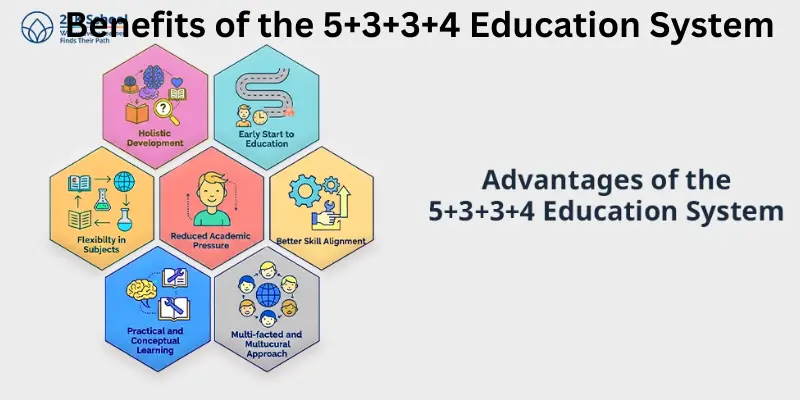
Benefits of the 5+3+3+4 Education System
Better Alignment With Child Development
The four stages correspond to different age groups and learning requirements.
Stronger Early Childhood Foundation
Preschool and early primary years receive greater importance within the overall educational structure.
Improved Foundational Learning
Literacy and numeracy are treated as essential foundations for later learning.
More Practical Learning
Students can connect concepts with activities, experiments, projects, and real-life situations.
Greater Subject Flexibility
Secondary students can have greater opportunities to explore subjects according to interests and aspirations.
Reduced Dependence on Rote Learning
The broader NEP vision emphasizes conceptual understanding, application, critical thinking, creativity, and problem-solving.
Greater Exposure to Skills
Vocational education and practical skills become more visible within school education.
Holistic Education
Academic knowledge can be combined with arts, sports, vocational learning, technology, communication, and other areas.
The National Curriculum Framework for School Education 2023 presents multidisciplinary and integrated learning as important elements of the school education framework.
Challenges in Implementing the 5+3+3+4 Education System
The structure provides a framework, but successful implementation depends on resources, teacher preparation, curriculum development, infrastructure, assessment reform, and coordination among education authorities.
Schools may have different levels of access to technology, teaching resources, laboratories, trained teachers, and learning materials.
Teacher training is another important requirement. Teachers need practical support to implement activity-based, competency-focused, experiential, and stage-appropriate teaching.
Regional differences can also influence implementation.
The Ministry of Education’s NEP 2020 initiatives include school education and literacy initiatives intended to support implementation.
EducationBeacon also discusses these implementation concerns in Challenges of NEP 2020 and Practical Solutions.
Is 5+3+3+4 Better Than 10+2?
The 5+3+3+4 Education System is designed to provide a more developmentally aligned structure than the traditional 10+2 model.
Its strength is not simply the new division of years. The larger change involves the way learning is expected to happen.
The model gives greater importance to early childhood education, foundational learning, experiential education, conceptual understanding, competency development, multidisciplinary learning, vocational exposure, and student choice.
Its effectiveness depends on implementation.
A strong structure requires trained teachers, suitable curriculum materials, adequate infrastructure, appropriate assessment methods, and consistent educational support.
What Does 5+3+3+4 Mean in Simple Words?
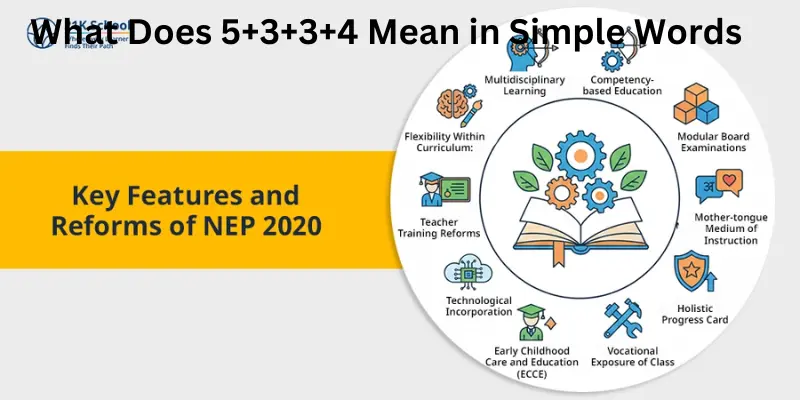
In simple terms:
5 means five years of the Foundational Stage, including three years of preschool or Anganwadi education and Classes 1–2.
3 means three years of the Preparatory Stage, covering Classes 3–5.
3 means three years of the Middle Stage, covering Classes 6–8.
4 means four years of the Secondary Stage, covering Classes 9–12.
The structure covers the educational journey from approximately age 3 to age 18.
Frequently Asked Questions
What is the 5+3+3+4 Education System?
The 5+3+3+4 Education System is the curricular and pedagogical structure proposed under NEP 2020. It divides school education into four stages: Foundational, Preparatory, Middle, and Secondary.
What are the four stages of the 5+3+3+4 Education System?
The four stages are Foundational Stage, Preparatory Stage, Middle Stage, and Secondary Stage. They cover approximately ages 3–8, 8–11, 11–14, and 14–18 respectively.
Which classes are included in the 5+3+3+4 system?
The Foundational Stage includes three years of preschool or Anganwadi education and Classes 1–2. The Preparatory Stage includes Classes 3–5. The Middle Stage includes Classes 6–8. The Secondary Stage includes Classes 9–12.
What is the difference between 5+3+3+4 and 10+2?
The 10+2 model represents 10 years of schooling followed by two years of senior secondary education. The 5+3+3+4 structure organizes education into four developmental stages and includes three years of preschool or Anganwadi education within the overall framework.
Why is the Foundational Stage important?
The Foundational Stage establishes early literacy, numeracy, communication, social development, and learning skills. NEP 2020 gives significant importance to early childhood care and foundational learning.
Does the 5+3+3+4 system focus only on academic subjects?
No. The broader NEP 2020 vision includes academic learning alongside arts, sports, vocational education, technology, practical skills, communication, and other areas of development.
How does the 5+3+3+4 system affect teachers?
Teachers are expected to use teaching methods appropriate to each developmental stage. The approach places greater emphasis on learning outcomes, experiential learning, conceptual understanding, competency development, and student participation.
Is 5+3+3+4 already the same in every school in India?
The 5+3+3+4 structure is part of NEP 2020, but implementation can vary across states, boards, institutions, and stages. The policy provides the national framework while implementation involves education authorities and institutions.
Conclusion
The 5+3+3+4 Education System represents a major structural change proposed under NEP 2020 for school education in India. It covers ages 3 to 18 through four stages: Foundational, Preparatory, Middle, and Secondary.
The model gives early childhood education a formal place within the overall structure. It emphasizes foundational literacy and numeracy, activity-based learning, conceptual understanding, experiential education, competency development, multidisciplinary learning, vocational exposure, and greater flexibility at the secondary level.
The meaning of 5+3+3+4 becomes simple when viewed through the four stages:
5 years – Foundational
3 years – Preparatory
3 years – Middle
4 years – Secondary
The long-term value of the model depends on how effectively schools, teachers, education boards, governments, and other stakeholders implement the curriculum and pedagogy. The National Education Policy 2020 and National Curriculum Framework for School Education provide the foundation for this transformation in Indian school education.



- Be Respectful
- Stay Relevant
- Stay Positive
- True Feedback
- Encourage Discussion
- Avoid Spamming
- No Fake News
- Don't Copy-Paste
- No Personal Attacks
- Be Respectful
- Stay Relevant
- Stay Positive
- True Feedback
- Encourage Discussion
- Avoid Spamming
- No Fake News
- Don't Copy-Paste
- No Personal Attacks
