Holistic Progress Card Under NEP 2020: Meaning, Features, Benefits & Assessment
Published: 7 Oct 2026
The Holistic Progress Card Under NEP 2020 is an important reform in the way student progress is assessed and communicated in Indian schools. Instead of depending mainly on examination marks, grades, and memorization, the Holistic Progress Card aims to present a broader picture of a learner’s development, competencies, strengths, participation, and areas for improvement.
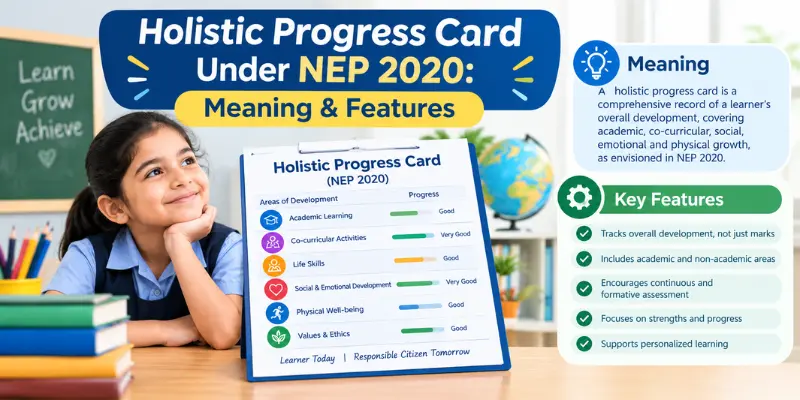
The National Education Policy 2020 recommends a 360-degree, multidimensional progress card that considers different aspects of student development. The approach is connected with the wider shift toward competency-based, formative, experiential, and learner-centred education. The official NEP 2020 policy framework provides the policy foundation for these assessment reforms.
The Central Board of Secondary Education describes the Holistic Progress Card as a 360-degree, multidimensional report that reflects the progress and uniqueness of each learner across cognitive, affective, socio-emotional, and psychomotor domains. The CBSE Holistic Progress Card resources provide official information about its objectives and assessment approach.
EducationBeacon’s Key Features of the National Education Policy 2020 provides the wider policy background. This article focuses specifically on the Holistic Progress Card, its components, assessment methods, benefits, challenges, and role in student development.
What Is Holistic Progress Card Under NEP 2020?
The Holistic Progress Card Under NEP 2020 is a comprehensive method of reporting a student’s progress across multiple dimensions of learning and development.
A conventional report card generally gives considerable importance to marks or grades obtained in individual subjects. A holistic progress card provides a wider view by bringing together evidence from classroom activities, projects, practical work, portfolios, teacher observations, self-assessment, peer assessment, and other learning experiences.
According to CBSE’s official HPC page, the purpose is to move assessment away from an approach primarily based on summative testing and rote memorization toward regular, formative, competency-based assessment.
This means the report is not simply a new format for displaying marks. It represents a broader understanding of what student progress means.
A learner may achieve good marks in a written examination but need improvement in communication, teamwork, creativity, confidence, or practical application. Another learner may demonstrate strong problem-solving and creative abilities that are not fully reflected by conventional examinations.
The Holistic Progress Card Under NEP 2020 is intended to make such dimensions of learning more visible.
Why Was Holistic Progress Card Introduced?
The introduction of the Holistic Progress Card Under NEP 2020 is connected with the policy’s broader objective of improving the quality and relevance of education.
NEP 2020 places greater importance on conceptual understanding, critical thinking, creativity, problem-solving, communication, collaboration, experiential learning, and competency development.
EducationBeacon’s article on Competency-Based Education Under NEP 2020 explains how this approach changes the emphasis from simply completing curriculum content toward demonstrating meaningful learning.
A similar principle applies to assessment.
If education expects students to apply knowledge, solve problems, communicate ideas, collaborate with others, and think critically, assessment also needs to provide opportunities to observe these abilities.
The Ministry of Education’s official material on the Holistic Progress Card under NEP 2020 illustrates the policy direction toward a more comprehensive understanding of student progress.
What Does 360-Degree Assessment Mean?
One of the most important ideas behind the Holistic Progress Card Under NEP 2020 is 360-degree assessment.
The term means that student progress is viewed from multiple perspectives rather than from one examination score.
These perspectives can include:
- Teacher assessment
- Student self-assessment
- Peer assessment
- Parent feedback
- Classroom observation
- Project work
- Portfolio evidence
- Practical activities
- Group work
- Inquiry-based learning
- Presentations
- Role-play
- Quizzes
- Other learning experiences
The CBSE Holistic Progress Card framework specifically highlights several of these forms of evidence.
The objective is to understand not only what a student remembers but also what the student understands, applies, demonstrates, creates, communicates, and develops over time.
Main Features of Holistic Progress Card Under NEP 2020
The Holistic Progress Card Under NEP 2020 has several features that distinguish it from a traditional marks-based report card.
Multidimensional Assessment
The HPC considers multiple areas of student development.
Academic performance remains important, but it is considered alongside cognitive, affective, socio-emotional, and psychomotor development.
Competency-Based Approach
The focus is increasingly placed on what students can understand and demonstrate.
EducationBeacon’s Competency-Based Assessment Under NEP 2020 explains how competency-based assessment focuses on knowledge, application, reasoning, skills, and demonstrated abilities.
Continuous and Formative Assessment
The HPC is designed to use evidence gathered during the learning process rather than relying entirely on a final examination.
Teachers can observe students throughout the academic period and provide feedback that supports further learning.
Student Participation
Students can become active participants in the assessment process through self-assessment and reflection.
This can encourage learners to think about their own strengths, challenges, progress, and learning needs.
Parent Participation
Parents can provide useful information about learning and development outside the classroom.
The approach can therefore strengthen communication between school and home.
Individualised Reporting
Every student has different strengths and learning needs.
The Holistic Progress Card Under NEP 2020 is intended to capture the uniqueness of individual learners instead of reducing every learner to a single numerical score.
Domains Covered by Holistic Progress Card
The Holistic Progress Card Under NEP 2020 considers several dimensions of development.
CBSE identifies cognitive, affective, socio-emotional, and psychomotor domains as important components of holistic assessment. (CBSE)
Cognitive Development
Cognitive development relates to thinking and intellectual abilities.
It can include:
- Conceptual understanding
- Reasoning
- Critical thinking
- Analysis
- Problem-solving
- Application of knowledge
- Interpretation
- Decision-making
For example, a science student may demonstrate cognitive development by explaining a concept, analysing experimental results, interpreting information, or applying scientific knowledge to a practical problem.
Affective Development
The affective domain relates to attitudes, interests, values, motivation, and responses.
A learner’s willingness to participate, sense of responsibility, attitude toward learning, respect for others, and engagement in activities can provide evidence in this area.
Socio-Emotional Development
Socio-emotional development includes areas such as self-awareness, communication, cooperation, confidence, relationships, empathy, and interaction with others.
Group activities, classroom discussions, collaborative projects, and peer interactions can provide useful evidence.
Psychomotor Development
Psychomotor development relates to physical coordination and practical performance.
Sports, experiments, art, crafts, practical activities, demonstrations, and other hands-on experiences can provide evidence of development in this domain.
Holistic Progress Card and Competency-Based Assessment
The Holistic Progress Card Under NEP 2020 is closely connected with competency-based assessment.
Competency-based assessment focuses on what students can do with their knowledge instead of measuring memorization alone.
For example, a traditional question might ask students to reproduce the definition of a scientific concept. A competency-based task could ask students to apply the concept to an unfamiliar situation and explain their reasoning.
EducationBeacon’s Competency-Based Assessment Under NEP 2020 provides a detailed explanation of this assessment approach.
The HPC gives schools a broader way to document evidence generated through such activities.
This makes the progress card more closely connected with actual classroom learning.
Holistic Progress Card and Learning Outcomes
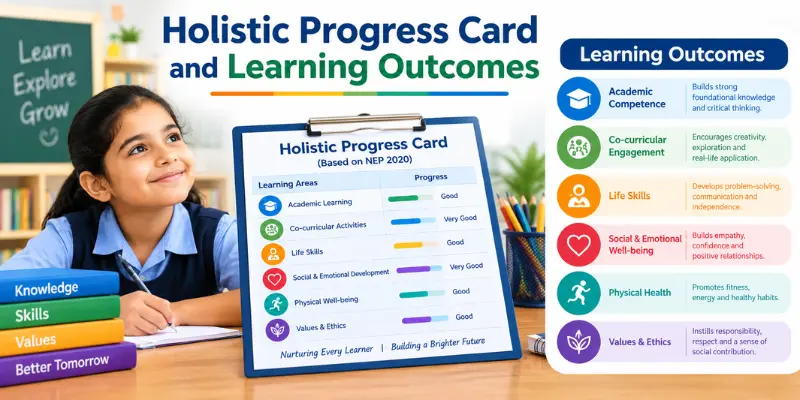
Learning outcomes describe what students should know, understand, perform, apply, or demonstrate after a learning experience.
The Holistic Progress Card Under NEP 2020 can connect these learning outcomes with observable evidence.
EducationBeacon’s NEP 2020 Learning Outcomes explains how learning outcomes connect curriculum, classroom activities, competencies, and assessment.
For example, if the expected learning outcome is related to communication, a teacher may collect evidence from a presentation, discussion, writing activity, or group task.
If the outcome involves problem-solving, an authentic problem or practical activity may provide better evidence than a simple recall question.
This connection between learning outcomes and evidence makes assessment more meaningful.
Role of Teachers in Holistic Progress Card
Teachers play a central role in implementing the Holistic Progress Card Under NEP 2020.
Their responsibility extends beyond assigning marks after examinations.
Teachers may need to observe students during classroom activities, identify competencies, document evidence, provide feedback, and recognise areas where learners require additional support.
The CBSE HPC Resources provide stage-specific materials and guidance for teachers, including resources for the foundational, preparatory, and middle stages.
Teachers can gather evidence through:
- Classroom observation
- Projects
- Practical activities
- Presentations
- Group work
- Portfolios
- Quizzes
- Discussions
- Self-assessment
- Peer assessment
- Reflective activities
EducationBeacon’s NEP 2020 for Teachers discusses the broader changes in teaching responsibilities associated with the policy.
Role of Students in Holistic Progress Card
Students are not passive subjects of assessment.
The Holistic Progress Card Under NEP 2020 can involve students in understanding and evaluating their own learning.
Self-assessment encourages students to reflect on questions such as:
What have I learned?
What can I do independently?
Which task was difficult?
Where have I improved?
What do I need to practise?
This reflection can promote self-awareness and encourage learners to take greater responsibility for their education.
A student who understands personal strengths and learning gaps may become more capable of setting realistic learning goals.
Role of Peer Assessment
Peer assessment is another important component of holistic assessment.
Students can review or provide feedback on appropriate classroom activities under teacher guidance.
For example, students working on a group presentation may provide feedback about communication, participation, organisation, collaboration, and clarity.
Peer assessment should be structured carefully. Students need clear criteria and guidance so that feedback remains constructive and relevant.
The CBSE HPC framework recognises peer assessment as one of the components that can contribute to a broader picture of student progress.
Role of Parents in Holistic Progress Card
Parents can contribute to the Holistic Progress Card Under NEP 2020 by providing information about a child’s learning, interests, behaviour, participation, and development outside school.
The purpose is not to make parents responsible for formal academic grading.
Instead, parent feedback can provide additional context that teachers may not always observe in the classroom.
For example, a child may demonstrate strong creativity at home through drawing, building models, reading, music, storytelling, or other activities.
Parents can share relevant observations with teachers.
The CBSE HPC information emphasises the importance of involving parents in understanding the learner’s progress.

Holistic Progress Card and Portfolio Assessment
Portfolio assessment can support the Holistic Progress Card Under NEP 2020 because it provides evidence of learning over time.
A portfolio may contain:
- Project reports
- Drawings
- Written assignments
- Research work
- Photographs of activities
- Practical work
- Presentations
- Reflections
- Creative work
- Teacher feedback
A portfolio can demonstrate development rather than showing only a final result.
For example, a student’s writing portfolio may show how writing improved from an early assignment to later work.
Similarly, a science portfolio can demonstrate how a learner’s observation, investigation, recording, analysis, and communication skills developed.
EducationBeacon’s Experiential Learning Under NEP 2020 provides additional information about projects, portfolios, practical activities, and other forms of active learning.
Holistic Progress Card and Experiential Learning
Experiential learning gives students opportunities to learn through activities, investigation, practice, and real-world situations.
The Holistic Progress Card Under NEP 2020 can capture evidence produced through these experiences.
Suppose students investigate waste management in their school.
They may observe waste collection, classify different types of waste, collect information, work in groups, analyse their findings, prepare a presentation, and suggest solutions.
A conventional examination may measure what students remember about waste management.
A holistic assessment can additionally provide evidence of research, communication, collaboration, problem-solving, creativity, and practical application.
This is one reason experiential learning and holistic assessment complement each other.
What Can Be Included in Holistic Progress Card?
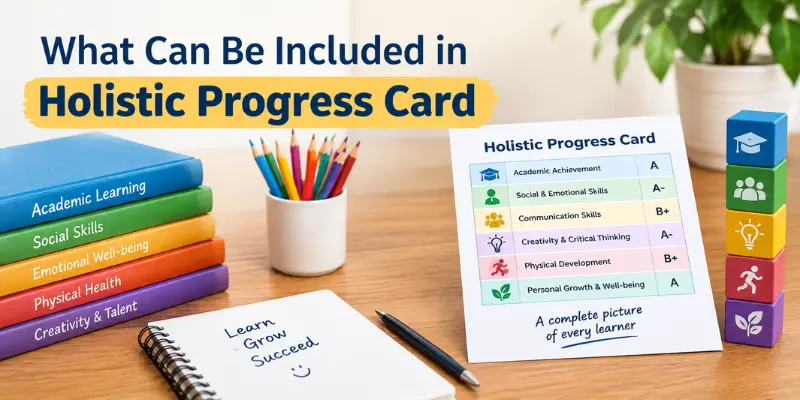
The exact format can vary according to the educational stage and framework, but a Holistic Progress Card Under NEP 2020 may include several types of information.
These can include:
- Academic learning
- Competency development
- Learning outcomes
- Teacher observations
- Self-assessment
- Peer assessment
- Parent feedback
- Project work
- Portfolio evidence
- Practical activities
- Communication
- Creativity
- Critical thinking
- Problem-solving
- Collaboration
- Social and emotional development
- Areas requiring improvement
The CBSE HPC Resources page contains different HPC resources for different educational stages.
This is important because a progress card for a young child should not necessarily use the same assessment approach as one designed for an older learner.
Holistic Progress Card for Foundational Stage
The foundational stage requires age-appropriate assessment.
CBSE has developed Holistic Progress Card resources for children in the foundational stage, including the age group of 3–6 years and Grades 1 and 2.
The CBSE notification on HPC for the Foundational Stage explains that the HPC is intended to document children’s progress through regular and formative assessment, with attention to age-appropriate competencies.
At this stage, assessment may include observations of language, early literacy, numeracy, physical development, social interaction, creativity, and other developmental areas.
The focus should remain appropriate to the child’s age and stage rather than becoming a miniature version of examination-based assessment.
Holistic Progress Card and Foundational Literacy and Numeracy
Foundational Literacy and Numeracy, commonly known as FLN, is a major priority under NEP 2020.
The Holistic Progress Card Under NEP 2020 can help teachers understand children’s progress in foundational skills.
CBSE states that the HPC can help map the status of each child’s learning in foundational literacy and numeracy. (CBSE HPC)
Instead of depending entirely on a written examination, teachers can gather evidence through classroom activities and age-appropriate tasks.
This can help identify children who require additional support in reading, writing, comprehension, counting, mathematical reasoning, or related skills.
Difference Between Traditional Report Card and Holistic Progress Card
A traditional report card often focuses heavily on marks, grades, and subject-level performance.
The Holistic Progress Card Under NEP 2020 provides a broader picture.
| Traditional Report Card | Holistic Progress Card |
|---|---|
| Mainly focuses on marks and grades | Provides a multidimensional picture |
| Strong emphasis on examinations | Uses multiple forms of evidence |
| Primarily teacher-generated | Can include multiple perspectives |
| Mainly subject-focused | Considers wider development |
| Limited information about strengths | Highlights individual strengths |
| Often reflects performance at a point in time | Can document progress over time |
| Mainly academic reporting | Includes academic and developmental dimensions |
The purpose is not to make academic achievement less important. Academic knowledge remains essential.
The difference is that academic achievement is considered alongside other meaningful dimensions of learning.
Benefits of Holistic Progress Card Under NEP 2020
The Holistic Progress Card Under NEP 2020 can provide benefits for students, parents, teachers, and schools.
Provides a Broader Picture of Development
The most important benefit is that the report provides information beyond examination marks.
It can show how a learner is progressing academically, socially, emotionally, practically, and in terms of competencies.
Identifies Individual Strengths
Students have different abilities.
One learner may demonstrate excellent analytical skills, another may show creativity, while another may excel at communication, collaboration, leadership, or practical activities.
A broader assessment system can make these strengths more visible.
Identifies Learning Gaps
The HPC can also help identify areas where additional support is needed.
A student may understand a concept but struggle to communicate it. Another may perform well in written work but struggle to apply knowledge practically.
Such differences can help teachers plan appropriate interventions.
Encourages Student Reflection
Self-assessment can encourage learners to reflect on their own performance.
This may improve self-awareness and create a stronger sense of responsibility for learning.
Supports Individualised Learning
Students do not learn at exactly the same pace or in exactly the same way.
A detailed progress report can provide information that helps teachers understand individual learning needs.
Strengthens Parent-Teacher Communication
Instead of discussing only examination marks, teachers and parents can discuss competencies, strengths, participation, learning gaps, and improvement.
This can make communication more useful for supporting the child.
Holistic Progress Card and Assessment Reform Under NEP 2020
The Holistic Progress Card Under NEP 2020 should be understood as part of a broader assessment reform rather than as an isolated initiative.
NEP 2020 promotes a shift toward assessment that supports learning, identifies learning gaps, measures competencies, and reduces excessive dependence on rote memorization.
EducationBeacon’s How NEP 2020 Changes Teaching Methods explains how classroom teaching itself is moving toward conceptual understanding, application, activity-based learning, and competency development.
When teaching changes, assessment also needs to change.
If students learn through experiments, projects, discussions, investigations, and collaborative tasks, assessment should provide opportunities to recognise what they demonstrate through those experiences.
Holistic Progress Card and Continuous Assessment
Continuous assessment does not mean testing students every day.
It means gathering meaningful evidence of learning during the educational process.
A teacher may observe a student’s participation in a discussion, review project work, assess a presentation, examine a portfolio, or use a short quiz to understand progress.
The evidence can then be used to provide feedback and improve instruction.
The CBSE Holistic Progress Card framework describes the shift toward regular and formative competency-based assessment.
This makes assessment part of learning rather than something that happens only after teaching has finished.
Challenges in Implementing Holistic Progress Card
The Holistic Progress Card Under NEP 2020 offers significant opportunities, but implementation can also present challenges.
Teacher Training
Teachers need training in competency-based assessment, observation, documentation, rubrics, feedback, portfolio assessment, and other methods.
Without adequate preparation, holistic assessment can become difficult to implement consistently.
Additional Documentation
Collecting evidence from multiple activities may require additional planning and record-keeping.
Schools need simple and practical systems to prevent unnecessary administrative burden.
Consistency in Assessment
Different teachers may interpret competencies differently.
Clear learning outcomes, assessment criteria, examples, rubrics, and collaborative teacher planning can help improve consistency.
Parent Awareness
Parents who are accustomed to marks may initially find a multidimensional report unfamiliar.
Schools may need to explain what different sections mean and how parents can use the information to support learning.
Managing Large Classes
Teachers working with large numbers of students may find individualised observation and documentation challenging.
Technology and well-designed assessment systems can potentially reduce some administrative difficulties.
How Schools Can Implement Holistic Progress Card
Schools can begin implementation by identifying clear learning outcomes and competencies.
Teachers can then select suitable activities that generate evidence of those outcomes.
For example, schools can use:
- Projects
- Practical activities
- Presentations
- Portfolios
- Classroom observation
- Group work
- Quizzes
- Self-assessment
- Peer assessment
- Reflection activities
The evidence should be collected over time rather than depending entirely on one examination.
Teachers can review the evidence, identify strengths and learning gaps, provide feedback, and communicate meaningful progress to parents and students.
CBSE has published official HPC resources and implementation materials to support different educational stages.
Holistic Progress Card and Student-Centred Education
Student-centred education recognises that learners have different abilities, interests, experiences, learning speeds, and support needs.
The Holistic Progress Card Under NEP 2020 supports this philosophy by focusing on individual progress.
Instead of asking only whether a student is above or below the class average, teachers can examine the learner’s own development.
Has the student improved?
Which competencies have developed?
Which areas require additional support?
What learning strategies are working?
What should the learner focus on next?
These questions can make assessment more useful for individual learning.
Is Holistic Progress Card the Same as a Report Card?
The Holistic Progress Card is a form of progress reporting, but it is broader than a conventional marks-based report card.
The key difference is the range of evidence and developmental areas considered.
A traditional report may tell parents how a student performed in examinations.
A Holistic Progress Card Under NEP 2020 can provide information about academic learning, competencies, activities, behaviour related to learning, self-reflection, peer feedback, teacher observations, and other relevant developmental areas.
It is therefore better understood as a comprehensive picture of learner progress.
What Is the Main Purpose of Holistic Progress Card?
The main purpose is to make assessment more meaningful and comprehensive.
The Holistic Progress Card Under NEP 2020 aims to help students, parents, teachers, and schools understand progress rather than simply record scores.
It can help answer questions such as:
What has the student learned?
What can the student apply?
Which competencies are developing?
What are the student’s strengths?
Where does the learner require support?
How has the learner progressed over time?
These questions are more closely connected with the wider goals of learner-centred and competency-based education.
Holistic Progress Card and Future of School Assessment
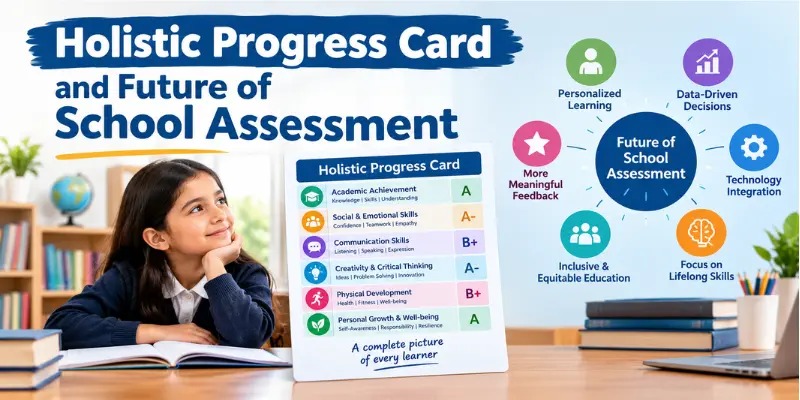
The Holistic Progress Card Under NEP 2020 represents a broader change in how student achievement can be understood.
As schools increasingly use projects, practical activities, experiential learning, digital tools, portfolios, and competency-based assessment, progress reporting may also become more comprehensive.
CBSE’s Holistic Progress Card resources demonstrate that implementation materials are being developed for different stages of school education.
The future effectiveness of holistic assessment will depend on teacher preparation, practical assessment systems, clear competencies, reliable evidence, meaningful feedback, parent awareness, and manageable documentation.
The goal should not be to create more paperwork.
The goal should be to generate better information about student learning and use that information to improve education.
Frequently Asked Questions About Holistic Progress Card Under NEP 2020
What is Holistic Progress Card under NEP 2020?
The Holistic Progress Card Under NEP 2020 is a multidimensional student progress report designed to provide a broader picture of learning and development. It can include teacher assessment, self-assessment, peer assessment, parent feedback, projects, portfolios, classroom activities, and other evidence.
What is the purpose of Holistic Progress Card?
Its purpose is to assess and communicate student progress more comprehensively rather than relying mainly on examination marks and grades.
What are the main domains of Holistic Progress Card?
The major domains include cognitive, affective, socio-emotional, and psychomotor development. The specific components can vary according to the learner’s educational stage and applicable framework.
Does Holistic Progress Card replace examinations?
The Holistic Progress Card Under NEP 2020 does not mean that all examinations or academic assessments disappear. Rather, it broadens the evidence used to understand student learning and development.
Who contributes to Holistic Progress Card?
Teachers are central to the assessment process, while students can contribute through self-assessment, peers through peer assessment, and parents through relevant feedback.
Why is Holistic Progress Card important?
It provides a broader picture of student development, identifies strengths and learning gaps, encourages reflection, supports personalised learning, and can improve communication between teachers, students, and parents.
Conclusion
The Holistic Progress Card Under NEP 2020 represents an important shift in student assessment from a narrow focus on marks toward a broader understanding of learning and development.
It recognises that education involves more than remembering information for an examination. Students also need opportunities to develop conceptual understanding, critical thinking, creativity, communication, collaboration, problem-solving, practical abilities, and social and emotional skills.
The official CBSE Holistic Progress Card framework describes HPC as a 360-degree, multidimensional report covering important areas of learner development. The Government of India’s NEP 2020 material provides the broader policy context for this reform.
The Holistic Progress Card Under NEP 2020 can bring together teacher assessment, self-assessment, peer assessment, parent feedback, project work, portfolios, practical activities, inquiry-based learning, group work, and other forms of evidence.
Its greatest value lies in making assessment useful for learning.
For students, it can provide a clearer understanding of strengths and areas for improvement. For teachers, it can provide richer evidence for instructional decisions. For parents, it can provide a broader understanding of their child’s development.
The successful implementation of the Holistic Progress Card Under NEP 2020 will depend on appropriate teacher training, clear competencies, manageable documentation, meaningful feedback, and cooperation among schools, students, and parents.
Ultimately, the purpose of holistic assessment is not simply to produce a different report card. It is to create a more complete understanding of each learner and use that understanding to support continuous educational growth.



- Be Respectful
- Stay Relevant
- Stay Positive
- True Feedback
- Encourage Discussion
- Avoid Spamming
- No Fake News
- Don't Copy-Paste
- No Personal Attacks
- Be Respectful
- Stay Relevant
- Stay Positive
- True Feedback
- Encourage Discussion
- Avoid Spamming
- No Fake News
- Don't Copy-Paste
- No Personal Attacks
