NEP 2020 Learning Outcomes: Meaning, Examples, Importance & Assessment
Published: 19 Sep 2026
The NEP 2020 Learning Outcomes framework focuses on what students are expected to know, understand, apply, and demonstrate after completing a learning experience. The National Education Policy 2020 gives greater importance to conceptual understanding, competency, critical thinking, problem-solving, creativity, communication, and holistic development rather than relying only on memorization and examination marks.
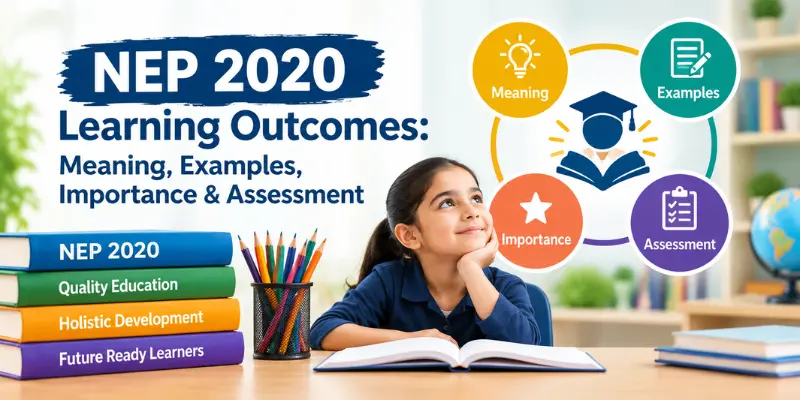
The idea of learning outcomes is closely connected with the broader shift toward competency-based education. CBSE Competency-Based Education framework explains that competency-based education focuses on students demonstrating learning outcomes and attaining proficiency in specific competencies.
For students, parents, teachers, and schools, understanding NEP 2020 Learning Outcomes provides a clearer picture of what meaningful learning should look like. It also connects with the broader reforms explained in EducationBeacon’s Key Features of the National Education Policy 2020 article.
The official NEP 2020 policy document from the Ministry of Education provides the policy framework behind these changes, while NCERT’s learning-outcome resources provide stage-specific resources for educators.
What Are NEP 2020 Learning Outcomes?
NEP 2020 Learning Outcomes are statements describing what learners should know, understand, perform, apply, or demonstrate after a particular learning experience or stage of education.
Completing a chapter does not automatically mean that meaningful learning has taken place. A student may remember information from a textbook but struggle to apply the same concept to an unfamiliar situation.
A learning-outcome approach focuses on observable evidence of learning.
For example, instead of asking students only to memorise the definition of water pollution, a learning outcome may require them to identify its causes, explain its effects, interpret relevant information, and suggest practical measures for prevention.
This makes the expected learning more specific and measurable.
CBSE’s official guidance explains the relationship between learning outcomes, curriculum, pedagogy, assessment, and competency-based education. CBSE guidance on Learning Outcomes and Competency-Based Education
Why Are Learning Outcomes Important Under NEP 2020?
Learning outcomes provide a connection between curriculum goals, classroom teaching, student activities, and assessment.
Teachers can use them to decide what students should achieve from a lesson or unit. Students can understand what they are expected to demonstrate. Parents can obtain a clearer picture of progress. Schools can identify learning gaps through evidence of student performance.
The approach also supports the shift from rote learning toward conceptual understanding and application.
The NEP 2020 framework places emphasis on learning, understanding, critical thinking, application, and broader development. The policy therefore provides a foundation for approaches in which students demonstrate what they can do with their knowledge.
EducationBeacon’s article on Competency-Based Education Under NEP 2020 explains the broader competency-based approach, while this article focuses specifically on learning outcomes.
Key Features of NEP 2020 Learning Outcomes
Observable learning: Learning outcomes should describe something students can demonstrate through their work, performance, communication, activities, or assessment.
Competency-focused learning: The approach considers knowledge, skills, abilities, attitudes, and application rather than information recall alone.
Application of knowledge: Students are expected to use concepts in meaningful and practical situations.
Higher-order thinking: Analysis, reasoning, problem-solving, evaluation, and creativity can become part of the learning process.
Holistic development: Learning outcomes can address academic, social, emotional, ethical, physical, creative, and practical dimensions.
Assessment alignment: Assessment methods should provide evidence related to the intended learning.
The NCERT National Curriculum Framework for the Foundational Stage explains the relationship between aims, curricular goals, competencies, and learning outcomes and shows how these elements can be connected within the learning process.
NEP 2020 Learning Outcomes and Competency-Based Education
Competency-based education is closely connected with NEP 2020 Learning Outcomes.
A competency represents a broader capability that a learner develops. Learning outcomes can provide observable indicators showing whether students are progressing toward that capability.
For example, a science competency may involve using scientific reasoning to investigate a problem. Related learning outcomes may require students to interpret evidence, formulate explanations, conduct an investigation, and communicate conclusions.
This makes the expected achievement more visible.
CBSE describes competency-based education as an approach centred on the demonstration of learning outcomes and proficiency in competencies. It also gives importance to real-world application, formative assessment, and evidence of learning. CBSE Competency-Based Education resources
EducationBeacon also covers Competency-Based Assessment Under NEP 2020, which focuses specifically on the assessment side of this educational approach.
NEP 2020 Learning Outcomes Across Different School Stages
Learning outcomes vary according to the learner’s developmental stage, grade, subject, and expected competency level.
The NEP 2020 school structure consists of Foundational, Preparatory, Middle, and Secondary stages. EducationBeacon’s 5+3+3+4 Education System article provides additional information about these four stages.
At the Foundational Stage, learning outcomes can focus on early literacy, numeracy, communication, physical development, social interaction, creativity, and basic understanding.
At the Preparatory Stage, learners progressively develop conceptual knowledge, language abilities, mathematical reasoning, observation, creativity, and application.
At the Middle Stage, learning outcomes can become more subject-specific while continuing to develop analytical thinking, experimentation, problem-solving, and practical application.
At the Secondary Stage, students can demonstrate deeper understanding, reasoning, independent thinking, application, communication, and preparation for further education and life beyond school.
NCERT provides learning-outcome resources for different stages, including elementary and secondary education. Its current resource collection also includes a draft resource for the higher secondary stage. NCERT Learning Outcomes resources
Examples of NEP 2020 Learning Outcomes
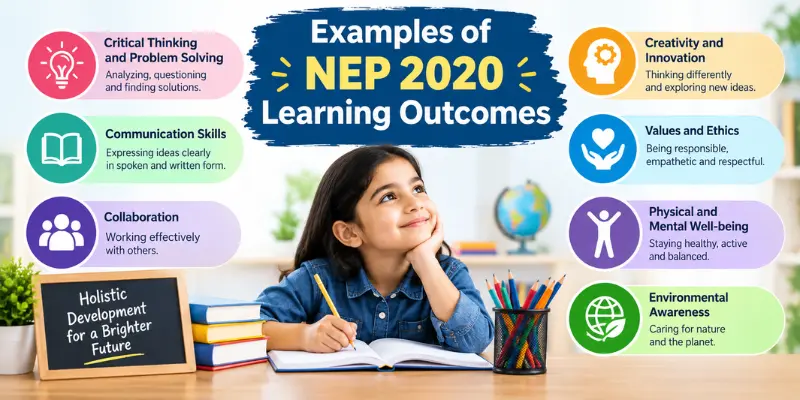
The easiest way to understand NEP 2020 Learning Outcomes is through practical examples.
In mathematics, a learning outcome may require students to apply mathematical reasoning to solve a practical problem instead of simply reproducing a formula.
In science, students may be expected to conduct an investigation, interpret observations, explain evidence, and communicate conclusions.
In language learning, a learner may need to understand different types of texts, express ideas clearly, write for a specific purpose, or communicate effectively with different audiences.
In social science, students may analyse information, interpret evidence, compare perspectives, and connect classroom concepts with real situations.
In environmental education, students may identify a local environmental issue, examine its causes, evaluate possible solutions, and propose practical action.
These examples show the difference between completing content and demonstrating learning.
CBSE’s official learning framework provides subject-specific frameworks and assessment guidance aligned with NCERT learning outcomes. CBSE Learning Frameworks
Learning Outcomes for Foundational Literacy and Numeracy
Foundational Literacy and Numeracy has an important place in the NEP 2020 vision for school education.
Children need strong reading, writing, comprehension, and numeracy abilities to progress successfully through later stages of education.
The Foundational Stage covers the period from birth to eight years, with attention to physical and motor development, socio-emotional development, language and literacy, creative and aesthetic development, and cognitive development. NCERT Learning Outcomes at the Foundational Stage
Learning outcomes at this stage can include recognising and using language, understanding age-appropriate texts, communicating ideas, counting, performing basic mathematical operations, identifying patterns, and applying simple numerical reasoning.
These outcomes provide teachers with practical indicators for identifying learning gaps.
A child who can read a passage but cannot explain its meaning may require a different learning intervention from a child who understands the passage but struggles with reading fluency.
Role of Teachers in Achieving Learning Outcomes
Teachers play a central role in turning intended learning outcomes into classroom experiences.
The teacher first identifies what students are expected to achieve. Lesson activities can then be selected according to those expected outcomes.
A science learning outcome related to investigation may require experiments or observation. A communication outcome may require discussion, presentation, writing, or peer interaction. A problem-solving outcome may require authentic tasks instead of direct recall questions.
Teachers also need evidence of learning.
Evidence can come from classroom questioning, observation, assignments, projects, portfolios, presentations, practical work, quizzes, self-assessment, peer assessment, and formal tests.
CBSE provides teacher resources intended to help educators incorporate learning outcomes mapped to NCERT frameworks into everyday classroom teaching and learning. CBSE Teacher Resources for Learning Outcomes
EducationBeacon’s NEP 2020 for Teachers provides broader information about teacher-related changes under the policy.
NEP 2020 Learning Outcomes and Experiential Learning
Experiential learning gives students opportunities to connect classroom concepts with activities and real-world situations.
Projects, experiments, field visits, demonstrations, role plays, practical assignments, group activities, and problem-solving tasks can provide evidence of learning outcomes.
The NEP 2020 framework supports approaches that move learning beyond narrow rote memorization and encourage practical, active, and experiential learning.
EducationBeacon’s Experiential Learning Under NEP 2020 covers this teaching approach in greater detail.
The connection with learning outcomes is direct. An activity becomes more meaningful when students can demonstrate a defined understanding, skill, competency, or application.
A project on local water quality, for example, can involve observation, data collection, interpretation, teamwork, communication, and solution development.
One integrated activity can therefore provide evidence for multiple learning outcomes.
NEP 2020 Learning Outcomes and Assessment
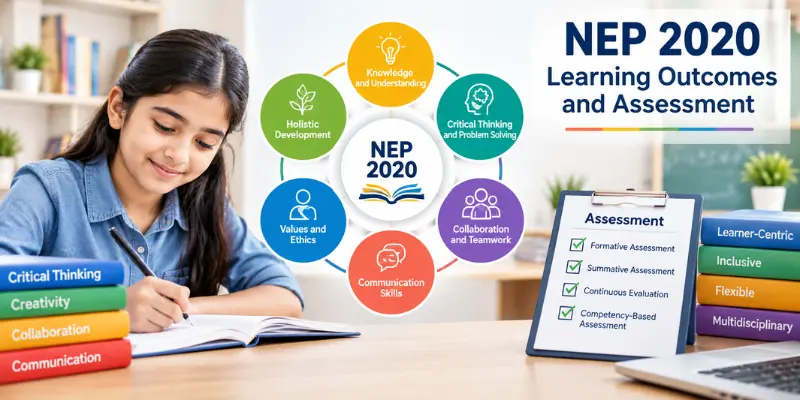
Assessment is closely connected with learning outcomes because teachers need evidence to determine whether students have achieved expected learning.
NEP 2020 supports assessment approaches that consider competency, application, higher-order thinking, and broader development.
CBSE provides curriculum-aligned competency-based assessment resources for subjects including mathematics, science, and English. These resources include assessment items designed around the relevant curriculum and learning expectations. CBSE Competency-Based Assessment Resources
An assessment question asking students to define a concept mainly measures recall. A question requiring students to use that concept to solve an unfamiliar situation can provide evidence of application.
Both types of questions can have a role, but the intended learning outcome should guide assessment design.
EducationBeacon’s Competency-Based Assessment Under NEP 2020 provides a dedicated discussion of this assessment approach.
Formative Assessment for Learning Outcomes
Formative assessment takes place during the learning process rather than only after a course or term has ended.
Teachers can use short activities, questioning, classroom observation, peer feedback, self-assessment, exit tasks, practical activities, and written work to identify student progress.
The evidence can then be used to adjust teaching.
For example, if most students can recall a mathematical rule but cannot apply it to a practical problem, the teacher has evidence of a learning gap.
The next lesson can focus on application rather than repeating the definition.
CBSE’s competency-based education framework identifies formative assessment, including peer and self-assessment, as part of the competency-based approach. CBSE Competency-Based Education Framework
Learning Outcomes and Holistic Development
The NEP 2020 Learning Outcomes approach is not limited to academic knowledge.
NEP 2020 gives importance to cognitive, social, emotional, ethical, physical, and other dimensions of student development.
The CBSE Holistic Progress Card describes a multidimensional approach to reporting student progress across cognitive, affective, socio-emotional, and psychomotor domains. CBSE Holistic Progress Card
Learning outcomes can therefore address communication, collaboration, creativity, critical thinking, problem-solving, practical abilities, and subject-specific knowledge.
Holistic development does not mean removing academic standards. It recognises that education involves more than memorising information for examinations.
A student who understands a scientific concept, investigates a problem, communicates findings clearly, collaborates with classmates, and applies knowledge responsibly demonstrates several dimensions of learning.
How Parents Can Understand Learning Outcomes
Parents often evaluate education through marks, grades, rankings, and examination results.
Learning outcomes provide another way to understand student progress.
Parents can ask:
Can my child explain what they learned?
Can they apply the concept to a new situation?
Can they solve a problem independently?
Can they communicate their reasoning?
Can they work with others?
Can they connect classroom knowledge with everyday situations?
These questions can provide useful information beyond a numerical score.
The holistic approach to student progress can also help schools communicate more information about children’s development with parents.
Challenges in Implementing NEP 2020 Learning Outcomes
Implementing outcome-based education across a large and diverse education system involves practical challenges.
Teachers need appropriate training to design learning activities and assessments around competencies and outcomes.
Schools need suitable teaching resources, assessment tools, adequate classroom time, and appropriate opportunities for practical and activity-based learning.
Large class sizes can make individual observation and feedback difficult. Differences in infrastructure can affect the availability of laboratories, technology, learning materials, and activity spaces.
Assessment systems also need alignment with learning outcomes. If classroom teaching encourages application but examinations reward only memorization, teachers and students can face conflicting expectations.
The practical implementation of learning outcomes therefore requires alignment among curriculum, pedagogy, teacher preparation, assessment, and school resources.
How Schools Can Support Better Learning Outcomes
Schools can begin with clear curriculum mapping.
Each unit can identify the knowledge, skills, competencies, and expected demonstrations of learning.
Teachers can then select classroom activities that provide evidence of those outcomes.
Assessment tools can be aligned with the intended level of learning. Rubrics can support projects, presentations, practical work, and other performance-based activities.
Schools can also use student work and assessment evidence to identify common learning gaps.
Teacher collaboration can strengthen the process. Teachers teaching the same grade or subject can discuss outcomes, lesson activities, assessment questions, student responses, and intervention strategies.
CBSE provides sample lesson plans, teacher resources, and competency-based materials designed to support classroom implementation. CBSE Teacher Resources
Difference Between Learning Objectives and Learning Outcomes
Learning objectives and learning outcomes are closely related but can serve different purposes.
A learning objective generally describes what the teacher or course intends to achieve.
A learning outcome describes what the learner should be able to demonstrate after the learning experience.
For example:
Learning Objective: Teach students the principles of photosynthesis.
Learning Outcome: Students explain the process of photosynthesis, identify the conditions required, interpret a simple experiment, and apply the concept to a real-life situation.
The second statement provides clearer evidence of what the learner should demonstrate.
This distinction helps teachers design instruction and assessment around observable student achievement.
NEP 2020 Learning Outcomes and Future-Ready Skills
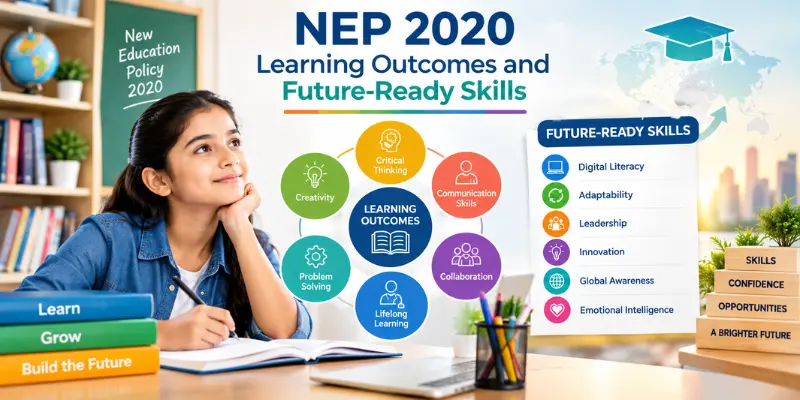
NEP 2020 connects education with skills needed for changing social, technological, and economic conditions.
Learning outcomes can support this goal by encouraging students to demonstrate critical thinking, creativity, communication, collaboration, digital capabilities, problem-solving, and practical application.
These skills should not be treated as replacements for subject knowledge.
Strong subject knowledge provides the foundation for meaningful application.
A student cannot effectively analyse scientific evidence without scientific knowledge. A student cannot solve complex mathematical problems without mathematical understanding. A student cannot communicate a historical argument without understanding historical information.
The outcome-based approach connects knowledge with what learners can do with that knowledge.
Frequently Asked Questions About NEP 2020 Learning Outcomes
What are NEP 2020 Learning Outcomes?
NEP 2020 Learning Outcomes describe what students should know, understand, apply, perform, or demonstrate after learning. They support competency-based teaching, assessment, and monitoring of student progress.
Why are learning outcomes important under NEP 2020?
They help connect curriculum, classroom teaching, learning activities, and assessment. They also support greater attention to conceptual understanding, application, higher-order thinking, and competency development.
Are learning outcomes the same for every grade?
No. Learning outcomes vary according to the learner’s stage, grade, subject, curriculum, and expected level of development. NCERT provides learning-outcome resources for different educational stages. NCERT official learning-outcome resources
How do learning outcomes change assessment?
They encourage assessment of what students can understand, apply, analyse, solve, create, and demonstrate. CBSE provides competency-based assessment resources aligned with curriculum and learning expectations. CBSE Assessment Resources
What is the relationship between competency and learning outcomes?
A competency represents a broader capability, while learning outcomes provide observable evidence of what a learner is expected to know, understand, or demonstrate.
How can teachers improve learning outcomes?
Teachers can use clear outcomes when planning lessons, select activities aligned with those outcomes, use formative assessment, provide feedback, and identify learning gaps through evidence of student performance.
Do NEP 2020 Learning Outcomes apply only to academic subjects?
No. The broader NEP 2020 approach supports holistic development. Learning can involve academic knowledge, practical abilities, communication, creativity, critical thinking, social and emotional development, and other relevant competencies.
Conclusion
NEP 2020 Learning Outcomes provide a practical way to understand what meaningful learning should look like under India’s education framework.
They connect curriculum goals with classroom activities, student performance, and assessment. The approach gives greater attention to conceptual understanding, competency, application of knowledge, higher-order thinking, problem-solving, creativity, communication, and holistic development.
Teachers can use learning outcomes to plan instruction and identify learning gaps. Students can use them to understand expected achievements. Parents can use them to look beyond marks and understand broader educational progress. Schools can use outcome-based evidence to strengthen teaching and assessment practices.
Official NCERT resources provide learning-outcome frameworks for different educational stages, while CBSE provides competency-based learning and assessment resources for classroom implementation. NCERT official resources CBSE competency-based education resources
The central idea is straightforward: education should not be measured only by what students remember. NEP 2020 Learning Outcomes place greater attention on what students understand, what they can do with their knowledge, and how effectively they can demonstrate learning in meaningful situations.





- Be Respectful
- Stay Relevant
- Stay Positive
- True Feedback
- Encourage Discussion
- Avoid Spamming
- No Fake News
- Don't Copy-Paste
- No Personal Attacks
- Be Respectful
- Stay Relevant
- Stay Positive
- True Feedback
- Encourage Discussion
- Avoid Spamming
- No Fake News
- Don't Copy-Paste
- No Personal Attacks
