How NEP 2020 Is Changing CBSE Schools
Published: 18 Sep 2026
NEP 2020 is changing CBSE schools by reshaping curriculum, classroom teaching, student assessment, subject choices, technology use, vocational exposure, teacher development, and overall student learning. The National Education Policy 2020 does not apply only to higher education. Its school education reforms are designed to move learning away from excessive memorization toward conceptual understanding, competencies, practical application, creativity, critical thinking, and holistic development.
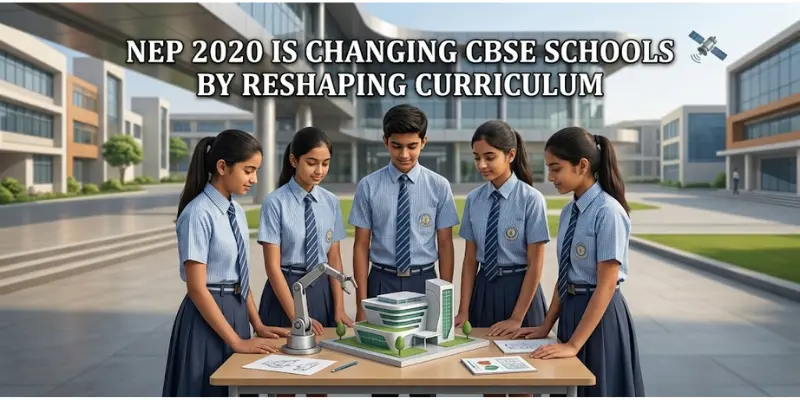
For CBSE schools, these changes are becoming relevant through curriculum planning, competency-based learning, assessment reforms, digital resources, skill development, and new approaches to student progress. The exact pace and form of implementation can differ between schools because CBSE-affiliated institutions operate within different infrastructure, staffing, and local conditions.
The broader <a href=”https://educationbeacon.com/key-features-of-the-national-education-policy-2020-explained/“>Key Features of the National Education Policy 2020</a> provide the foundation for understanding these reforms. This article focuses specifically on how those policy directions affect CBSE schools, teachers, students, classrooms, examinations, and school-level educational practices.
What Is NEP 2020 and Why Does It Matter to CBSE Schools?
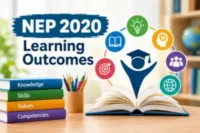
The National Education Policy 2020 is India’s comprehensive education policy introduced in 2020 to reform school and higher education. It seeks to create an education system that develops knowledge, skills, creativity, critical thinking, ethical values, and practical capabilities.
CBSE schools are an important part of India’s school education system. Changes associated with NEP 2020 therefore have implications for the way CBSE schools design learning experiences and evaluate student progress.
The policy promotes a shift from content-heavy learning toward competency-based education. Students are expected to understand concepts, apply knowledge, solve problems, communicate effectively, work collaboratively, and demonstrate learning through different forms of assessment.
This direction is different from an education model where examination marks and textbook memorization dominate classroom activity.
CBSE has been developing competency-focused assessment approaches. Its official material describes competency-based education as focusing on competencies, learning outcomes, higher-order skills, and application of learning in real-world contexts. <a href=”https://www.cbse.gov.in/cbsenew/rti/disclosures/GB_Minutes23122020.pdf“>CBSE’s competency-based education document</a> provides further detail on this approach.
How NEP 2020 Is Changing CBSE Schools
NEP 2020 is changing CBSE schools through several connected reforms. The changes are not limited to one new subject or one examination rule. They influence curriculum structure, pedagogy, assessment, technology, vocational exposure, teacher development, and student participation.
More Focus on Competency-Based Learning
One of the clearest changes is the growing emphasis on competency-based learning in CBSE schools.
Competency-based learning asks students to demonstrate what they understand and what they can do with their knowledge. A student studying science, for example, should not only remember a definition but should also be able to explain a concept, interpret information, apply a principle, or solve a relevant problem.
This approach encourages schools to design classroom activities around understanding and application.
Students may be asked to analyze a situation, conduct an experiment, prepare a project, interpret data, explain their reasoning, or solve a real-life problem.
The detailed <a href=”https://educationbeacon.com/competency-based-education-under-nep-2020/“>Competency-Based Education Under NEP 2020</a> article provides further context about this shift and its relationship with student learning.
Changes in CBSE Classroom Teaching
Classroom teaching under NEP 2020 is expected to become more learner-centered.
A teacher may spend less time treating the textbook as the complete learning experience and more time creating opportunities for discussion, questioning, experimentation, collaboration, projects, and practical application.
For example, a mathematics lesson can include real-world problem solving rather than only repetitive exercises. A science class can include experiments and observation. Social science can involve discussions, research activities, presentations, and analysis of real situations.
This approach does not eliminate textbooks or direct teaching. It expands the learning process beyond memorization.
CBSE schools may use a combination of classroom discussions, projects, experiments, presentations, group activities, case-based questions, practical assignments, research activities, and digital learning resources.
The aim is to give students more opportunities to demonstrate understanding.
The 5+3+3+4 Structure and CBSE School Education
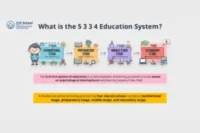
NEP 2020 proposes the 5+3+3+4 curricular and pedagogical structure covering ages 3 to 18. The four stages are Foundational, Preparatory, Middle, and Secondary.
The structure is based on developmental stages rather than simply dividing education into the earlier 10+2 pattern.
For CBSE schools, this framework affects the way learning is conceptualized across different age groups.
The Foundational Stage emphasizes play-based and activity-based learning. The Preparatory Stage develops stronger language, numeracy, and conceptual learning. The Middle Stage introduces more subject-oriented learning along with practical and experiential activities. The Secondary Stage provides greater flexibility and multidisciplinary opportunities.
The <a href=”https://www.ncert.nic.in/pdf/focus-group/NCF-FS_2022EN.pdf“>NCERT National Curriculum Framework for the Foundational Stage</a> explains how the Foundational Stage is connected with the 5+3+3+4 restructuring envisioned under NEP 2020.
More Flexible Subject Choices for CBSE Students
NEP 2020 promotes greater flexibility in subject selection, particularly at the secondary stage.
The traditional separation between Science, Commerce, and Arts can become less rigid as schools develop broader multidisciplinary opportunities.
A student interested in technology and humanities, for example, may benefit from opportunities to study subjects from different areas where the school’s curriculum and resources allow such combinations.
The purpose is to support student interests and reduce unnecessary separation between academic disciplines.
The <a href=”https://www.education.gov.in/sites/upload_files/mhrd/files/ncf_2023.pdf“>National Curriculum Framework for School Education 2023</a> describes flexibility across curricular areas and the move away from hard separation between Science, Arts/Humanities, and Commerce.
This can also help students explore career interests before making major educational decisions.
Greater Importance of Experiential Learning
Experiential learning is another important direction for CBSE schools.
Students learn through direct participation instead of receiving information only through lectures and textbooks.
Examples include science experiments, field visits, educational projects, surveys, model making, group investigations, case studies, demonstrations, community-based activities, and practical assignments.
The purpose is to connect classroom concepts with real situations.
CBSE schools can use experiential learning to make subjects more meaningful while developing communication, collaboration, creativity, observation, and problem-solving skills.
Schools should avoid treating every activity as an additional assignment. The activity should have a clear connection with the intended learning outcome.
Assessment Is Moving Toward Competency
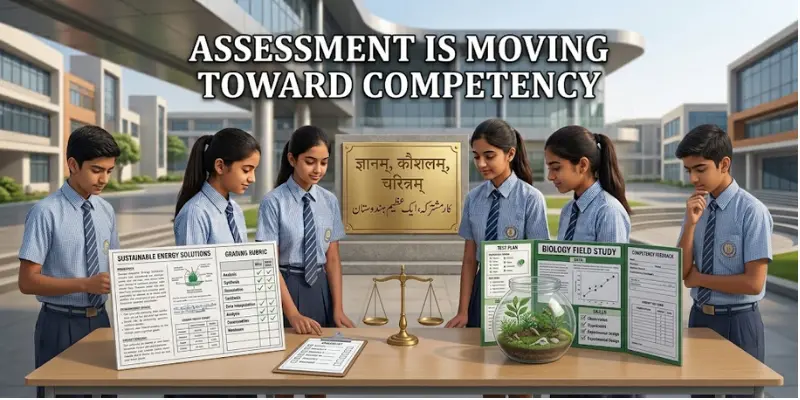
Assessment is one of the most visible areas where NEP 2020 is influencing school education.
Traditional examinations often place substantial emphasis on remembering information. Competency-based assessment focuses more strongly on understanding, application, analysis, reasoning, and demonstration of skills.
CBSE’s official competency-based education document specifically discusses reducing assessment based on simple recall and increasing opportunities for students to demonstrate higher-order competencies and application of learning in real-world contexts. <a href=”https://www.cbse.gov.in/cbsenew/rti/disclosures/GB_Minutes23122020.pdf“>Read the official CBSE competency-based education document</a>.
This means students may encounter more questions that require them to interpret information, apply concepts, analyze situations, explain reasoning, compare ideas, solve unfamiliar problems, and use knowledge in practical contexts.
The <a href=”https://educationbeacon.com/competency-based-assessment-under-nep-2020/“>Competency-Based Assessment Under NEP 2020</a> article can be used as a supporting resource for readers who want a deeper explanation of this assessment model.
Changes in CBSE Board Examination Preparation
NEP 2020 does not mean that examinations disappear.
Board examinations remain an important part of school education. The policy direction is to make assessment more focused on understanding and competencies rather than excessive memorization.
This affects how students prepare for examinations.
Students increasingly need to understand concepts instead of depending only on prepared answers. Teachers also need to expose learners to application-based and case-based questions.
The <a href=”https://www.cbse.gov.in/“>official CBSE website</a> provides current academic, curriculum, examination, and assessment information for affiliated schools, students, teachers, and parents.
This creates a stronger connection between everyday classroom learning and examination preparation.
Holistic Progress of Students
NEP 2020 promotes a broader understanding of student development.
Academic marks are important, but they do not represent every aspect of learning.
Schools are encouraged to pay attention to communication, creativity, critical thinking, collaboration, problem solving, physical development, social development, emotional development, values, and participation in activities.
The <a href=”https://www.education.gov.in/sites/upload_files/mhrd/files/ncf_2023.pdf“>National Curriculum Framework for School Education 2023</a> includes broader approaches to student progress and learning evidence.
This approach can give parents a wider picture of a child’s development.
Technology Is Becoming More Important in CBSE Schools
Technology integration is another major area associated with NEP 2020.
CBSE schools can use digital platforms, smart classrooms, virtual resources, online assessments, digital textbooks, educational applications, and other technology-enabled learning tools.
NCERT currently provides a range of digital and curriculum-related resources, including materials connected with NEP 2020 and the National Curriculum Framework. <a href=”https://www.ncert.nic.in/“>Explore NCERT’s official education resources</a>.
Technology can support classroom teaching in several ways.
A teacher can use a simulation to demonstrate a scientific process. Students can access digital learning material for revision. Virtual laboratories can supplement practical learning. Online resources can provide additional explanations for difficult concepts.
Technology does not replace teachers. Its educational value depends on how effectively teachers integrate it into learning objectives.
Digital Skills and Artificial Intelligence Exposure
NEP 2020 places considerable importance on technology, digital literacy, and future-oriented skills.
CBSE schools can introduce students to areas such as computational thinking, coding, artificial intelligence, data handling, and responsible use of digital technologies.
The purpose is not to turn every student into a software developer.
Digital literacy helps students understand and use technology responsibly across education, communication, research, and future employment.
Students may also need to learn how to evaluate online information, protect personal data, communicate responsibly, and use digital tools for learning.
Vocational Education and Skill Development
NEP 2020 gives greater importance to vocational education and practical skills.
School education is expected to develop abilities that can be useful beyond academic examinations.
Vocational exposure may include agriculture, healthcare, information technology, retail, tourism, handicrafts, entrepreneurship, electronics, design, and local trades.
The <a href=”https://www.education.gov.in/“>Ministry of Education</a> provides information and policy resources relating to school education and NEP 2020, including vocational and skill-development directions.
For CBSE students, this can create greater awareness of different career pathways.
Vocational learning should not be treated as inferior to academic learning. NEP 2020 aims to reduce the traditional separation between academic and vocational education.
Coding and Practical Skills in Middle School
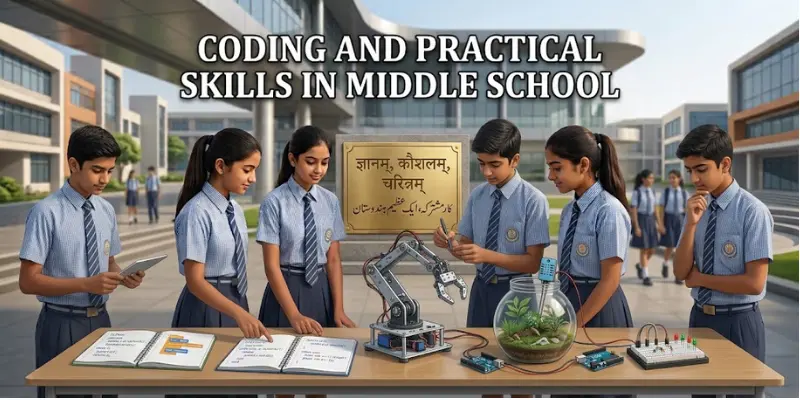
NEP 2020 gives importance to vocational exposure and contemporary skills from the school years.
Middle-school students can be introduced to practical activities, computational thinking, coding-related concepts, and skill-based experiences.
This can help students discover interests at an earlier stage.
A student who enjoys programming, electronics, design, agriculture, communication, or another practical field can gain exposure before choosing a future academic pathway.
The goal is exploration and skill development rather than forcing students into early career specialization.
Multilingual Education in CBSE Schools
Language education is another important component of NEP 2020.
The policy emphasizes multilingualism and recommends that, wherever possible, children receive early education in their home language, mother tongue, local language, or regional language. The policy also promotes bilingual approaches and access to learning materials in Indian languages.
The Ministry of Education provides the <a href=”https://www.education.gov.in/sites/upload_files/mhrd/files/ncf_2023.pdf“>National Curriculum Framework for School Education</a>, which provides curriculum guidance within the NEP 2020 framework.
For CBSE schools, implementation can depend on local language conditions, available teachers, learning materials, and school-level resources.
English therefore does not simply disappear from CBSE education. The policy promotes multilingual development rather than eliminating English.
Teacher’s Role Is Changing
NEP 2020 places teachers at the centre of educational reform.
The teacher’s role is expanding from delivering information to facilitating learning.
Teachers are increasingly expected to design engaging learning activities, use competency-based approaches, integrate technology, provide meaningful feedback, support different learning needs, encourage critical thinking, use varied assessment methods, and participate in professional development.
Teacher training is therefore an important part of successful implementation.
CBSE’s official resources include information about teacher training and capacity-building activities. <a href=”https://www.cbse.gov.in/“>CBSE’s official website</a> can be used to check current teacher-development and academic updates.
Readers interested specifically in the teacher dimension can explore <a href=”https://educationbeacon.com/nep-2020-for-teachers/“>NEP 2020 for Teachers</a> for a more focused discussion.

Continuous Professional Development for Teachers
A teacher cannot effectively implement new educational approaches without appropriate training.
NEP 2020 emphasizes continuous professional development so that teachers can improve their pedagogical knowledge and adapt to changing classroom requirements.
Professional development can cover competency-based teaching, assessment design, digital education, inclusive education, classroom management, experiential learning, subject-specific pedagogy, and student well-being.
NCERT also provides official guidance and resources related to professional development for teachers. <a href=”https://www.ncert.nic.in/“>NCERT’s official website</a> provides access to current teacher-education resources and curriculum documents.
CBSE schools may therefore need to invest time and resources in regular teacher training.
Teacher development is not a one-time activity. New curriculum requirements, technologies, assessment methods, and student needs require continuing professional learning.
Foundational Literacy and Numeracy
NEP 2020 gives high priority to foundational literacy and numeracy.
Students need strong reading, writing, language, and basic mathematical abilities before they can successfully handle more complex learning.
CBSE schools serving younger children therefore have an important role in building these foundations.
Play-based learning, storytelling, language activities, games, practical mathematics, and developmentally appropriate classroom experiences can support early learning.
The <a href=”https://www.ncert.nic.in/flipbook/NCF/National_Curriculum_Framework_for_Foundational_Stage_2022/files/basic-html/page37.html“>NCERT Foundational Stage framework</a> explains the connection between NEP 2020, foundational literacy and numeracy, and initiatives such as Vidya Pravesh.
Strong foundations can reduce learning gaps before students reach higher grades.
More Student-Centered Learning
NEP 2020 places the learner at the centre of education.
In a student-centered CBSE classroom, students are not passive recipients of information. They ask questions, discuss ideas, investigate problems, work with classmates, complete projects, and receive feedback.
Teachers still provide structure and guidance.
The difference is that learning becomes more interactive and focused on student participation.
This approach can also help teachers identify students who need additional support.
Inclusive Education in CBSE Schools
NEP 2020 emphasizes equitable access to education.
CBSE schools need to consider the learning requirements of students from different social, economic, linguistic, geographical, and learning backgrounds.
Inclusive education can involve accessible learning materials, appropriate classroom support, assistive technologies, special educators, flexible teaching strategies, additional academic support, and inclusive school infrastructure.
NCERT also provides resources related to children with special educational needs and inclusive schooling. <a href=”https://www.ncert.nic.in/“>NCERT’s official resources</a> can help schools and teachers locate relevant guidance.
How NEP 2020 Can Affect Parents
Parents may notice changes in how schools communicate student progress.
Instead of focusing only on examination marks, schools can provide broader information about academic performance, participation, skills, projects, behaviour, and development.
Parents may also see more project work, practical activities, digital learning, skill-based activities, and competency-oriented assessments.
The <a href=”https://educationbeacon.com/nep-2020-benefits-for-students-across-different-education-levels/“>NEP 2020 Benefits for Students Across Different Education Levels</a> article provides additional information about how these reforms are intended to benefit learners at different stages.
Parents should remember that implementation is not identical across every CBSE school. The actual experience can depend on school leadership, teacher preparation, infrastructure, curriculum planning, and available resources.
What Students Need to Do Differently
Students adapting to NEP 2020-style learning need more than memorization skills.
They should develop the ability to understand concepts, explain ideas in their own words, apply knowledge, solve unfamiliar problems, communicate clearly, work in teams, conduct research, use technology responsibly, complete projects, and learn independently.
Exam preparation remains important for CBSE students, but strong conceptual understanding can become increasingly important for competency-based questions.
Challenges for CBSE Schools
NEP 2020 reforms require more than changing textbooks.
Schools need trained teachers, appropriate infrastructure, digital resources, laboratories, learning materials, assessment systems, and effective leadership.
Some schools may have better access to these resources than others.
Teacher workload can also affect implementation. Designing projects, developing competency-based questions, assessing student work, and providing individual feedback can require additional planning.
Digital education creates another challenge when students do not have equal access to devices or reliable internet.
Language implementation can also require suitable teachers and high-quality learning resources.
The National Curriculum Framework recognizes the importance of teachers, resources, infrastructure, parents, communities, and school-level conditions in making curriculum meaningful. <a href=”https://www.ncert.nic.in/pdf/focus-group/NCF-FS_2022EN.pdf“>Read the NCERT framework</a>.
NEP 2020 and the Future of CBSE School Education
The direction of NEP 2020 suggests a school system in which academic knowledge is combined with skills, practical learning, technology, creativity, values, and multidisciplinary education.
For CBSE schools, this can mean greater emphasis on competency-based learning, application-oriented assessment, digital resources, vocational exposure, flexible subject choices, and continuous teacher development.
The transformation is not completed by introducing one new curriculum or one examination pattern.
It requires changes in classroom culture.
Students need opportunities to ask questions and solve problems. Teachers need training and appropriate resources. Schools need effective assessment systems. Parents need to understand broader measures of student development.
The <a href=”https://educationbeacon.com/how-nep-2020-is-transforming-school-education-in-india/“>How NEP 2020 Is Transforming School Education in India</a> article covers the wider school-education transformation, while this article focuses specifically on its relevance to CBSE schools.
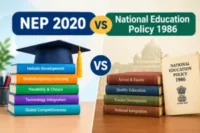
NEP 2020 vs Traditional CBSE Learning Approach
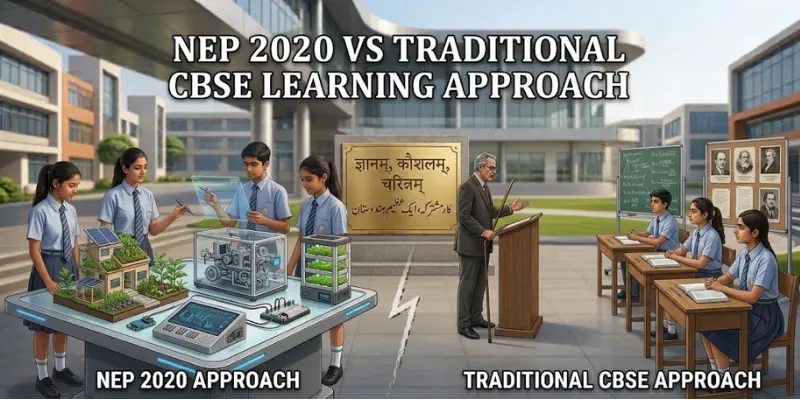
The effect of NEP 2020 becomes easier to understand by comparing broad learning approaches.
Traditional exam-focused learning can place greater emphasis on completing the syllabus, memorizing information, and preparing for examinations.
The NEP 2020 direction places greater emphasis on conceptual understanding, competencies, practical application, multidisciplinary learning, and holistic development.
The National Curriculum Framework 2023 specifically connects the secondary-stage vision with core capacities, competencies, critical thinking, inquiry, discovery, discussion, analysis, and reduced content load. <a href=”https://www.education.gov.in/sites/upload_files/mhrd/files/ncf_2023.pdf“>View the official NCF 2023 document</a>.
This does not mean that examinations or academic discipline become unimportant.
The emphasis changes from learning primarily for examination reproduction toward learning that can be demonstrated through different forms of academic and practical performance.
Frequently Asked Questions
How is NEP 2020 changing CBSE schools?
NEP 2020 is influencing CBSE schools through competency-based learning, assessment reforms, experiential education, digital learning, skill development, flexible subject choices, multilingual education, teacher development, and holistic student assessment.
What is competency-based learning in CBSE schools?
Competency-based learning focuses on what students can understand, apply, analyze, and demonstrate rather than measuring learning mainly through memorized information.
Will NEP 2020 remove CBSE board examinations?
No. NEP 2020 does not eliminate board examinations. Its assessment direction emphasizes reducing excessive memorization and increasing conceptual understanding and competency-based evaluation.
How does NEP 2020 affect CBSE teachers?
Teachers are expected to use more learner-centered and competency-oriented teaching approaches, integrate appropriate technology, use varied assessment methods, and participate in continuous professional development.
Does NEP 2020 allow students to choose different subjects?
NEP 2020 promotes greater flexibility and multidisciplinary learning, particularly at the secondary stage. The actual subject combinations available to students depend on the school’s curriculum, resources, and applicable CBSE requirements.
How does NEP 2020 promote vocational education?
The policy integrates vocational exposure and practical skills into school education. Its broader school-education framework includes vocational education as part of the multidisciplinary secondary-stage vision.
Is NEP 2020 fully implemented in every CBSE school?
Implementation is not identical across every school. Different institutions may progress at different speeds depending on teachers, infrastructure, resources, curriculum planning, and local circumstances.
Conclusion
How NEP 2020 Is Changing CBSE Schools can be understood through the shift toward competency-based, practical, flexible, technology-supported, and student-centered education.
The policy affects more than examination patterns. It influences classroom teaching, curriculum design, assessment, subject selection, vocational exposure, digital learning, teacher training, foundational education, and holistic student development.
CBSE schools are expected to give greater importance to what students understand and can apply rather than relying mainly on memorization. Projects, experiments, case-based questions, digital resources, practical activities, skill development, and broader assessment methods can become increasingly important parts of school education.
The pace of implementation can vary between schools. Effective implementation requires trained teachers, suitable infrastructure, appropriate learning resources, reliable assessment practices, and cooperation among schools, teachers, students, and parents.
For CBSE students, the emerging educational environment places value on both academic knowledge and practical capabilities. Understanding concepts, applying knowledge, communicating clearly, solving problems, using technology responsibly, and developing broader skills can help students adapt to the changing expectations of school education under NEP 2020.



- Be Respectful
- Stay Relevant
- Stay Positive
- True Feedback
- Encourage Discussion
- Avoid Spamming
- No Fake News
- Don't Copy-Paste
- No Personal Attacks
- Be Respectful
- Stay Relevant
- Stay Positive
- True Feedback
- Encourage Discussion
- Avoid Spamming
- No Fake News
- Don't Copy-Paste
- No Personal Attacks
