Competency-Based Education Under NEP 2020: Meaning, Benefits, Assessment & Implementation
Published: 8 Aug 2026
Introduction
Competency-Based Education Under NEP 2020 represents a major shift in how learning is understood, delivered, and assessed in India. Instead of focusing primarily on memorizing information and reproducing textbook answers, competency-based education emphasizes what students can understand, apply, analyze, create, and demonstrate in real-life situations. This approach supports the broader vision of the National Education Policy (NEP) 2020, which seeks to make education more holistic, flexible, multidisciplinary, experiential, and focused on developing students’ capabilities.
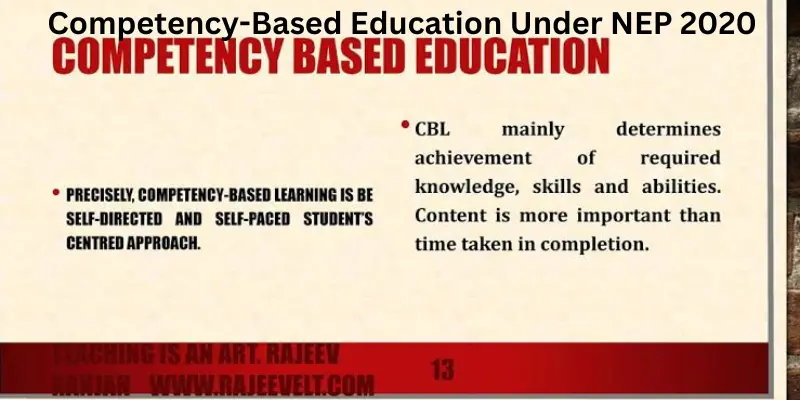
Traditional education systems have often measured student performance through examinations that reward memory, repetition, and the ability to reproduce prescribed content. Competency-based learning takes a different approach. It considers whether learners have developed the knowledge, skills, attitudes, values, and abilities required to use what they have learned effectively.
The implementation of Competency-Based Education Under NEP 2020 is particularly important because India’s education system serves students with different learning abilities, backgrounds, interests, and career aspirations. A competency-focused approach can help schools and educators move beyond a one-size-fits-all model and concentrate more closely on individual learning outcomes.
For students, this means classroom learning can become more practical and meaningful. For teachers, it requires a stronger focus on learning outcomes, formative assessment, classroom activities, problem-solving, and personalized support. For schools, it requires changes in curriculum planning, teaching practices, assessment systems, teacher training, and educational resources.
What Is Competency-Based Education?
Competency-based education is an approach in which learning is organized around clearly defined competencies that students are expected to develop. A competency generally combines knowledge, skills, understanding, application, and appropriate attitudes or behaviors that enable a learner to perform a particular task or address a particular situation.
In a competency-based classroom, knowing a fact is not considered sufficient by itself. Students should also be able to use that knowledge. For example, learning mathematical formulas is different from being able to select and apply the correct formula to solve a practical problem.
Similarly, learning scientific definitions is different from being able to observe a situation, identify a problem, analyze evidence, and explain an appropriate scientific solution.
This makes competency-based education meaning in NEP 2020 closely connected with application-oriented learning. Students are encouraged to demonstrate what they know rather than simply recall information during examinations.
Competencies can include communication, critical thinking, creativity, collaboration, problem-solving, digital literacy, mathematical reasoning, scientific thinking, social awareness, and subject-specific abilities. The exact competencies vary according to the learner’s age, grade, subject, and educational objectives.
Competency-Based Education Under NEP 2020
The National Education Policy 2020 places strong emphasis on learning outcomes, conceptual understanding, critical thinking, experiential learning, and reducing dependence on rote memorization. These principles create a strong foundation for competency-based education in Indian schools.
Under this approach, curriculum and teaching are expected to focus on essential learning rather than overwhelming students with excessive content. The objective is to ensure that students develop foundational knowledge and progressively acquire more advanced competencies.
Competency-Based Education Under NEP 2020 also supports the policy’s broader objective of making education more learner-centered. Students are not expected to progress only by completing chapters or attending classes. Their development is increasingly connected with whether they have achieved the expected learning outcomes.
This distinction is important. Completing a textbook chapter does not automatically mean that a student has mastered the concepts within it. A competency-based approach asks educators to identify what learners should be able to do after instruction and then design teaching and assessment around those expectations.
The approach also complements the policy’s emphasis on experiential learning, arts-integrated education, sports-integrated learning, storytelling, vocational exposure, and multidisciplinary education.
Why Competency-Based Education Is Important in Indian Schools
India’s education system has historically faced challenges related to rote learning, examination pressure, unequal learning outcomes, and differences in access to quality educational resources. Competency-based education provides a framework for addressing some of these challenges by placing greater emphasis on demonstrated learning.
A student may obtain a high examination score without being able to apply concepts independently. Another student may understand a concept but struggle with conventional examination formats. Competency-based assessment can provide more opportunities to evaluate different dimensions of learning.
The importance of competency-based learning for Indian students is also connected to the changing demands of higher education, employment, entrepreneurship, and society. Modern learners need more than subject knowledge. They need communication skills, digital capabilities, adaptability, collaboration, analytical thinking, and the ability to solve unfamiliar problems.
For example, a student studying environmental science should not only remember definitions related to pollution. The learner should ideally be able to identify environmental problems, interpret relevant information, explain causes, evaluate possible solutions, and communicate findings.
This approach makes education more connected to real-world applications.
Key Principles of Competency-Based Education
Competency-based education is built around several important principles. One of the most important is clarity about expected learning outcomes. Students and teachers should understand what learners are expected to know and demonstrate.
Another principle is active learning. Students participate in activities that require them to think, discuss, investigate, create, practice, and solve problems rather than simply listen to lectures.
Assessment is also integrated into the learning process. Instead of relying entirely on a final examination, teachers can use quizzes, classroom activities, projects, presentations, observations, portfolios, practical tasks, and other methods to understand student progress.
Personalized learning is another important component. Students do not always learn at the same pace. A competency-based system can help teachers identify areas where individual learners require additional practice or support.
The approach also emphasizes mastery. The objective is not simply to move students from one chapter to another. It is to help them develop the required competency before progressing to increasingly complex learning.
Role of Learning Outcomes in Competency-Based Education
Learning outcomes describe what students should be able to demonstrate after completing a particular learning experience. They provide a foundation for curriculum planning, classroom instruction, and assessment.
For example, instead of defining a learning objective only as “students will understand fractions,” a competency-oriented outcome might require students to compare fractions, solve practical problems involving fractions, and explain their reasoning.
This makes the expected achievement more observable.
Learning outcomes under NEP 2020 are important because they help align teaching and assessment. If the desired outcome involves problem-solving, an examination consisting entirely of direct recall questions may not adequately measure that competency.
Teachers therefore need to select instructional activities and assessment methods that correspond with the expected learning outcomes.
Clear learning outcomes can also help parents understand what children are expected to learn. Rather than judging progress only through marks, parents can consider whether their child can communicate ideas, apply concepts, solve problems, work independently, and demonstrate subject-specific abilities.
Competency-Based Curriculum Under NEP 2020
A competency-based curriculum focuses on essential concepts and skills that students need to develop at each stage of education. This does not mean that subject knowledge becomes unimportant. Instead, knowledge becomes the foundation through which students develop deeper abilities.
The curriculum can be designed around progressively challenging competencies. Early learners may focus on foundational literacy, numeracy, communication, social interaction, and basic problem-solving. As students progress, competencies can become more sophisticated.
At the secondary level, learners may be expected to analyze information, evaluate evidence, conduct investigations, communicate arguments, collaborate on projects, and apply disciplinary knowledge to practical situations.
The curriculum therefore becomes more than a list of chapters. It becomes a structured pathway through which learners develop increasingly complex capabilities.
How Competency-Based Education Changes Classroom Learning
Classroom teaching under Competency-Based Education Under NEP 2020 can become more activity-oriented and application-focused. Teachers may use case studies, experiments, discussions, group activities, projects, simulations, problem-solving exercises, and real-world examples to help students demonstrate learning.
For example, instead of asking students to memorize the causes of water pollution, a teacher might present a local water-related scenario and ask learners to identify possible sources of pollution, analyze available information, propose solutions, and explain the reasoning behind their recommendations.
Such activities encourage students to use multiple competencies simultaneously.
Teachers also become facilitators of learning. Their role is not limited to delivering information. They observe students, identify misconceptions, provide feedback, design learning activities, and support learners who require additional assistance.
This approach can make classroom learning more meaningful because students can see how concepts connect with situations outside the textbook.
Competency-Based Education and Experiential Learning
Experiential learning is closely connected with competency-based education because students often demonstrate competencies most effectively when they engage with practical experiences.
A science experiment, community project, field visit, school survey, role-play, design activity, or vocational exercise can provide opportunities for students to apply knowledge.
For example, students learning about basic economics could conduct a small survey of household spending patterns, organize the information, calculate percentages, interpret results, and present their findings. Such an activity develops mathematical reasoning, communication, data interpretation, collaboration, and analytical thinking.
Experiential learning under NEP 2020 therefore provides practical opportunities for competency development rather than treating learning as purely theoretical.
Role of Teachers in Competency-Based Education
Teachers are central to the successful implementation of competency-based education. A curriculum cannot become competency-focused simply by changing textbooks or examination formats. Teachers need appropriate training, resources, planning time, and institutional support.
Teachers need to understand the competencies expected at different educational stages and identify appropriate methods for developing them. They also need to learn how to create assessment tasks that measure application, reasoning, creativity, communication, and problem-solving.
Professional development can help educators understand formative assessment, rubric development, project-based learning, differentiated instruction, experiential learning, and digital educational tools.
Teachers also need to provide meaningful feedback. Instead of telling a student only that an answer is wrong, competency-focused feedback can explain which skill requires improvement and how the learner can improve it.
This makes assessment part of the learning process rather than merely a method of assigning marks.
Competency-Based Education for Different Education Levels
The application of competency-based education differs according to the developmental stage of learners.
At the foundational stage, emphasis can be placed on foundational literacy and numeracy, communication, social interaction, curiosity, observation, and basic reasoning. Young children can develop these abilities through play, stories, activities, conversations, and hands-on experiences.
At the preparatory and middle stages, learners can gradually engage with more structured problem-solving, experiments, projects, discussions, and subject-specific applications.
At the secondary level, competency development can become more advanced. Students can work with research tasks, analytical questions, practical projects, presentations, interdisciplinary assignments, and career-oriented learning experiences.
This progression supports the broader NEP 2020 vision of age-appropriate and holistic development.
Benefits of Competency-Based Education Under NEP 2020
One of the major benefits of competency-based education under NEP 2020 is its focus on meaningful learning. Students are encouraged to understand concepts rather than memorize information for examinations.
Another benefit is improved application of knowledge. Learners practice using concepts in different contexts, which can strengthen their ability to solve unfamiliar problems.
Competency-based education can also encourage critical thinking. Students may be asked to analyze information, compare alternatives, justify conclusions, and evaluate possible solutions.
Communication skills can improve when students regularly participate in presentations, discussions, group projects, written explanations, and collaborative activities.
The approach may also support greater student engagement. Practical tasks and real-world problems can make lessons more relevant to learners’ interests and experiences.
A further advantage is that competency-based assessment can provide teachers with more detailed information about student strengths and weaknesses. Instead of knowing only that a student received 60 marks, teachers can identify specific areas where the learner demonstrates competence and areas requiring additional support.
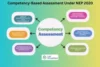
Competency-Based Assessment Under NEP 2020
Competency-Based Education Under NEP 2020 requires a corresponding change in assessment. If classroom teaching focuses on understanding, application, critical thinking, creativity, and problem-solving, assessment should measure these abilities rather than relying mainly on memorization.
Competency-based assessment evaluates whether a learner can demonstrate a particular competency in an observable way. The assessment may involve a written response, practical activity, project, presentation, experiment, case study, portfolio, oral response, or problem-solving task.
The objective is not simply to determine how many questions a student answered correctly. It is to understand whether the learner can use knowledge appropriately and independently.
For example, a traditional question may ask a student to define a scientific term. A competency-based question may provide a real-life situation and ask the learner to identify the relevant scientific principle, analyze the situation, and recommend an appropriate solution.
This type of assessment provides a broader picture of student learning.
Difference Between Traditional and Competency-Based Assessment
Traditional assessment often places significant emphasis on examinations, marks, grades, and recall-based questions. While these methods can measure certain aspects of learning, they may not adequately capture skills such as collaboration, creativity, communication, reasoning, and practical application.
Competency-based assessment focuses more directly on what a student can demonstrate.
For example, a traditional mathematics assessment might ask students to solve ten problems using formulas they have practiced. A competency-focused assessment could present a practical budgeting situation where students need to select appropriate mathematical operations, calculate the results, explain their reasoning, and evaluate whether their answer makes sense.
The second approach assesses several abilities at the same time.
Traditional assessment vs competency-based assessment therefore represents a shift from primarily measuring content recall toward measuring knowledge application and demonstrated learning outcomes.
This does not mean conventional written examinations become completely irrelevant. Written assessments can remain useful when they are designed to measure conceptual understanding, reasoning, interpretation, and application rather than only memorization.
Types of Competency-Based Assessment
Schools can use multiple assessment methods to evaluate competencies effectively. No single method can measure every type of learning.
Formative Assessment
Formative assessment takes place during the learning process. It helps teachers identify what students understand, where they are struggling, and what support they need.
Short quizzes, classroom questioning, observations, discussions, worksheets, peer activities, exit questions, and practical exercises can all provide formative information.
The primary purpose is improvement rather than simply assigning a grade.
For example, a teacher teaching fractions may ask students to explain how they reached an answer instead of checking only the final numerical result. The explanation can reveal whether the learner understands the underlying concept.
Summative Assessment
Summative assessment generally takes place after a learning period and provides an overall judgment of achievement. It can include examinations, projects, practical tests, presentations, or comprehensive assignments.
Under a competency-focused approach, summative assessments can include application-oriented questions and authentic tasks.
A final assessment should therefore measure whether students have achieved the expected competencies rather than simply whether they have completed the prescribed content.
Project-Based Assessment
Project-based assessment gives students opportunities to apply multiple skills to a defined task.
For example, students might investigate waste management in their school. They could collect information, classify waste, analyze findings, calculate quantities, prepare recommendations, and present their conclusions.
Such a project can assess research, communication, collaboration, analytical thinking, problem-solving, and subject knowledge.
Project-based assessment under NEP 2020 can therefore support holistic learning while giving students opportunities to demonstrate competencies in realistic situations.
Performance-Based Assessment
Performance-based assessment requires learners to demonstrate a skill through action.
A science student may conduct an experiment. A language student may deliver a presentation. A vocational student may perform a practical task. A mathematics student may solve a real-world problem and explain the process.
The assessment focuses on observable performance.
Portfolio Assessment
A portfolio is a collection of student work that demonstrates learning and progress over time. It can contain written assignments, projects, artwork, research activities, reflections, practical work, presentations, and other evidence.
Portfolio assessment can be especially useful because it shows development rather than relying on a single examination.
It can also encourage students to reflect on their own learning and identify areas where they have improved.
Role of Rubrics in Competency-Based Assessment
Rubrics provide clear criteria for evaluating student performance. A rubric can identify specific competencies and describe different levels of achievement.
For example, a presentation rubric may assess content accuracy, communication, organization, evidence, critical thinking, and delivery.
Rubrics make assessment more transparent because students can understand what is expected before completing an activity.
Teachers can also use rubrics to provide more specific feedback. Instead of giving only a numerical score, the teacher can explain which competencies have been demonstrated successfully and which require further development.
Competency-based assessment rubrics for schools are therefore useful tools for creating consistency and clarity in evaluation.
Assessment of Higher-Order Thinking Skills
A major objective of competency-based learning is to develop higher-order thinking skills. These include analysis, evaluation, reasoning, creativity, decision-making, and problem-solving.
Assessment questions should therefore move beyond direct recall.
For example, instead of asking students to list causes of air pollution, an application-based question could provide information about air quality in a city and ask students to identify possible causes, interpret the evidence, evaluate solutions, and recommend practical actions.
Such questions require students to use knowledge rather than simply reproduce it.
This approach is particularly relevant to critical thinking skills under NEP 2020, where learners are expected to develop the ability to analyze information and make informed decisions.
Benefits of Competency-Based Education for Students
One important advantage of Competency-Based Education Under NEP 2020 is that it can help students develop practical abilities alongside academic knowledge.
Students learn to apply concepts rather than treating education as a process of memorizing textbook material. This can improve conceptual understanding and make learning more relevant.
Competency-based learning can also support independent learning. When students understand the expected outcomes, they can monitor their own progress and identify areas requiring additional practice.
The approach may also reduce excessive dependence on marks as the only indicator of achievement. A learner’s progress can be considered across multiple dimensions, including communication, creativity, collaboration, practical application, and problem-solving.
Another important benefit is preparation for future education and employment. Universities, workplaces, and professional environments require individuals who can use knowledge effectively, communicate clearly, adapt to new situations, and solve problems.
Competency-focused education can help students begin developing these abilities during school years.
Competency-based education can also provide teachers with more useful information about student performance.
A traditional examination may indicate that a student scored poorly, but it may not clearly explain why. Competency-focused assessment can identify specific weaknesses.
For example, a student may understand a mathematical concept but struggle to interpret word problems. Another learner may understand the concept but have difficulty explaining the reasoning.
This information allows teachers to provide targeted support.
Teachers can also use assessment evidence to modify their instructional strategies. If many students struggle with the same competency, the teacher can revisit the concept, introduce a different activity, or provide additional practice.
This makes teaching more responsive to actual learning needs.
Benefits for Parents
Parents can also benefit from a more detailed understanding of children’s learning progress.
Instead of focusing exclusively on examination marks, parents can receive information about specific competencies. They may learn whether a child is developing communication, reasoning, problem-solving, creativity, collaboration, literacy, numeracy, or subject-specific skills.
This can encourage parents to support learning at home through practical activities rather than relying entirely on memorization and homework.
For example, parents can encourage children to calculate household expenses, read and discuss news articles, conduct simple experiments, explain concepts in their own words, or participate in decision-making activities.
Such experiences can reinforce competency development outside the classroom.
Implementation of Competency-Based Education in Schools
Implementing Competency-Based Education Under NEP 2020 requires coordinated changes at multiple levels. Simply introducing competency-based questions in examinations is not enough.
Schools first need to identify the competencies expected at different grade levels and subjects. These competencies should be aligned with curriculum objectives and learning outcomes.
Teachers then need to design classroom activities that provide opportunities to develop those competencies.
Assessment should be aligned with instruction. If students are expected to develop problem-solving abilities, classroom teaching should include problem-solving activities, and assessment should provide opportunities to demonstrate those abilities.
Schools also need systems for tracking student progress. Assessment evidence can be used to identify learners who need additional support and students who are ready for more advanced challenges.
Teacher Training for Competency-Based Education
Teacher preparation is one of the most important factors affecting implementation.
Educators need practical training in competency-based lesson planning, learning outcomes, formative assessment, rubric creation, project-based learning, experiential activities, differentiated instruction, and feedback.
Professional development should not be limited to theoretical explanations. Teachers need opportunities to create assessment tasks, evaluate sample student responses, develop rubrics, and practice competency-focused lesson planning.
Schools can also encourage teachers to share successful classroom strategies with colleagues. Collaborative professional learning can help educators solve implementation challenges collectively.
The success of teacher training for competency-based education in India depends on sustained professional support rather than one-time workshops.
Technology and Competency-Based Learning
Digital technology can support competency-based education when it is used appropriately.
Learning management systems, digital quizzes, educational applications, virtual laboratories, interactive simulations, and online portfolios can provide additional opportunities for students to practice and demonstrate competencies.
Technology can also help teachers track student performance and identify areas where learners require additional practice.
For example, digital assessment platforms can provide immediate feedback on certain types of activities. Teachers can use this information to plan subsequent lessons.
However, technology should support pedagogy rather than replace effective teaching. Access to devices, internet connectivity, teacher digital literacy, and infrastructure must also be considered.
Personalized Learning Under NEP 2020
Students differ in their learning pace, interests, prior knowledge, and abilities. A competency-focused system can support more personalized learning because teachers can identify specific competencies that individual students have or have not mastered.
A learner who has already demonstrated mastery can receive more challenging activities. A student who is struggling can receive additional explanation, practice, or alternative learning resources.
This approach can prevent students from being treated as a single homogeneous group.
Personalized learning under NEP 2020 can therefore complement competency-based education by focusing on individual learning needs while maintaining clear educational standards.
Challenges of Implementing Competency-Based Education
Despite its potential benefits, implementing competency-based education across India’s diverse education system presents several challenges.
One challenge is teacher workload. Designing practical activities, creating rubrics, conducting formative assessments, and providing individual feedback can require more time than traditional examination-based teaching.
Another challenge is teacher preparedness. Educators who have primarily worked within conventional examination systems may require significant support to adopt new teaching and assessment practices.
Infrastructure is another concern. Some schools may have limited access to laboratories, digital tools, libraries, internet connectivity, or other resources needed for experiential learning.
Large class sizes can also make personalized assessment difficult. A teacher managing a large number of students may struggle to observe individual performance and provide detailed feedback.
Assessment consistency presents another challenge. Different teachers may evaluate the same competency differently unless clear criteria and rubrics are established.
These challenges do not make competency-based education impractical, but they demonstrate why implementation needs planning, teacher support, resources, monitoring, and gradual improvement.
Making Competency-Based Assessment Fair and Inclusive
A competency-based system should provide equitable opportunities for students to demonstrate learning.
Assessment tasks need to consider differences in language, learning needs, socioeconomic circumstances, access to technology, and physical abilities.
Schools can provide alternative methods of demonstrating competencies when appropriate. For example, a student may demonstrate understanding through an oral explanation, written response, practical activity, or supported digital presentation depending on the learning objective and individual needs.
The focus should remain on the competency being assessed rather than unrelated barriers.
Inclusive assessment can help ensure that competency-based education does not unintentionally disadvantage students who learn or communicate differently.
Role of Parents and Community
Competency development does not occur only inside classrooms. Parents and communities can provide real-world learning opportunities.
Schools can encourage students to participate in community surveys, environmental projects, local problem-solving activities, cultural programs, entrepreneurship exercises, and vocational experiences.
Parents can support children by encouraging questioning, reading, practical decision-making, communication, and independent problem-solving.
Community participation can make education more connected to real-world needs.
This aligns with the broader objective of making education relevant to students’ lives and future responsibilities.
Measuring the Success of Competency-Based Education
The success of Competency-Based Education Under NEP 2020 should not be measured only by examination scores.
Schools can consider whether students demonstrate stronger conceptual understanding, improved problem-solving, better communication, increased engagement, practical application of knowledge, and greater independence.
Teachers can examine assessment data to identify learning gaps and monitor progress over time.
Student portfolios, project performance, classroom observations, formative assessment results, and standardized assessments can collectively provide evidence of learning.
The most meaningful indicator is whether students can transfer what they have learned to new contexts.
Practical Implementation of Competency-Based Education Under NEP 2020
Competency-Based Education Under NEP 2020 requires schools to connect curriculum, teaching, assessment, teacher development, and student support around clearly defined competencies. Implementation should therefore be gradual and systematic rather than limited to changing examination questions.
The first step is identifying the learning outcomes expected at each grade and subject level. Schools can then determine which knowledge, skills, and abilities students should demonstrate after completing a particular unit.
Teachers can convert these outcomes into classroom activities. A lesson should provide opportunities for students to observe, question, practice, analyze, discuss, create, and apply concepts.
Assessment should be planned alongside teaching. When teachers know how a competency will be assessed, they can design classroom experiences that prepare students to demonstrate it.
Regular review is also necessary. Schools can examine assessment evidence to determine whether students are achieving expected competencies and whether teaching strategies need modification.
Subject-Wise Examples of Competency-Based Learning
Competency-based learning can be implemented across different subjects rather than being restricted to science or mathematics.
In mathematics, students can develop competencies through practical problems involving budgeting, measurements, percentages, data interpretation, geometry, and financial calculations. Instead of simply memorizing formulas, learners can explain why a particular method works and determine which method is appropriate for a given situation.
In science, students can conduct experiments, interpret observations, analyze evidence, formulate explanations, and propose solutions to environmental or health-related problems. These activities develop scientific reasoning alongside subject knowledge.
In social science, students can analyze historical sources, compare perspectives, interpret maps, examine social issues, and construct evidence-based arguments.
Language education can focus on reading comprehension, writing, speaking, listening, vocabulary, communication, interpretation, and creative expression. Students can demonstrate competency through presentations, debates, essays, discussions, storytelling, and real-world communication tasks.
Vocational education provides particularly strong opportunities for competency development because learners can demonstrate practical skills through authentic tasks.
Competency-Based Learning in Primary Education
At the primary level, competency-based education for school students should be developmentally appropriate. Young learners need opportunities to build foundational literacy, numeracy, communication, curiosity, observation, social interaction, and problem-solving abilities.
Teachers can use stories, games, puzzles, role-play, drawing, classroom discussions, practical demonstrations, and hands-on activities.
For example, a mathematics lesson on addition can involve a simulated shop where children calculate the cost of several items. This activity combines numerical understanding with communication and practical decision-making.
A language lesson can involve storytelling followed by questions that require children to explain characters’ actions, predict outcomes, and express their own opinions.
Such activities allow teachers to observe competencies naturally while keeping learning engaging.
Competency-Based Learning at the Secondary Level
At the secondary level, learners can engage with more complex and interdisciplinary competencies.
Students can conduct research projects, analyze data, solve case studies, participate in debates, prepare presentations, perform experiments, develop business ideas, and investigate community issues.
For example, a group of students studying environmental science could examine waste generation in their school. They could collect data, categorize waste, calculate quantities, identify problems, research solutions, and present an action plan.
This single activity can assess scientific understanding, mathematics, research skills, communication, collaboration, critical thinking, and problem-solving.
Such competency-based activities for secondary school students can also help learners understand how different subjects connect with each other.
Competency-Based Education and Vocational Learning
NEP 2020 gives importance to vocational education and exposure to practical skills. Competency-based education naturally supports this objective because vocational learning depends heavily on demonstrated performance.
A student studying a vocational skill should not be evaluated only through written questions. The learner should have opportunities to demonstrate practical abilities in realistic situations.
For example, students learning basic electrical work may need to identify tools, follow safety procedures, understand circuit principles, and perform a practical task correctly.
Similarly, students learning entrepreneurship can develop a basic business idea, identify a target market, estimate costs, prepare a simple budget, and present their proposal.
This creates a direct connection between education and practical capabilities.
Role of Schools in Successful Implementation
School leadership has a major influence on implementation. Principals and academic coordinators need to provide teachers with adequate planning time, professional development, assessment resources, and opportunities for collaboration.
Schools can establish competency-focused academic planning systems. Teachers from different subjects can discuss common competencies such as communication, critical thinking, collaboration, creativity, and problem-solving.
Schools can also create repositories of assessment tasks and rubrics. This reduces duplication of effort and allows teachers to improve assessment practices over time.
Classroom observations can be used for professional support rather than simply evaluation. School leaders can identify successful practices and help teachers overcome implementation difficulties.
Role of CBSE and Educational Institutions
Boards and educational institutions play an important role in creating the broader assessment environment required for competency-based education.
Curriculum frameworks, sample question papers, teacher training programs, learning resources, and assessment guidelines can help schools understand how competency-focused education should work in practice.
The Central Board of Secondary Education has increasingly emphasized competency-oriented assessment in its examination approach, reinforcing the broader movement away from purely memory-based testing.
However, meaningful implementation depends on alignment across the entire education system. If classroom teaching remains focused on memorization while examinations reward only recall, teachers and students will have limited incentives to change their practices.
Curriculum, textbooks, classroom instruction, assessment, and teacher training therefore need to support the same learning objectives.
Challenges of Competency-Based Education Under NEP 2020
One of the most significant challenges of Competency-Based Education Under NEP 2020 is the transition from traditional teaching methods to more learner-centered approaches.
Teachers may initially find it difficult to design competency-focused activities and assessment questions. Developing high-quality rubrics and evaluating practical work can also require additional time.
Large classrooms create another challenge. When one teacher is responsible for many students, providing individual feedback and monitoring progress can become difficult.
Infrastructure differences between schools can also affect implementation. Well-equipped schools may have laboratories, digital tools, libraries, and activity spaces, while schools in resource-constrained environments may have fewer facilities.
Another challenge is parental expectations. Parents accustomed to judging achievement primarily through marks may initially find competency-based evaluation unfamiliar.
Students can also experience difficulties during the transition. Learners who are accustomed to memorization may need time to develop independent thinking, explanation, analysis, and application skills.
Practical Solutions to Implementation Challenges
The implementation challenges can be addressed through gradual and realistic strategies.
Teacher training should focus on practical classroom applications rather than only theoretical explanations. Teachers can begin with a small number of competency-based activities and gradually expand them.
Schools can create shared resources so individual teachers do not have to design every assessment task from the beginning.
Technology can assist with record keeping and formative assessment where infrastructure permits, but schools should also maintain low-cost alternatives for classrooms with limited digital access.
Large classes can be managed through group activities, peer assessment, structured observation, and carefully designed rubrics.
Parents should be informed about the purpose of competency-based education. Schools can explain that marks remain useful but do not provide a complete picture of learning.
Students should also be taught how to reflect on their own performance. Self-assessment can help learners understand their strengths, weaknesses, and learning goals.
Competency-Based Education and Student-Centered Learning
Student-centered learning is an important part of the broader approach. Instead of treating students as passive recipients of information, teachers provide opportunities for learners to participate actively.
Students can ask questions, investigate topics, collaborate with classmates, solve problems, make decisions, and reflect on their learning.
This can also support greater learner autonomy. Students gradually become responsible for understanding what they need to learn and how they can improve.
Student-centered learning under NEP 2020 therefore complements competency-based education by placing the learner’s development at the center of classroom practice.
Competency-Based Education and Critical Thinking
Critical thinking is increasingly important in education because students encounter large amounts of information through books, websites, social media, and digital platforms.
Competency-based learning can help students evaluate information instead of accepting every claim without examination.
Teachers can present multiple viewpoints, case studies, data sets, or real-world problems and ask students to compare evidence, identify assumptions, explain reasoning, and reach justified conclusions.
For example, students studying climate-related topics can analyze different sources of information and determine which claims are supported by evidence.
These activities develop critical thinking and problem-solving skills under NEP 2020, which are valuable both academically and professionally.
Competency-Based Education and Future Careers
The relevance of competency-based education extends beyond school examinations. Higher education institutions and employers increasingly value individuals who can apply knowledge, communicate effectively, collaborate with others, adapt to change, and solve practical problems.
Students who have repeatedly practiced these abilities during school may be better prepared for future academic and professional environments.
Career preparation is not limited to vocational subjects. A student pursuing engineering, medicine, business, law, teaching, technology, or another field needs multiple transferable competencies.
Communication, analytical reasoning, teamwork, digital literacy, creativity, and problem-solving can contribute to success across different career paths.
This makes competency-based education for career readiness an important part of preparing learners for a changing economy.
Long-Term Impact of Competency-Based Education
The long-term impact of Competency-Based Education Under NEP 2020 depends on the quality and consistency of implementation.
If curriculum, teaching, assessment, and teacher training become genuinely aligned around competencies, students may experience a stronger connection between classroom learning and real-world applications.
The approach can encourage deeper conceptual understanding, independent learning, practical problem-solving, and broader skill development.
It may also encourage schools to move away from viewing education primarily as examination preparation.
However, competency-based education should not be treated as a quick replacement for traditional education. Subject knowledge remains essential. Students cannot apply concepts they do not understand.
The strongest model combines solid foundational knowledge with opportunities to apply, analyze, evaluate, communicate, and create.
How Parents Can Support Competency-Based Learning
Parents can reinforce competency development through everyday activities.
Children can be encouraged to explain how they reached an answer instead of simply giving the correct answer. Parents can involve them in budgeting, planning, reading, organizing household activities, researching questions, and making age-appropriate decisions.
Reading together can support vocabulary, comprehension, reasoning, and communication. Practical activities can reinforce mathematics and science concepts.
Parents should also avoid placing excessive emphasis on marks alone. A student’s ability to communicate, think independently, solve problems, collaborate, and apply knowledge is also important.
Frequently Asked Questions
What Is Competency-Based Education Under NEP 2020?
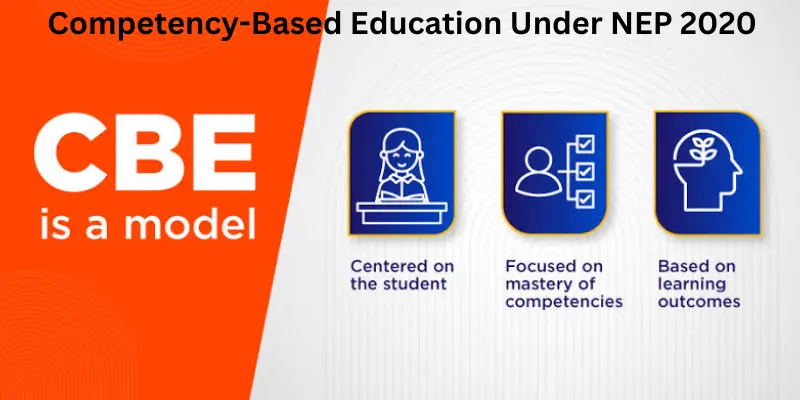
Competency-Based Education Under NEP 2020 is an approach that emphasizes the development and demonstration of knowledge, skills, understanding, application, critical thinking, problem-solving, communication, and other competencies. It moves education beyond simple memorization and focuses on meaningful learning outcomes.
What Is the Main Goal of Competency-Based Education?
The main goal is to ensure that students can demonstrate and apply what they learn. Education focuses on mastery of important competencies rather than merely completing a syllabus or memorizing information for examinations.
How Does Competency-Based Assessment Differ From Traditional Assessment?
Competency-based assessment measures the ability to apply knowledge, solve problems, analyze information, communicate ideas, and perform practical tasks. Traditional assessment often places greater emphasis on written examinations and recall, although conventional assessments can also include competency-focused questions.
What Are the Benefits of Competency-Based Education for Students?
Major benefits include deeper conceptual understanding, practical application of knowledge, critical thinking, problem-solving, communication, collaboration, independent learning, and better preparation for higher education and careers.
What Is the Role of Teachers in Competency-Based Education?
Teachers identify learning outcomes, design competency-focused activities, assess student performance, provide feedback, support individual learning needs, and create opportunities for students to apply knowledge in meaningful contexts.
What Are the Main Challenges of Implementing Competency-Based Education in India?
Major challenges include teacher training requirements, increased assessment workload, large class sizes, infrastructure differences, limited resources, parental expectations, and the need to align curriculum, teaching, textbooks, and examinations with competency-focused learning.
Conclusion
Competency-Based Education Under NEP 2020 represents an important shift toward education that emphasizes understanding, application, practical skills, critical thinking, creativity, communication, and problem-solving. Instead of measuring learning primarily through the ability to reproduce information, competency-based education focuses on whether students can demonstrate what they know and use it effectively.
Its successful implementation requires alignment between curriculum, classroom teaching, assessment, teacher training, school leadership, educational resources, and examination systems. Teachers need practical support, students need opportunities to learn through meaningful activities, and parents need to understand why competency development extends beyond examination marks.
The approach can be particularly valuable when combined with experiential learning, project-based activities, formative assessment, personalized support, vocational exposure, and real-world problem-solving.
NEP 2020 provides a policy framework for moving Indian education toward more holistic and application-oriented learning. The effectiveness of Competency-Based Education Under NEP 2020 will ultimately depend on how consistently these principles are translated into everyday classroom practices.
When students are given opportunities to understand concepts deeply, apply knowledge, solve unfamiliar problems, communicate their ideas, collaborate with others, and reflect on their progress, education becomes more closely connected with the abilities they need for higher education, employment, citizenship, and lifelong learning.
NEP 2020 Benefits for Students Across Different Education Levels: Complete Guide for Learners in India (2026)



- Be Respectful
- Stay Relevant
- Stay Positive
- True Feedback
- Encourage Discussion
- Avoid Spamming
- No Fake News
- Don't Copy-Paste
- No Personal Attacks
- Be Respectful
- Stay Relevant
- Stay Positive
- True Feedback
- Encourage Discussion
- Avoid Spamming
- No Fake News
- Don't Copy-Paste
- No Personal Attacks
