How NEP 2020 Changes Teaching Methods
Published: 25 Sep 2026
The National Education Policy 2020 has introduced a broader approach to classroom teaching in India. How NEP 2020 Changes Teaching Methods can be understood through its emphasis on learner-centred education, competency development, experiential learning, critical thinking, practical application, technology, inclusion, multilingual learning, and continuous assessment.

Traditional classroom instruction often placed strong emphasis on completing prescribed content, memorising information, and preparing students for examinations. NEP 2020 places greater importance on what students can understand, apply, create, communicate, and demonstrate.
This change affects lesson planning, classroom activities, questioning techniques, assessment practices, teaching resources, and the role of teachers. The teacher remains central to the learning process but increasingly works as a facilitator, mentor, designer of learning experiences, and assessor of student progress.
The policy states that teachers should be at the centre of fundamental reforms in education. It connects quality teaching with professional development, appropriate pedagogy, technology, assessment reform, and student development. National Education Policy 2020
What Does NEP 2020 Mean for Teaching Methods?
NEP 2020 and learner-centred teaching
One of the most important answers to How NEP 2020 Changes Teaching Methods is the movement toward learner-centred classroom practices.
Learner-centred teaching gives students a more active role in the learning process. Instead of listening to explanations for the entire lesson, students can participate through questions, discussions, investigations, projects, demonstrations, problem-solving activities, presentations, and practical tasks.
The teacher still explains concepts when direct instruction is useful. The difference lies in how learning experiences are designed around student understanding.
A mathematics lesson can include real-life problem situations instead of only textbook exercises. A science lesson can involve observation, experimentation, measurement, and interpretation. A language lesson can include discussion, storytelling, presentation, writing, and interpretation.
This approach connects NEP 2020 teaching methods with learning outcomes and competencies rather than treating content completion as the only classroom objective.
Shift From Rote Learning to Conceptual Understanding
Understanding instead of memorising
A central part of How NEP 2020 Changes Teaching Methods is the greater emphasis on conceptual understanding.
Memorisation can help students remember facts, definitions, formulas, vocabulary, and other information. Teaching methods under NEP 2020 are expected to create opportunities for students to understand relationships, explain ideas, apply knowledge, analyse information, and solve problems.
A teacher explaining photosynthesis, for example, can move beyond asking students to reproduce a definition. Students can observe plants, examine the requirements for photosynthesis, discuss observations, interpret diagrams, and explain the process in their own words.
The same principle can be applied across subjects.
Teachers can ask:
What does this concept mean?
Why does it happen?
How can this knowledge be applied?
What evidence supports the answer?
Can the student explain the concept using a real-life example?
These questions create a classroom environment focused on understanding.
EducationBeacon’s existing article on Key Features of the National Education Policy 2020 provides broader policy context, while this article focuses specifically on classroom teaching methods.
Competency-Based Teaching Under NEP 2020
Teaching for competencies
Competency-based teaching is one of the clearest examples of How NEP 2020 Changes Teaching Methods.
A competency represents what learners can demonstrate through knowledge, skills, values, attitudes, or application. The classroom task is not limited to delivering information. Teachers need to create opportunities for students to demonstrate learning.
CBSE has documented work around competency-based education that focuses on defining competencies, aligning teaching objectives with learner outcomes, reducing excessive recall-based assessment, and increasing opportunities for students to apply learning in real-world contexts. CBSE competency-based education information
Example of competency-based teaching
A teacher teaching environmental science can ask students to identify a local environmental problem, collect information, analyse possible causes, discuss solutions, and present recommendations.
The learning activity develops several competencies at once:
- Information gathering
- Critical thinking
- Communication
- Collaboration
- Problem-solving
- Application of knowledge
- Decision-making
This is different from asking students to memorise a paragraph about environmental pollution.
Competency-based teaching does not remove subject knowledge. It changes how knowledge is used in the learning process.
Experiential Learning in NEP 2020 Classrooms
Learning through experience
Experiential learning is another major part of How NEP 2020 Changes Teaching Methods.
NEP 2020 recommends experiential learning across educational stages, including hands-on learning, arts-integrated education, sports-integrated education, storytelling-based pedagogy, and connections between different subjects. NCERT resources describe experiential learning as a process involving experiences followed by reflection, analysis, investigation, problem-solving, and meaning-making. NCERT resource on NEP 2020 and experiential learning
Teachers can use:
- Experiments
- Projects
- Field activities
- Educational visits
- Role-play
- Models
- Games
- Storytelling
- Art-based activities
- Group investigations
- Community-based tasks
- Practical demonstrations
The objective is not simply to make a class entertaining. Activities need to connect with learning objectives.
A geography teacher can ask students to study local land use. A mathematics teacher can use household budgeting to teach percentages. A science teacher can design a simple observation-based investigation. A language teacher can use interviews or storytelling to develop communication skills.
EducationBeacon already has Experiential Learning Under NEP 2020, so this article uses experiential learning as one component of the wider teaching-method transformation rather than repeating that topic as the main subject.
Project-Based Learning and Classroom Practice
Projects as learning experiences
Project-based learning can support the teaching approach described by NEP 2020.
A project gives students a structured problem, question, theme, or practical task. Students may need to research information, organise evidence, work with classmates, create an output, and present their findings.
A teacher’s role changes during a project.
The teacher may:
- Define the learning objective
- Explain the task
- Provide resources
- Establish milestones
- Guide student research
- Ask probing questions
- Monitor group work
- Give feedback
- Assess the final outcome
- Encourage reflection
Students receive greater responsibility for their learning.
Project work can be particularly useful for developing communication, collaboration, creativity, research skills, and problem-solving.
The project does not need to be complicated. A short investigation completed over several lessons can provide meaningful learning if the task has a clear purpose and suitable assessment criteria.
Inquiry-Based Teaching Under NEP 2020
Questions before answers
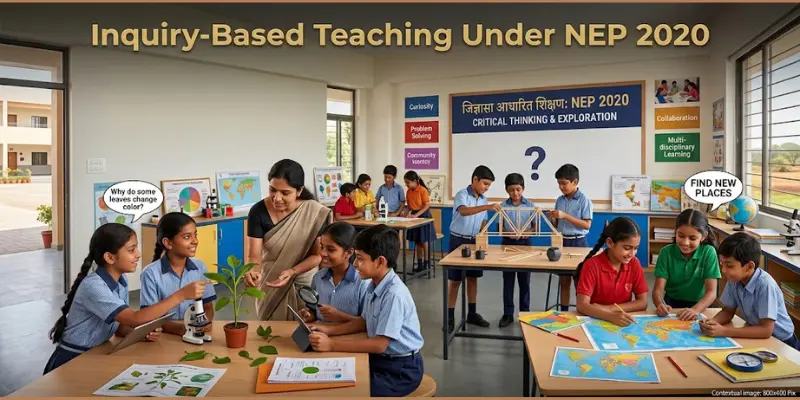
Inquiry-based learning is closely connected with the goal of developing curiosity and critical thinking.
Instead of presenting every answer immediately, teachers can begin with a question or problem.
For example:
Why does one material float while another sinks?
Why does a particular historical event have different interpretations?
How does household electricity consumption change during different seasons?
Why do plants grow differently under different conditions?
Students can predict, investigate, compare information, discuss evidence, and develop explanations.
The teacher guides the process and corrects misconceptions when required.
This approach supports the development of questioning, reasoning, evidence-based thinking, and independent learning.
How NEP 2020 Changes Lesson Planning
From content planning to learning design
Lesson planning becomes an important area affected by How NEP 2020 Changes Teaching Methods.
A conventional lesson plan may focus heavily on the topic to be covered. A competency-oriented lesson plan can begin with what students should understand or demonstrate by the end of the lesson.
A teacher can structure a lesson around:
Learning objective
What should students know, understand, or demonstrate?
Prior knowledge
What do students already know about the topic?
Learning activity
What experience will help students develop the intended competency?
Questioning
What questions can reveal student understanding?
Practice
How will students apply the concept?
Assessment
What evidence will show that learning has occurred?
Reflection
What did students understand, find difficult, or discover?
This planning structure connects teaching activities with measurable learning.
EducationBeacon’s article on NEP 2020 Learning Outcomes provides additional information about how learning outcomes can guide classroom activities and evidence of learning.
Role of the Teacher Is Changing
From information provider to learning facilitator
The teacher remains an essential part of the classroom under NEP 2020. The role becomes broader.
A teacher may function as:
- Subject expert
- Learning facilitator
- Mentor
- Discussion leader
- Activity designer
- Assessment practitioner
- Digital learning guide
- Inclusive educator
- Reflective practitioner
This does not mean teachers stop explaining concepts. Direct teaching remains useful when students need clear instruction.
The change concerns the balance between teacher explanation and student participation.
A 40-minute lesson does not need to become a 40-minute lecture. It can include a short explanation, guided questioning, collaborative activity, independent application, and a brief assessment.
EducationBeacon’s NEP 2020 for Teachers covers the broader responsibilities of educators under the policy.
Formative Assessment Becomes More Important
Assessment during learning
Assessment is another major area in How NEP 2020 Changes Teaching Methods.
Teachers can use assessment not only after completing a unit but during the learning process.
Formative assessment can include:
- Classroom questions
- Short quizzes
- Exit tickets
- Observation
- Student discussions
- Practical demonstrations
- Projects
- Portfolios
- Presentations
- Peer assessment
- Self-assessment
- Short written responses
The teacher uses the evidence to identify learning gaps.
If students cannot explain a concept, the teacher can change the instructional approach. If most students demonstrate understanding, the teacher can move toward application or more advanced tasks.
NEP 2020’s assessment framework supports competency, portfolio, rubric, and assessment-analytics approaches.
Technology-Supported Teaching
Digital tools as teaching resources
Technology is another important part of How NEP 2020 Changes Teaching Methods.
Digital resources can provide videos, simulations, interactive activities, online assignments, digital textbooks, virtual laboratories, educational applications, and collaborative learning opportunities.
Technology should serve a learning objective rather than become the objective itself.
A teacher can use an animation to explain a difficult scientific process. A simulation can help students explore a mathematical or scientific concept. An online quiz can provide quick feedback. A digital presentation can help students communicate research findings.
NEP 2020 recognises blended learning and the importance of combining digital opportunities with face-to-face education.
CBSE has documented teacher training initiatives involving competency-based education, experiential learning, digital resources, and online professional development.

Multilingual and Bilingual Teaching Approaches
Supporting language diversity
NEP 2020 gives significant attention to language in school education.
The policy states that, wherever possible, the medium of instruction should be the home language, mother tongue, local language, or regional language until at least Grade 5 and preferably beyond Grade 8. It encourages bilingual approaches when appropriate. NEP 2020 language provisions
This has implications for classroom teaching methods.
Teachers can use:
- Bilingual explanations
- Local examples
- Visual resources
- Vocabulary support
- Student discussion
- Multilingual learning materials
- Peer explanation
- Context-based activities
The objective is to improve comprehension while respecting the linguistic backgrounds of learners.
Language-sensitive teaching can be particularly relevant when students understand a concept but struggle to express it in the language used for classroom instruction.
Inclusive Teaching Methods Under NEP 2020
Teaching diverse learners
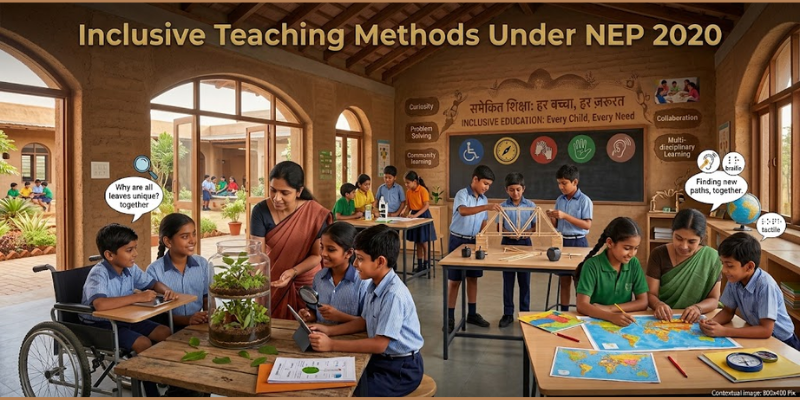
A classroom may contain students with different abilities, learning speeds, languages, interests, socioeconomic backgrounds, and learning needs.
NEP 2020 places importance on inclusion and equitable access to education.
Teaching methods can respond through:
- Flexible grouping
- Differentiated tasks
- Multiple forms of explanation
- Visual and practical resources
- Additional practice
- Accessible learning materials
- Peer support
- Individual feedback
- Varied assessment formats
Differentiated teaching does not mean creating an entirely separate lesson for every student. Teachers can provide different levels of support within the same learning objective.
For example, one group may receive guided questions while another group works independently on an application-based task.
Arts-Integrated and Sports-Integrated Learning
Connecting subjects with activities
NEP 2020 encourages approaches that make learning more engaging and connected to different forms of experience.
Arts-integrated learning can help students explore concepts through drawing, music, drama, storytelling, design, or creative expression.
Sports-integrated learning can connect physical activities with mathematics, science, health, teamwork, measurement, and data interpretation.
These approaches can make abstract concepts easier to explore.
A mathematics class can use sports statistics to teach averages and percentages. A language class can use drama to develop communication. A science class can use drawing and model-making to represent complex structures.
The method should remain connected to the intended learning outcome.
Critical Thinking and Problem-Solving
Teaching students how to think
A major goal of How NEP 2020 Changes Teaching Methods is greater attention to higher-order thinking.
Students can be asked to compare, classify, evaluate, justify, design, predict, investigate, and solve.
A teacher can replace a simple recall question with an application-based question.
Instead of asking students to list causes of pollution, the teacher might present a local pollution scenario and ask students to identify causes, analyse available evidence, and propose practical solutions.
The answer becomes less important than the reasoning used to reach it.
This approach supports critical thinking while keeping subject knowledge central.
Teacher Professional Development Under NEP 2020
Continuous development of teaching skills
Changes in teaching methods require teachers to continue developing their professional knowledge.
NEP 2020 places emphasis on continuous professional development. NCERT’s CPD guidance connects teacher development with activity-based teaching, competency-based learning, assessment, reflection, research, digital resources, and twenty-first-century teaching skills. NCERT CPD guidelines
Professional development can cover:
- Competency-based pedagogy
- Experiential learning
- Assessment design
- Digital education
- Inclusive teaching
- Classroom management
- Subject-specific pedagogy
- Learning outcomes
- Multilingual education
- Artificial intelligence literacy
- Reflective teaching
The Department of Teacher Education at NCERT currently describes teacher education, professional development, research, innovation, and learner-centred education as important areas aligned with NEP 2020 and national curriculum frameworks. NCERT Department of Teacher Education
Practical Example of NEP 2020 Teaching Methods
A classroom lesson before and after the shift
Consider a science lesson about water conservation.
A content-heavy approach may involve:
Teacher explanation → textbook reading → notes → questions → examination.
A more competency-oriented lesson can involve:
Local water-use problem → student discussion → observation → data collection → group analysis → proposed solutions → presentation → teacher feedback → reflection.
The teacher remains responsible for accuracy, structure, guidance, and assessment.
Students become active participants.
The second approach can develop subject knowledge along with observation, communication, data interpretation, collaboration, problem-solving, and environmental awareness.
This example demonstrates How NEP 2020 Changes Teaching Methods at classroom level.
Challenges in Implementing New Teaching Methods
Implementation depends on classroom conditions
Changing teaching methods is not only a matter of policy.
Schools may differ in:
- Teacher availability
- Class size
- Infrastructure
- Digital access
- Learning materials
- Time available
- Teacher training
- Language environment
- Administrative support
- Assessment requirements
A teacher working with a large class may need different strategies from a teacher working with a small group.
Digital teaching may be difficult where reliable devices or connectivity are unavailable.
Project-based learning may require careful time management.
Experiential learning may require locally available materials rather than expensive equipment.
The practical implementation of NEP 2020 can therefore vary across schools and regions.
How Teachers Can Apply NEP 2020 Teaching Methods
Start with manageable classroom changes
Teachers do not need to redesign every lesson at once.
Practical steps include:
Define a learning outcome
Identify what students should understand or demonstrate.
Add one active learning task
Use a question, investigation, discussion, demonstration, or short project.
Use real-life examples
Connect subject concepts with situations students recognise.
Ask application-based questions
Move beyond questions that require only recall.
Use formative assessment
Check understanding during the lesson.
Give students opportunities to explain
Student explanations can reveal misconceptions and depth of understanding.
Use technology when it adds value
Select digital tools because they improve learning, not simply because they are available.
Reflect after the lesson
Identify what worked, what students found difficult, and what can be changed in the next lesson.
These steps make How NEP 2020 Changes Teaching Methods practical for everyday classroom teaching.
NEP 2020 Teaching Methods and Student Learning Outcomes
Teaching methods should remain connected with learning outcomes.
A learning outcome provides a clear indication of what students should achieve. The teacher can select classroom activities according to that intended outcome.
For example, an outcome related to communication may require speaking or presentation. An outcome related to scientific investigation may require observation and experimentation. An outcome related to problem-solving may require an authentic task.
The assessment should provide evidence that the outcome has been achieved.
This connection creates a teaching cycle:
Learning outcome → Teaching activity → Student practice → Evidence → Feedback → Improvement.
The approach reduces the gap between what teachers teach and what students are expected to demonstrate.
Future of Teaching Methods After NEP 2020
A broader role for classroom pedagogy
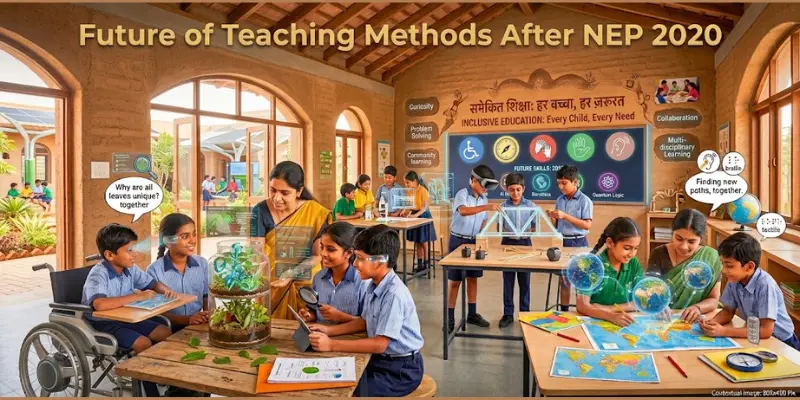
The teaching environment in India is continuing to develop around competency-based learning, digital resources, experiential pedagogy, inclusive education, professional development, multidisciplinary learning, and changing assessment practices.
The future classroom may contain a combination of direct instruction, collaborative learning, practical activities, digital resources, projects, discussion, individual practice, and formative assessment.
Technology will continue to influence teaching, but teachers will remain responsible for selecting suitable learning experiences, understanding student needs, interpreting evidence of learning, and providing human guidance.
EducationBeacon’s Future of Indian Education After NEP 2020 explores the broader changes affecting curriculum, pedagogy, technology, assessment, and teacher development.
Frequently Asked Questions
How does NEP 2020 change teaching methods?
NEP 2020 promotes learner-centred, competency-based, experiential, inquiry-oriented, inclusive, technology-supported, and multidisciplinary approaches. Teachers are encouraged to create learning experiences that develop understanding, application, critical thinking, creativity, communication, and problem-solving.
Does NEP 2020 eliminate traditional teaching methods?
No. Direct teaching and explanation remain useful. The policy expands classroom pedagogy by encouraging active participation, practical application, experiential learning, competency development, and varied assessment.
What is competency-based teaching under NEP 2020?
Competency-based teaching focuses on what students can demonstrate through knowledge, skills, application, reasoning, and other capabilities. Lessons and assessments are aligned with intended learning outcomes.
How does experiential learning support NEP 2020?
Experiential learning gives students opportunities to learn through activities, projects, investigations, practical experiences, reflection, and problem-solving. NCERT resources connect experiential learning with active engagement and competency-based learning.
How does NEP 2020 affect teachers?
Teachers are expected to facilitate learning, support diverse learners, use appropriate teaching and assessment strategies, integrate technology where useful, and participate in continuous professional development.
Does NEP 2020 promote digital teaching?
Yes. NEP 2020 recognises digital education and blended learning while recognising the continuing importance of face-to-face education.
Why is formative assessment important under NEP 2020?
Formative assessment gives teachers evidence of student understanding during learning. It can help identify learning gaps and guide subsequent instruction.
What teaching skills are important under NEP 2020?
Important areas include lesson planning, competency-based pedagogy, experiential learning, questioning, assessment, technology integration, inclusive teaching, communication, classroom management, and reflective practice.
Conclusion
How NEP 2020 Changes Teaching Methods is best understood as a shift in the way classroom learning is designed and experienced.
The policy places greater emphasis on conceptual understanding, competency development, experiential learning, inquiry, critical thinking, practical application, technology-supported education, multilingual approaches, inclusion, and continuous assessment.
Teachers remain the central part of this process. Their role extends beyond delivering textbook content to designing meaningful learning experiences, guiding students, assessing progress, providing feedback, supporting diverse learners, and continuing their own professional development.
The implementation of these teaching methods will depend on teacher preparation, school resources, classroom conditions, curriculum requirements, and local educational needs. NEP 2020 provides the policy direction; effective classroom practice depends on how that direction is translated into suitable learning experiences for students.




- Be Respectful
- Stay Relevant
- Stay Positive
- True Feedback
- Encourage Discussion
- Avoid Spamming
- No Fake News
- Don't Copy-Paste
- No Personal Attacks
- Be Respectful
- Stay Relevant
- Stay Positive
- True Feedback
- Encourage Discussion
- Avoid Spamming
- No Fake News
- Don't Copy-Paste
- No Personal Attacks
