Competency-Based Assessment Under NEP 2020: Meaning, Benefits, Methods & Implementation
Published: 8 Aug 2026
Introduction
The Indian education system is moving from traditional examination-focused learning toward an approach that measures what students can actually understand, apply and demonstrate. A major part of this transformation is Competency-Based Assessment Under NEP 2020, which places greater emphasis on students’ knowledge, skills, abilities and practical application rather than simple memorization.
The National Education Policy 2020 introduced a broader vision for improving the quality of school education in India. It encourages competency-based learning, formative assessment, experiential learning, critical thinking, problem-solving and holistic development. Assessment is therefore expected to become more continuous, learner-focused and aligned with clearly defined learning outcomes.
Under the traditional examination model, students may spend considerable time memorizing textbook information to perform well in tests. However, high marks do not always demonstrate whether a learner can apply knowledge to real-life situations. Competency-Based Assessment Under NEP 2020 addresses this gap by evaluating whether students can use concepts, skills and knowledge effectively.
This approach is particularly important as schools increasingly prepare students for academic progression, higher education, employment and real-world challenges. Instead of asking only what a student remembers, competency-based assessment can ask what the student understands, how the student applies it and whether the student can solve unfamiliar problems.
For teachers, parents and students, understanding this assessment model is important because it changes the role of examinations, classroom activities and feedback. It also requires schools to reconsider how they design questions, evaluate performance and identify learning gaps.
What Is Competency-Based Assessment Under NEP 2020?
Competency-Based Assessment Under NEP 2020 refers to an assessment approach that evaluates whether learners have developed specific competencies and learning outcomes expected at a particular stage of education. These competencies can include conceptual understanding, communication, critical thinking, creativity, collaboration, problem-solving and the ability to apply knowledge in practical contexts.
The central idea is that assessment should measure meaningful learning rather than memorization alone. A student who has memorized a definition may reproduce it in an examination, but competency-based assessment can require the student to explain the concept, apply it to a situation or use it to solve a problem.
This makes the assessment process more closely connected with learning objectives. If a curriculum expects students to develop analytical thinking, assessment should provide opportunities to demonstrate analytical thinking. If students are expected to apply mathematical concepts to everyday problems, assessment should include real-life problem-solving situations.
The approach is also connected with the broader NEP 2020 vision of reducing the importance of rote learning and encouraging conceptual understanding. Assessment becomes a tool for understanding student progress rather than simply assigning marks.
Why Did NEP 2020 Emphasize Competency-Based Assessment?
The emphasis on competency-based assessment reflects concerns about the limitations of an examination system that can encourage rote memorization. Conventional examinations often place significant importance on recalling information within a limited time.
NEP 2020 seeks a more comprehensive educational experience in which students develop knowledge alongside skills and attitudes. The policy emphasizes conceptual understanding, critical thinking, creativity, communication and problem-solving.
An effective assessment system must therefore measure these capabilities.
For example, suppose students are learning about environmental pollution. A conventional question might ask them to define air pollution and list its causes. A competency-based question could provide information about pollution levels in a city and ask students to identify possible causes, interpret the information and recommend practical solutions.
Both questions relate to the same subject, but the second requires students to use knowledge rather than simply reproduce it.
This is one of the most important changes associated with Competency-Based Assessment Under NEP 2020.
Key Features of Competency-Based Assessment
Competency-based assessment has several characteristics that distinguish it from traditional examination practices.
Focus On Learning Outcomes
Assessment begins with clearly defined learning outcomes. Teachers need to identify what students should know, understand or be able to do after completing a lesson, unit or course.
For example, a learning outcome in science might require students to explain how a particular process works and apply the concept to a practical situation.
The assessment should then provide evidence that the learner has achieved that outcome.
Emphasis On Application Of Knowledge
A major characteristic is the application of knowledge. Students may be asked to use concepts in unfamiliar situations rather than reproduce textbook answers.
This can make assessments more meaningful because students demonstrate whether their knowledge can be transferred beyond the exact examples discussed in class.
Assessment Of Skills
Competencies can include several skills beyond academic knowledge. Depending on the subject and grade level, these may include communication, reasoning, analysis, collaboration, creativity and problem-solving.
A competency-focused assessment can therefore use multiple forms of evidence rather than relying exclusively on written examinations.
Real-Life And Contextual Questions
Real-world situations can make assessment more relevant. Students may be presented with scenarios, case studies, data, diagrams, experiments or practical problems.
For example, a mathematics assessment could ask students to calculate expenses for a household budget instead of presenting only abstract numerical equations.
Continuous Feedback
Competency-based assessment is not limited to an annual or term-end examination. Formative assessment can provide information about student progress during the learning process.
Teachers can use this information to identify misconceptions and provide additional support before students move to more advanced concepts.
Holistic Evaluation
NEP 2020 promotes holistic development. Assessment can therefore consider different dimensions of learning rather than focusing exclusively on examination marks.
Academic knowledge remains important, but communication, creativity, critical thinking, social skills and practical application can also contribute to a broader picture of student development.
Competency-Based Assessment Vs Traditional Assessment
The difference between traditional assessment and competency-based assessment can be understood through their primary objectives.
Traditional assessment often focuses on whether students can recall and reproduce information. Competency-based assessment focuses more strongly on whether students understand concepts and can apply them appropriately.
For example, a traditional history question might ask students to identify the date of an important event. A competency-oriented question might provide historical information and ask students to analyze causes, consequences or relationships between events.
Traditional assessments can still have value. Basic factual knowledge is necessary for deeper learning. The important change is that factual recall should not become the only measure of learning.
Competency-Based Assessment Under NEP 2020 encourages a balance in which knowledge provides the foundation while students are also evaluated on how they use that knowledge.
Role Of Learning Outcomes In Competency-Based Assessment
Learning outcomes are central to competency-based education and assessment. They describe what learners should be able to demonstrate after completing a particular learning experience.
A well-written learning outcome should be sufficiently clear to guide both teaching and assessment.
For example, instead of stating that students will “understand fractions,” an outcome could indicate that students will be able to compare fractions, perform relevant calculations and apply fractions to everyday situations.
Once the expected competency is clearly defined, teachers can design activities and assessment tasks that generate evidence of learning.
This alignment between curriculum, teaching and assessment is essential. If classroom teaching focuses on conceptual understanding but examinations primarily test memorization, students may naturally prioritize memorization. Competency-based assessment attempts to bring teaching, learning and evaluation closer together.
Types Of Competencies Assessed Under NEP 2020
The competencies assessed can vary according to the subject, grade and learning objectives. However, several broad areas are particularly relevant.
- Conceptual Understanding
Students should understand the meaning behind concepts rather than simply memorize definitions. Assessment can require them to explain ideas in their own words, compare concepts or identify relationships.
Critical Thinking
Critical thinking involves examining information, identifying assumptions, evaluating evidence and reaching reasoned conclusions.
Competency-based questions can present students with information that requires interpretation rather than direct recall.
Problem-Solving
Problem-solving assesses whether students can identify a problem, select an appropriate approach and reach a reasonable solution.
This competency is particularly relevant in mathematics, science and real-world learning situations.
Communication
Students need to communicate ideas clearly through written, verbal or visual forms. Language assessments can evaluate comprehension, expression and interpretation, while other subjects can require students to explain their reasoning.
Creativity
Creativity involves producing original ideas, approaches or solutions. Open-ended tasks can provide opportunities for students to demonstrate creative thinking.
Collaboration
In appropriate learning environments, students can demonstrate their ability to work with others, share responsibilities and contribute constructively to group activities.
Application Of Knowledge
This competency determines whether students can transfer classroom learning to practical or unfamiliar situations.
Application is one of the strongest distinguishing characteristics of competency-focused assessment.
How Competency-Based Assessment Changes Classroom Learning
The assessment model influences what happens inside classrooms. When examinations primarily reward memorization, students and teachers may naturally dedicate substantial time to preparing for factual questions.
When assessment rewards application and reasoning, classroom learning can become more activity-oriented.
Teachers may use discussions, projects, experiments, case studies, demonstrations, problem-solving exercises and group activities. Students may be encouraged to explain why an answer is correct rather than simply provide the answer.
For example, instead of asking students to memorize scientific facts, a teacher might provide a practical situation and ask learners to predict an outcome based on the scientific principle they have studied.
This approach can make learning more interactive and can help teachers identify whether students have genuine conceptual understanding.
Role Of Teachers In Competency-Based Assessment
Teachers have a central role in implementing competency-based assessment. They need to understand the expected competencies and create appropriate opportunities for students to demonstrate them.
Assessment design is particularly important. A question may appear different from a conventional question but still measure simple recall. Teachers therefore need to consider the cognitive demand of each task.
Teachers can also use formative assessment to monitor learning throughout the academic year. Short classroom tasks, discussions, quizzes, observations, projects and practical activities can provide evidence of student progress.
Feedback is another important responsibility. Instead of simply informing students whether an answer is right or wrong, teachers can explain what was done well, identify the learning gap and suggest how the student can improve.
Professional development will therefore be important for successful implementation. Teachers need appropriate training in assessment design, rubrics, learning outcomes, formative assessment and competency-based pedagogy.
Role Of CBSE And Other Education Boards
School boards have an important role in supporting the shift toward competency-based assessment. Boards influence examination patterns, question-paper design, curriculum implementation and assessment guidelines.
In recent years, competency-oriented questions have become increasingly important in Indian school examinations, particularly through case-based questions, source-based questions, application-based questions and analytical tasks.
The broader direction is consistent with the objectives of NEP 2020: students should demonstrate understanding and application rather than depend exclusively on rote memorization.
Schools following different boards may implement these principles differently, but the underlying objective remains similar: assessment should provide meaningful evidence of learning.
Examples Of Competency-Based Assessment Questions
Understanding examples can make the concept easier.
In mathematics, instead of asking students to calculate a simple percentage, an assessment could present the price of a product before and after a discount and ask students to determine the effective percentage reduction.
In science, students could receive an observation from an experiment and be asked to explain the result using the relevant scientific principle.
In social science, students could be given a short source or data set and asked to interpret it, identify a trend and explain its possible causes.
In language education, students could read an unfamiliar passage and answer questions requiring inference, interpretation and evaluation rather than direct copying from the text.
These examples demonstrate how Competency-Based Assessment Under NEP 2020 can move assessment beyond simple factual recall.
Benefits Of Competency-Based Assessment For Students
One of the major benefits is that students are encouraged to understand concepts more deeply. They cannot always depend on memorized answers because assessment may require them to apply knowledge to new situations.
The approach can also support critical thinking and problem-solving. Students learn to examine information, identify relevant facts and develop solutions.
Another benefit is improved awareness of individual learning gaps. Formative assessment can help teachers determine which competencies students have developed and where additional instruction is required.
Competency-based assessment can also make education more relevant to everyday life. When students encounter practical scenarios in assessments, they can see how classroom knowledge connects with situations outside school.
The approach may further support long-term learning because students are encouraged to develop transferable skills instead of preparing only for a specific examination.
Benefits For Teachers And Schools
Teachers can gain a clearer understanding of student learning. Instead of relying entirely on marks, they can collect evidence about specific competencies.
Schools can use assessment information to identify broader learning trends. If many students struggle with a particular competency, school leaders can consider additional teacher training, instructional resources or changes in classroom strategies.
This creates an assessment cycle in which evidence leads to improvement.
Competency-based assessment can therefore become more than an examination reform. It can support a broader culture of continuous learning and improvement within schools.
How Parents Can Understand Competency-Based Assessment
Parents may initially find competency-based assessment unfamiliar, particularly if they are accustomed to judging academic progress primarily through marks and ranks.
A lower score on one traditional-style question does not necessarily provide a complete picture of a child’s learning. Parents should also consider whether the child can explain concepts, solve unfamiliar problems, communicate ideas and apply knowledge independently.
Parents can support this approach at home by asking children questions such as “Why do you think this happened?”, “How would you solve this problem differently?” or “Where can you use this concept in real life?”
Such conversations can encourage deeper understanding without turning every learning activity into an examination.
Importance Of Formative Assessment
Formative assessment is particularly important because competency development takes time. A final examination provides information at the end of a learning period, but formative assessment can provide information while learning is still taking place.
Teachers can use classroom questions, observations, short tasks, projects and discussions to identify misconceptions.
For example, if students can calculate an answer but cannot explain why the method works, the teacher has evidence of a conceptual gap. Instruction can then be adjusted before the next stage of learning.
This makes assessment part of the learning process rather than an activity that occurs only after teaching is completed.
Assessment Tools For Competency-Based Learning
Different tools can be used depending on the competency being assessed. Written tests remain useful, but they can be combined with other approaches.
Projects can evaluate research, creativity, planning and application. Practical activities can assess procedural skills. Presentations can provide evidence of communication and conceptual understanding.
Portfolios can document student work over time. Rubrics can help teachers evaluate performance against clearly defined criteria.
Case studies and scenario-based questions are particularly useful for assessing application and analytical thinking.
The appropriate tool depends on the learning outcome. There is no single assessment method that can accurately measure every competency.
Rubrics In Competency-Based Assessment
Rubrics can improve transparency by describing what different levels of performance look like.
For example, a presentation rubric might evaluate conceptual accuracy, organization, communication, use of evidence and ability to answer questions.
Instead of receiving only a numerical score, students can understand which aspects of their performance are strong and which require improvement.
Well-designed rubrics can also improve consistency among evaluators. This becomes particularly important when assessment involves projects, presentations or practical activities where subjective judgment can influence results.
Methods Of Competency-Based Assessment Under NEP 2020
The successful implementation of Competency-Based Assessment Under NEP 2020 requires schools to use different assessment methods according to the competency being measured. A single written examination cannot accurately evaluate every aspect of student learning.
Competency-based assessment can include written tests, practical activities, projects, portfolios, presentations, classroom observations, case studies, oral assessments, peer assessment and self-assessment. The objective is to collect sufficient evidence to determine whether students have achieved the expected learning outcomes.
The assessment method should match the competency. For example, a practical science skill is better evaluated through an experiment than through a multiple-choice question. Similarly, communication skills can be assessed through presentations, discussions or structured speaking activities.
Formative Assessment
Formative assessment is one of the most useful approaches for implementing competency-based learning. It takes place during the learning process and provides teachers with information about student progress.
A teacher may use short quizzes, classroom questions, worksheets, group discussions, observations or practical activities to determine whether students understand a concept.
The purpose is not simply to assign marks. The information should be used to improve learning.
For example, if students understand the definition of a mathematical concept but struggle to apply it to a real-world problem, the teacher can provide additional examples and practice activities.
This creates an ongoing cycle of teaching, assessment, feedback and improvement.
Summative Assessment
Summative assessment evaluates learning after a particular period, such as a term, semester or academic year. Under a competency-focused approach, summative examinations can still be used, but their design should reflect the competencies identified in the curriculum.
Instead of relying entirely on direct recall questions, examinations can include application-based, analytical, case-based and scenario-based questions.
A balanced examination can assess foundational knowledge while also determining whether students can interpret information, apply concepts and solve problems.
Diagnostic Assessment
Diagnostic assessment helps identify existing learning gaps before or during instruction.
For example, before beginning a new mathematics unit, a teacher can use a short diagnostic activity to determine whether students have mastered prerequisite concepts.
If several students lack the required foundation, the teacher can provide additional instruction before moving forward.
This approach is particularly valuable in competency-based education because advanced competencies often depend on previously developed knowledge and skills.
Project-Based Assessment
Projects can provide evidence of multiple competencies at the same time. Depending on the task, students may need to research information, analyze evidence, work with classmates, solve problems and present their findings.
For example, students studying water conservation could investigate local water-use patterns, collect information, identify problems and propose practical solutions.
A project of this type can assess research skills, environmental understanding, analytical thinking, collaboration and communication.
The project should have clear evaluation criteria so that students understand what is expected.
Portfolio Assessment
A portfolio is a collection of student work demonstrating progress over time. It can contain written assignments, project work, artwork, reflections, practical records or other evidence of learning.
Portfolio assessment can provide a broader picture than a single examination because it demonstrates development across a period.
Students can also reflect on their own work and identify areas in which they have improved.
Performance-Based Assessment
Performance-based assessment requires students to demonstrate a skill or competency through an activity.
For example, students may conduct a science experiment, deliver a presentation, perform a role-play, analyze a data set or demonstrate a practical procedure.
This type of assessment can be particularly useful when the learning outcome involves application rather than simple knowledge recall.
Designing Competency-Based Questions
Question-paper design is one of the most important aspects of Competency-Based Assessment Under NEP 2020.
A question should be designed around the intended learning outcome. Teachers should first identify what students are expected to demonstrate and then create a task that provides evidence of that competency.
For example, if the competency is “apply mathematical reasoning to everyday situations,” a direct definition question would not adequately measure it.
A better question could provide a realistic situation involving prices, discounts, savings or measurements and require students to calculate, interpret and explain their answer.
Case-Based Questions
Case-based questions provide students with a situation, passage, data set or problem and ask them to analyze it.
These questions can measure comprehension, application and reasoning.
For example, a science case could describe changes in the growth of plants under different environmental conditions. Students could then be asked to identify patterns, explain possible causes and predict outcomes.
Case-based assessment can make examinations more closely connected to practical situations.
Scenario-Based Questions
Scenario-based questions place students in a realistic situation and ask them to determine what should happen next.
Such questions are useful for assessing decision-making and application.
A social science question could present a community facing a specific environmental challenge and ask students to identify possible solutions while explaining the reasoning behind their recommendations.
Assertion And Reason Questions
Assertion-and-reason formats can test conceptual relationships when they are designed appropriately.
Students need to determine whether statements are correct and whether a logical relationship exists between them.
However, teachers should avoid using a particular question format simply because it appears competency-based. The actual cognitive demand of the question is more important than its format.
Data Interpretation Questions
Data interpretation is another useful method for assessing analytical skills.
Students can be given tables, graphs, charts or numerical information and asked to identify trends, compare values or draw conclusions.
This approach can be used across subjects. Mathematics and science can use numerical data, while geography, economics and social science can use demographic, environmental or socioeconomic information.
Bloom’s Taxonomy And Competency-Based Assessment
Bloom’s Taxonomy can help teachers consider the level of thinking required by an assessment task.
Remembering represents basic recall. Understanding involves explaining meaning. Applying requires the use of knowledge in a situation. Analyzing involves examining relationships and components. Evaluating requires judgment based on evidence, while creating involves developing something new.
Competency-based assessment does not eliminate questions at the remembering level. Foundational knowledge remains important.
However, a balanced assessment should provide sufficient opportunities for students to demonstrate higher-order thinking where appropriate.
For example, students may first need to remember a scientific principle, understand its meaning and then apply it to a new situation. A well-designed assessment can measure several levels of learning.
Aligning Curriculum, Teaching And Assessment
One of the most important principles is alignment.
If curriculum documents identify particular competencies but classroom instruction and examinations focus on something else, students may not develop the intended skills.
Curriculum objectives should therefore guide teaching activities, while assessment should provide evidence of those objectives.
For example, if a curriculum expects students to develop critical thinking, classroom activities should provide opportunities for analysis and evaluation. Assessment should then include tasks that allow students to demonstrate these abilities.
This alignment helps prevent a situation in which schools claim to use competency-based education while continuing to rely almost entirely on rote-learning examinations.
Steps For Implementing Competency-Based Assessment In Schools
Schools can approach implementation systematically rather than attempting to change every assessment practice immediately.
Identify Expected Competencies
The first step is to identify the competencies students are expected to develop at each grade and subject level.
Teachers should understand the learning outcomes before creating assessment activities.
Develop Assessment Criteria
Schools should define what successful performance looks like.
Criteria may include accuracy, conceptual understanding, reasoning, application, communication, creativity or other relevant dimensions.
Clear criteria help teachers evaluate students consistently.
Train Teachers
Teacher preparation is essential. Educators need practical training in designing competency-based questions, developing rubrics, conducting formative assessments and interpreting student performance.
Training should not focus only on theory. Teachers benefit from working with real examples and creating assessment tasks for their own subjects.
Introduce Varied Assessment Methods
Schools can gradually expand assessment beyond conventional written tests.
Projects, presentations, practical activities, portfolios and classroom observations can complement examinations.
Use Feedback For Improvement
Assessment results should be analyzed to identify learning gaps.
Students should receive feedback that explains what they have achieved and what they need to improve.
Review The Assessment System
Schools should periodically examine whether their assessments actually measure the intended competencies.
If an assessment continues to reward memorization almost exclusively, its design may need to be revised.
Role Of Technology In Competency-Based Assessment
Technology can support the implementation of competency-based assessment by making assessment more flexible and providing faster access to learning data.
Digital platforms can deliver quizzes, simulations, interactive exercises and adaptive assessments. Teachers can use digital records to monitor student responses and identify common areas of difficulty.
Online portfolios can also allow students to collect and present evidence of their learning.
Technology can be particularly useful for formative assessment because teachers can receive information about student performance during the learning process.
However, technology itself does not make an assessment competency-based. A digital question that tests simple memorization remains a recall-based question. The quality and purpose of the assessment remain more important than the delivery platform.
Artificial Intelligence And Future Assessment
Artificial intelligence can potentially support personalized assessment by analyzing patterns in student responses and identifying areas where additional practice may be required.
AI-based educational systems may generate different levels of questions, provide immediate feedback and help teachers analyze large amounts of assessment data.
However, schools need to consider accuracy, privacy, transparency and teacher oversight when using AI-supported educational tools.
Human judgment remains important, particularly when assessing creativity, communication, collaboration and complex performance.
The future of Competency-Based Assessment Under NEP 2020 may therefore involve greater use of technology while maintaining teachers at the center of educational decision-making.
Rubrics And Competency-Based Evaluation
Rubrics provide a structured way to evaluate student performance.
A rubric can describe several levels of achievement for specific criteria. For example, a project rubric could evaluate:
- Conceptual understanding
- Accuracy of information
- Application of knowledge
- Problem-solving
- Creativity
- Communication
- Collaboration
- Quality of presentation
The criteria should be directly related to the learning outcome.
Rubrics can also help students understand assessment expectations before they begin an assignment. This encourages greater responsibility for learning.
Peer Assessment
Peer assessment allows students to evaluate each other’s work using established criteria.
When properly guided, peer assessment can develop critical thinking because students need to compare work against defined expectations.
For example, students preparing presentations can review each other’s organization, clarity and use of evidence.
Peer assessment should not replace teacher evaluation, particularly when high-stakes decisions are involved. Instead, it can complement teacher feedback and provide students with another perspective on their performance.
Self-Assessment
Self-assessment encourages students to reflect on their own learning.
Students can ask themselves whether they understand a concept, whether they can apply it independently and which areas require additional practice.
Reflection can be incorporated into projects, portfolios or classroom activities.
This is consistent with the broader goal of developing independent learners who understand their strengths and learning needs.
Challenges Of Competency-Based Assessment Under NEP 2020
Despite its potential benefits, implementing Competency-Based Assessment Under NEP 2020 can create practical challenges.
Teacher Workload
Designing high-quality competency-based assessments can require more time than creating conventional recall-based questions.
Teachers may need to develop scenarios, rubrics, projects and performance tasks.
Schools should therefore provide appropriate planning time and professional support.
Lack Of Teacher Training
Some educators may be familiar with traditional examination systems but have limited experience with competency-based assessment.
Without sufficient training, teachers may create questions that look different but still measure simple recall.
Continuous professional development is therefore essential.
Large Class Sizes
Large classrooms can make individual assessment, observation and feedback difficult.
Teachers may struggle to evaluate practical activities and projects for every student within available time.
Schools may need structured rubrics, group activities and appropriate digital tools to manage assessment efficiently.
Resource Limitations
Some schools may have limited access to laboratories, technology, internet connectivity or other resources required for certain assessment activities.
Implementation strategies should therefore be adaptable to different school contexts.
Competency-based assessment should not depend entirely on expensive technology or sophisticated infrastructure.
Standardization
Assessing open-ended tasks can create concerns about consistency.
Different teachers may evaluate similar responses differently.
Clear rubrics, assessment guidelines, teacher moderation and training can help improve consistency.
Examination Pressure
Parents and students may continue to focus heavily on marks, ranks and examination results.
Changing this mindset requires communication about why competency development matters.
Students need to understand that the purpose of assessment is not merely to obtain marks but to demonstrate meaningful learning.
Challenges For Students
Students accustomed to memorization may initially find competency-based questions difficult.
A question requiring interpretation or application may appear unfamiliar even when the underlying concept has already been taught.
Students therefore need regular exposure to different question types rather than encountering competency-based questions only in major examinations.
Teachers can gradually introduce application-based tasks so that students develop confidence.
Challenges For Parents
Parents may also need greater awareness of the new assessment approach.
A child may know the correct answer but struggle to explain the reasoning behind it. Conversely, a student may demonstrate strong reasoning even if a particular response contains a minor factual error.
Parents should therefore look beyond marks and consider the broader development of knowledge, skills and understanding.
Schools can support parents through orientation sessions, assessment reports and clear explanations of learning outcomes.
Measuring Student Progress Through Competencies
Competency-based evaluation requires schools to track progress over time.
Instead of recording only marks, teachers can maintain information about specific competencies.
For example, a student may demonstrate strong conceptual understanding but require support with written communication. Another student may communicate effectively but need additional help with analytical reasoning.
This type of information can make intervention more targeted.
It also allows teachers to distinguish between different reasons for low performance. A low examination score does not necessarily indicate the same learning problem for every student.
Importance Of Feedback In Competency-Based Assessment
Feedback is one of the most valuable outputs of assessment.
Effective feedback should be specific and actionable. Instead of simply stating “improve your answer,” a teacher might explain that the student correctly identified the main concept but needs to provide evidence to support the conclusion.
Such feedback tells students what they did well, what remains incomplete and how they can improve.
Feedback can also be provided during learning rather than only after final examinations.
This makes assessment a mechanism for improvement rather than merely a method of ranking students.
How Schools Can Make Assessment More Student-Centered
A student-centered assessment system gives learners opportunities to demonstrate understanding in different ways.
Schools can combine written examinations with projects, practical activities, presentations, portfolios and classroom tasks.
Students can also receive opportunities to reflect on their work and set learning goals.
The purpose is not to reduce academic standards. Instead, it is to measure learning more comprehensively.
High-quality competency-based assessment should remain rigorous while giving students meaningful opportunities to demonstrate what they know and can do.
Practical Implementation Of Competency-Based Assessment Under NEP 2020
The practical implementation of Competency-Based Assessment Under NEP 2020 requires schools to connect learning outcomes, classroom instruction and assessment activities. The objective is not simply to replace one examination format with another. It is to create an assessment system that provides reliable evidence of what students know, understand and can apply.
Schools can begin by reviewing existing assessments and identifying how much of the current examination system measures memorization compared with application, reasoning and problem-solving. Teachers can then redesign selected questions and activities to measure specific competencies.
A practical implementation model can involve four key stages: identifying competencies, designing learning activities, collecting assessment evidence and providing feedback.
For example, if students are expected to develop environmental problem-solving skills, the teacher can introduce a local environmental issue, allow students to investigate the problem, ask them to analyze available information and evaluate their proposed solutions. The final assessment can consider research, reasoning, application and communication.
This approach makes the assessment directly connected with the learning objective.
Competency-Based Assessment Examples Across Subjects
The application of competency-based assessment differs from subject to subject because each discipline has different learning outcomes.
In mathematics, students can be asked to solve practical problems involving budgeting, measurements, percentages, data interpretation or financial decisions. The assessment can evaluate whether students select an appropriate method and explain their reasoning.
In science, students can interpret experimental results, identify relationships between variables, predict outcomes or design solutions to practical problems.
In social science, learners can analyze historical sources, interpret demographic data, evaluate social issues or compare different perspectives.
In language subjects, students can demonstrate comprehension, inference, communication, interpretation and creative expression.
In computer science, students can be assessed through programming tasks, debugging exercises, logical reasoning and practical applications.
These examples show that competency-based assessment is not restricted to one particular subject or examination format.
Competency-Based Assessment In Primary Education
At the primary level, assessment should be age-appropriate and developmentally suitable. Young learners may demonstrate competencies through classroom activities, oral responses, drawings, simple projects, practical tasks and observation.
For example, instead of asking a child to memorize a definition of healthy food, a teacher might provide pictures of different foods and ask the child to classify them and explain which choices support a healthy lifestyle.
In mathematics, students can demonstrate numerical understanding by solving simple problems involving money, time, measurements or everyday objects.
Assessment at this stage should avoid unnecessary examination pressure while providing useful evidence about learning progress.
The objective is to establish strong foundational competencies that can support more complex learning in later grades.
Competency-Based Assessment In Secondary Education
Secondary education requires more sophisticated assessment because students are expected to demonstrate increasingly complex knowledge and skills.
Students can be given case studies, data interpretation tasks, practical experiments, research projects and analytical questions.
For example, a secondary science assessment can provide experimental observations and ask students to interpret the results, identify possible errors and suggest improvements.
In social science, students can analyze a source, compare viewpoints and develop evidence-based conclusions.
Such activities can prepare students for higher education and professional environments where the ability to analyze and apply information is often more important than memorizing isolated facts.
Competency-Based Assessment For Board Examinations
Board examinations have significant influence over teaching and learning practices in schools. When board assessments include greater proportions of competency-oriented questions, schools are encouraged to prepare students for understanding and application.
However, students should not approach competency-based board questions as completely unrelated to their textbooks.
A strong understanding of concepts remains the foundation. Students need to understand the subject thoroughly and then practice applying that knowledge to unfamiliar situations.
Preparation should therefore include textbook concepts, examples, case-based questions, data interpretation, analytical questions and practice scenarios.
Students should also learn to read questions carefully because competency-based questions may contain information that must be interpreted before an answer can be developed.
How Students Can Prepare For Competency-Based Assessment
Students can improve their performance by changing the way they study.
Instead of memorizing an answer word-for-word, students should first understand the concept and then try to explain it independently.
After learning a topic, students can ask themselves:
What does this concept mean?
Why does it happen?
How does it work?
Where can it be applied?
What would happen if the situation changed?
Can I explain it using my own example?
These questions encourage deeper understanding.
Students should also practice unfamiliar problems rather than repeatedly solving only questions they have already seen.
Study Strategies For Competency-Based Questions
One useful strategy is to practice application immediately after learning a concept.
For example, after studying percentages, students can solve problems involving discounts, taxes, savings or price changes.
After learning a scientific principle, students can identify examples of that principle in everyday life.
Students should also practice explaining their reasoning. In many competency-based questions, reaching the correct answer is important, but demonstrating how the answer was obtained can provide evidence of understanding.
Reading comprehension is equally important because case-based and scenario-based questions may contain substantial information.
Students should identify the key facts, understand what the question requires and then select the relevant information.
Role Of Parents In Supporting Competency Development
Parents can support competency development without turning the home environment into another examination center.
Everyday activities can provide opportunities for learning. Shopping can involve calculations and budgeting. Cooking can introduce measurements and ratios. News discussions can encourage critical thinking and interpretation. Planning a trip can involve geography, mathematics and decision-making.
Parents can ask children to explain their reasoning rather than immediately providing answers.
For example, instead of asking only “What is the answer?”, parents can ask “How did you reach that answer?”
This encourages children to think about the process of learning.
Role Of School Leadership
School leadership plays an important role in creating an environment that supports competency-based assessment.
Principals and academic coordinators can provide teachers with planning time, professional development and assessment resources.
Schools can also establish common assessment guidelines so that teachers across different classes follow broadly consistent principles.
Academic leaders should review whether assessments are actually measuring the competencies identified in the curriculum.
Data from assessments can be used to identify common learning gaps and determine where additional academic support is required.
Creating An Assessment Culture
Successful implementation requires a cultural shift.
Assessment should not be viewed exclusively as a mechanism for ranking students. It should also help students understand their progress and help teachers improve instruction.
Students should feel that mistakes are opportunities for learning rather than simply reasons for losing marks.
Teachers can encourage this culture by discussing common errors, allowing students to revise selected work and providing constructive feedback.
When students understand that assessment is part of learning, they may become more willing to attempt challenging problems.
Competency-Based Assessment And Holistic Development
One of the broader objectives of NEP 2020 is holistic development. Education is expected to contribute to intellectual, social, emotional, creative and practical development.
A competency-focused assessment system can support this objective when it evaluates a broader range of abilities.
Academic competencies remain essential, but students also need communication, collaboration, creativity, critical thinking and problem-solving abilities.
These competencies are relevant beyond school examinations. They can support higher education, employment, entrepreneurship and everyday decision-making.
Competency-Based Assessment And Experiential Learning
Experiential learning and competency-based assessment can complement each other.
When students learn through experiments, projects, field activities and real-world problems, teachers have opportunities to observe how learners apply knowledge.
For example, a school environmental project can involve identifying a local problem, collecting information, analyzing findings and presenting recommendations.
The final evaluation can measure several competencies at once.
This creates a direct connection between learning experience and assessment evidence.
Competency-Based Assessment And Inclusive Education
Assessment should also consider the diverse learning needs of students.
A single assessment format may not provide every learner with an equal opportunity to demonstrate understanding.
Schools may need appropriate accommodations and flexible assessment practices for students who require additional support, while maintaining the intended learning outcomes.
The focus should remain on measuring the relevant competency rather than creating unnecessary barriers unrelated to the learning objective.
Inclusive assessment requires careful planning, teacher awareness and appropriate institutional support.
Importance Of Authentic Assessment
Authentic assessment attempts to evaluate students through tasks that resemble meaningful real-world activities.
Instead of asking only theoretical questions, students may be required to analyze a practical problem, create a solution, communicate a recommendation or complete a realistic task.
Authentic assessment can demonstrate whether students can transfer learning beyond the classroom.
For example, a financial literacy task could ask students to create a simple monthly budget based on a hypothetical income and expenses.
The assessment can evaluate calculations, decision-making, reasoning and communication simultaneously.
Assessment Data And Learning Improvement
Assessment generates valuable information when schools use it correctly.
Teachers can analyze patterns in student responses to identify concepts that require additional instruction.
Suppose most students answer a factual question correctly but perform poorly on an application-based question involving the same concept. This may indicate that students have memorized the information without developing sufficient conceptual understanding.
The teacher can then modify instruction and provide additional application-based practice.
This makes assessment data useful for instructional improvement rather than simply record keeping.
Future Of Competency-Based Assessment In India
The future of Competency-Based Assessment Under NEP 2020 is likely to involve greater emphasis on learning outcomes, application, higher-order thinking and continuous evaluation.
Digital assessment platforms may make it easier to collect and analyze learning evidence. Simulations and interactive tasks can provide new ways to evaluate practical understanding.
However, technological development should complement sound educational principles.
The quality of an assessment will continue to depend on whether it measures the intended competency accurately and fairly.
Teacher expertise will remain essential because educational judgment involves understanding students, contexts and learning needs.
How Competency-Based Assessment Can Improve Employability Skills
The relevance of competency-based education extends beyond school examinations.
Employers often value skills such as communication, problem-solving, teamwork, adaptability and analytical thinking. These abilities cannot always be measured through traditional memory-based examinations.
When students regularly practice applying knowledge, solving unfamiliar problems and communicating their reasoning, they may develop skills that remain useful in higher education and professional environments.
This does not mean that school assessments should become employment tests. Rather, it highlights the importance of developing transferable competencies alongside academic knowledge.
Difference Between Competency, Skill And Knowledge
Understanding these terms is useful when discussing Competency-Based Assessment Under NEP 2020.
Knowledge refers to information and concepts that a learner understands.
A skill refers to the ability to perform a particular task.
Competency is broader. It can involve knowledge, skills and the ability to apply them appropriately in a particular context.
For example, knowing the rules of grammar represents knowledge. Writing an accurate sentence demonstrates a skill. Communicating effectively in different situations involves a broader competency.
Competency-based assessment therefore considers whether students can integrate what they know and use it effectively.
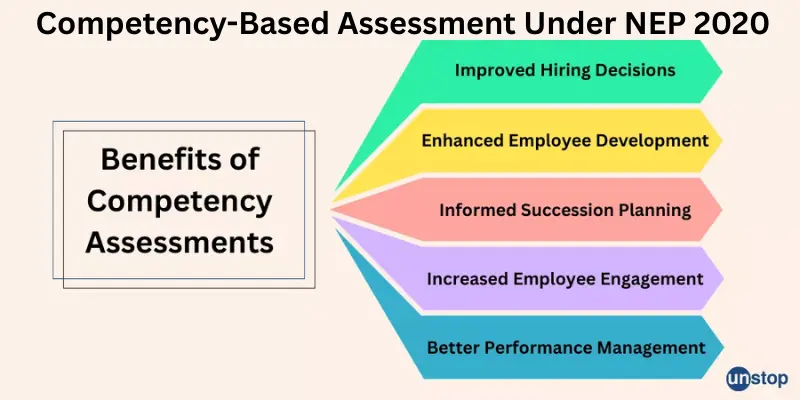
Key Benefits Of Competency-Based Assessment Under NEP 2020
The major benefits include deeper conceptual understanding, stronger problem-solving abilities, greater application of knowledge and improved critical thinking.
It can also provide teachers with more detailed information about student learning.
For students, the approach can make learning more meaningful because assessment tasks can relate to real-world situations.
For parents, competency-based evaluation can provide a broader view of educational progress.
For schools, assessment data can support curriculum planning and targeted interventions.
At the system level, it supports the broader NEP 2020 objective of reducing excessive dependence on rote learning and encouraging holistic educational development.
What Schools Should Avoid During Implementation
Schools should avoid treating competency-based assessment as simply a change in question-paper terminology.
Adding words such as “analyze,” “evaluate” or “apply” does not automatically make a question competency-based.
The actual task must require the intended thinking process.
Schools should also avoid excessive assessment. More tests do not necessarily mean better assessment.
The focus should be on collecting meaningful evidence of learning.
Another issue is using projects without clear criteria. Projects should have defined objectives and assessment standards so that evaluation remains fair.
Schools should also avoid making technology a requirement when the same competency can be assessed effectively through simpler methods.
A Practical School-Level Framework
A school can develop a practical framework based on the following sequence:
Identify: Determine the competency and learning outcome.
Teach: Provide appropriate instruction and learning experiences.
Practice: Give students opportunities to apply the concept.
Assess: Collect evidence through suitable assessment methods.
Analyze: Identify strengths and learning gaps.
Feedback: Explain what students have achieved and what needs improvement.
Improve: Modify instruction or provide additional practice.
Reassess: Determine whether the competency has improved.
This cycle helps make assessment an integral part of education.
Frequently Asked Questions
What Is Competency-Based Assessment Under NEP 2020?
Competency-Based Assessment Under NEP 2020 is an approach that evaluates students according to their ability to demonstrate expected knowledge, skills, understanding and application. It gives greater importance to meaningful learning, problem-solving, critical thinking and practical application rather than relying only on memorization.
How Is Competency-Based Assessment Different From Traditional Assessment?
Traditional assessment often emphasizes recalling and reproducing information. Competency-based assessment places greater emphasis on understanding, application, analysis and problem-solving. It can use case studies, projects, practical activities, scenario-based questions and other assessment methods.
What Are Examples Of Competency-Based Questions?
Examples include case-based questions, real-life mathematical problems, data interpretation tasks, scientific scenarios, source-based questions and practical problem-solving activities. The exact format depends on the learning outcome and subject.
Why Is Competency-Based Assessment Important Under NEP 2020?
It supports the broader goal of developing students who can understand concepts, apply knowledge, think critically and solve problems. It also helps shift education away from excessive dependence on rote memorization.
What Is The Role Of Teachers In Competency-Based Assessment?
Teachers identify learning outcomes, design appropriate assessment tasks, observe student performance, provide feedback and use assessment evidence to improve instruction. Teacher training is therefore important for successful implementation.
How Can Students Prepare For Competency-Based Assessment?
Students should focus on conceptual understanding rather than memorizing answers. They should practice unfamiliar problems, case studies, application-based questions and situations that require them to explain their reasoning.
Conclusion
Competency-Based Assessment Under NEP 2020 represents an important shift in how student learning can be understood and evaluated in Indian education. Instead of considering marks and factual recall as the only evidence of achievement, the approach emphasizes what students understand, what they can do and how effectively they can apply their learning.
The success of this approach depends on more than changing examination questions. Curriculum, teaching methods, classroom activities, assessment tools, teacher training and feedback practices need to work together.
Schools can use formative assessment, projects, portfolios, practical activities, case studies, scenario-based questions and performance tasks to collect evidence of different competencies. Teachers can use this evidence to identify learning gaps and provide targeted support.
Students can benefit by developing deeper understanding, critical thinking, problem-solving and application skills. Parents can support the process by focusing on learning and reasoning rather than marks alone. Schools can use assessment data to improve teaching and academic planning.
The long-term value of Competency-Based Assessment Under NEP 2020 lies in creating learners who are not only able to remember information but can understand it, apply it, analyze it and use it to address unfamiliar problems. This aligns assessment more closely with the broader purpose of education: preparing students for continued learning, higher education, professional life and real-world decision-making.
Competency-Based Education Under NEP 2020: Meaning, Benefits, Assessment & Implementation




- Be Respectful
- Stay Relevant
- Stay Positive
- True Feedback
- Encourage Discussion
- Avoid Spamming
- No Fake News
- Don't Copy-Paste
- No Personal Attacks
- Be Respectful
- Stay Relevant
- Stay Positive
- True Feedback
- Encourage Discussion
- Avoid Spamming
- No Fake News
- Don't Copy-Paste
- No Personal Attacks
