Experiential Learning Under NEP 2020: Meaning, Benefits, Examples & Implementation
Published: 1 Sep 2026
Experiential Learning Under NEP 2020 represents an important shift in how students are expected to learn in Indian schools. Instead of depending mainly on lectures, textbooks, memorization, and written examinations, experiential learning gives students opportunities to learn through activities, observation, experimentation, projects, discussion, reflection, and real-world experiences.
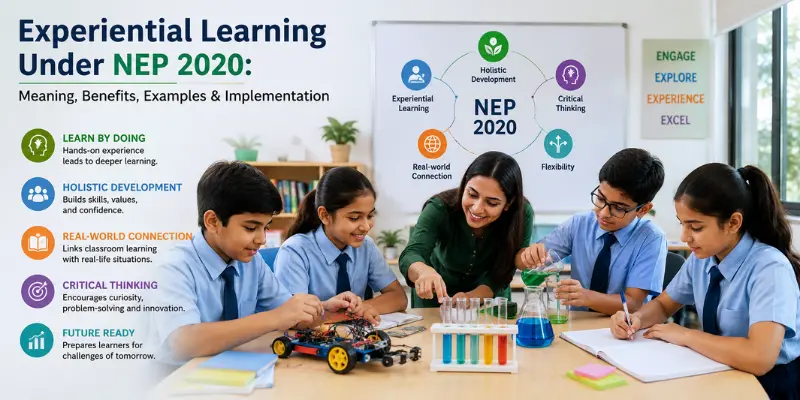
The National Education Policy 2020 places strong emphasis on experiential and activity-based pedagogy. Para 4.6 of NEP 2020 states that experiential learning should be adopted across educational stages and includes hands-on learning, arts-integrated education, sports-integrated education, storytelling-based pedagogy, and connections between different subjects.
This approach changes the role of both students and teachers. Students become active participants in the learning process. Teachers become facilitators who design meaningful experiences, guide investigation, ask questions, provide feedback, and help students connect practical experiences with academic concepts.
For educators, parents, and students, understanding Experiential Learning Under NEP 2020 is useful because the approach connects classroom knowledge with practical application. It can support conceptual understanding, creativity, communication, collaboration, problem-solving, critical thinking, and other competencies that NEP 2020 seeks to develop.
What Is Experiential Learning?
Experiential learning is a teaching and learning approach in which students gain knowledge and skills through direct or structured experiences.
The basic idea is often described as learning by doing.
A student does not only read about a scientific process. The student may perform an experiment, observe the result, record findings, discuss what happened, and explain the concept.
A mathematics student does not only memorize a formula. The student may use measurements, budgeting, data collection, patterns, or real-life calculations to understand how the concept works.
A social science student does not only read about a community. The student may conduct a local survey, interview people, examine historical material, or study a community issue.
The experience becomes part of the learning process.
The Central Board of Secondary Education describes experiential pedagogy as a way of connecting curricular knowledge with wider real-world contexts and encouraging constructive, experiential, cooperative, and collaborative learning.
Learning Through Experience
Experiential learning can include:
- Hands-on activities
- Science experiments
- Educational projects
- Field visits
- Community-based activities
- Surveys
- Case studies
- Role-playing
- Simulations
- Storytelling
- Art-integrated activities
- Sports-integrated learning
- Group investigations
- Practical demonstrations
- Problem-solving activities
- Reflective activities
The activity itself is not the complete learning process.
Students need opportunities to think about what they experienced, connect the experience with concepts, and apply what they learned to another situation.
Experiential Learning Under NEP 2020
Experiential Learning Under NEP 2020 is connected with the policy’s broader goal of making education more holistic, learner-centered, practical, and competency-focused.
NEP 2020 does not present experiential learning as a single classroom technique. It connects experiential approaches with hands-on learning, arts integration, sports integration, storytelling, multidisciplinary learning, and practical engagement.
The Government of India’s implementation information also identifies experiential learning pedagogy under NEP Para 4.6. CBSE has developed experiential learning resources and training initiatives to support schools and teachers.
The approach can be used across different educational stages, with activities adapted to students’ age, subject, learning objectives, and developmental needs.
For a broader explanation of the policy, readers can explore Key Features of the National Education Policy 2020 Explained.
Why NEP 2020 Emphasizes Experiential Learning
Traditional learning can sometimes become heavily dependent on memorizing information.
Experiential learning creates opportunities for students to use information.
A student studying environmental science can investigate local waste management. A student learning mathematics can analyze household expenditure. A language learner can conduct interviews and prepare a presentation. A history student can examine local historical sites or oral histories.
The objective is not to remove textbooks or classroom teaching.
The objective is to create a stronger relationship between knowledge, experience, application, and reflection.
Key Principles of Experiential Learning Under NEP 2020
Experiential learning can be understood through several principles.
Learning by Doing
Students actively participate rather than simply listen.
A science experiment, practical demonstration, school garden, model-making activity, survey, or community project can turn an abstract concept into an observable experience.
Learning Through Observation
Observation helps students notice patterns, differences, causes, effects, and relationships.
Students can observe plants, weather conditions, local businesses, community activities, physical phenomena, or social behavior depending on the subject.
Learning Through Reflection
Reflection allows students to think about what happened and why it happened.
Students can write a short reflection, participate in a discussion, explain their observations, or compare the experience with previously learned concepts.
Learning Through Application
Students use knowledge in a new situation.
A mathematics concept learned in class can be applied to a budgeting exercise. A science concept can be used to explain an everyday phenomenon.
Learning Through Collaboration
Many experiential activities involve groups.
Students divide responsibilities, communicate, negotiate ideas, solve problems, and present results.
Collaboration can make the learning experience more socially meaningful.
Experiential Learning Examples Under NEP 2020
The practical examples of experiential learning vary according to subject and educational stage.
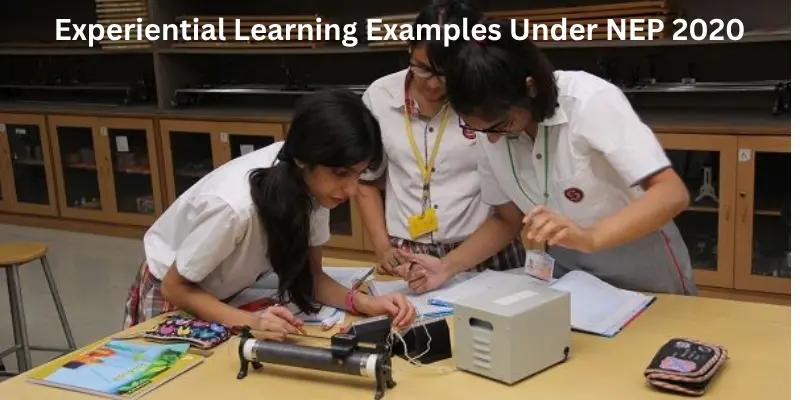
Science Experiments
Science is naturally suited to experiential learning.
Instead of explaining a scientific concept only through a textbook, teachers can design an experiment that allows students to observe the concept.
For example, students can investigate evaporation by observing water under different conditions.
They can record observations, compare results, discuss possible explanations, and connect their findings with scientific principles.
The teacher remains responsible for ensuring safety, accuracy, and appropriate interpretation.
Mathematics in Real-Life Situations
Mathematics can be connected with daily activities.
Students can calculate:
- Shopping costs
- Discounts
- Household budgets
- Measurements
- Travel distances
- Time differences
- Percentages
- Simple statistics
- Data collected from surveys
These activities demonstrate how mathematical concepts operate outside textbooks.
Social Science Community Projects
Social science students can investigate their local community.
A project could examine:
- Local occupations
- Water use
- Waste management
- Transportation
- Historical landmarks
- Local government services
- Community traditions
- Environmental concerns
Students can collect information, organize findings, analyze patterns, and present recommendations.
Language and Storytelling Activities
Storytelling is another experiential approach recognized within the NEP 2020 framework.
Students can:
- Create stories
- Interview community members
- Retell historical events
- Perform role-plays
- Prepare speeches
- Conduct group discussions
- Create classroom podcasts
- Write reflective journals
These activities can strengthen communication and creative expression.
Field Visits
Field visits allow students to observe real environments connected with classroom topics.
Possible destinations include:
- Museums
- Science centres
- Historical sites
- Farms
- Industries
- Libraries
- Government institutions
- Environmental sites
- Local businesses
- Community organizations
A field visit becomes more educational when students receive specific observation tasks rather than simply visiting a location.
Project-Based Learning
Project-based learning is one of the most practical forms of experiential education.
Students investigate a question or problem and produce an outcome.
A project may involve:
- Selecting a topic
- Defining a question
- Researching information
- Collecting data
- Working with peers
- Analysing findings
- Creating a product or presentation
- Reflecting on the process
Projects can combine multiple competencies.
Students may need research, writing, communication, mathematics, digital literacy, teamwork, and presentation skills within one project.
Experiential Learning and Competency-Based Education
Experiential learning and competency-based education are closely connected.
Competency-based education focuses on what students can understand, apply, demonstrate, analyze, create, and communicate.
Experiential activities provide opportunities for students to demonstrate these abilities.
For example, a student completing a community survey may demonstrate:
- Research skills
- Communication
- Data collection
- Data interpretation
- Teamwork
- Problem-solving
- Presentation skills
Education Beacon’s Competency-Based Education Under NEP 2020 explains how practical learning, application, communication, collaboration, and problem-solving support competency development.
The relationship can be summarized as:
Experience → Observation → Reflection → Understanding → Application → Competency
This makes experiential learning particularly relevant to the competency-focused direction of NEP 2020.
Experiential Learning and Assessment Under NEP 2020
Experiential learning also affects assessment.
A traditional test may measure whether a student remembers information.
An experiential task can measure whether a student can use information.
Assessment can include:
- Projects
- Presentations
- Practical demonstrations
- Portfolios
- Group tasks
- Research reports
- Observations
- Self-assessment
- Peer assessment
- Reflective writing
- Problem-solving activities
The assessment method should match the learning objective.
If students are expected to demonstrate practical skills, a purely memory-based examination may not provide enough evidence.
Education Beacon’s Competency-Based Assessment Under NEP 2020 covers assessment methods that focus on application, reasoning, skills, and demonstrated competencies.
Student Portfolios
Portfolios can document a student’s learning journey.
A portfolio may contain:
- Project reports
- Drawings
- Research notes
- Photographs
- Reflections
- Presentations
- Practical work
- Teacher feedback
- Self-assessment
CBSE’s teacher resources discuss documentation of experiential learning activities through student portfolios, particularly in relation to internal assessment.
Benefits of Experiential Learning Under NEP 2020
Experiential learning can provide several educational benefits when activities are well designed.
Better Conceptual Understanding
Students can understand concepts more deeply when they experience their practical application.
A learner who calculates a real budget may understand percentages more meaningfully than a learner who only solves isolated textbook questions.
Improved Student Engagement
Activities give students something to observe, discuss, investigate, create, or solve.
Active participation can make lessons more engaging.
Development of Critical Thinking
Students often need to interpret information, compare possibilities, identify problems, and explain results.
These activities support critical thinking.
Problem-Solving Skills
Real-world activities rarely have answers presented immediately.
Students may need to identify a problem, gather information, test ideas, and develop a solution.
Communication Skills
Experiential projects often require students to explain findings, present results, participate in discussions, and communicate with teammates.
Collaboration
Group activities can develop teamwork.
Students learn how to divide responsibilities, listen to others, resolve disagreements, and work toward a shared outcome.
Creativity
Open-ended projects can allow students to design, create, experiment, and present ideas in different ways.
Better Connection Between School and Real Life
Experiential learning connects academic knowledge with situations students can recognize in their communities and daily lives.
Confidence and Independence
Students who regularly participate in practical tasks can develop greater confidence in investigating problems and presenting their ideas.
CBSE’s experiential-learning information identifies benefits including deeper and more meaningful learning, motivation, socio-emotional development, critical thinking, lifelong learning, and learning from mistakes.
For a broader discussion of student-focused NEP reforms, readers can also explore NEP 2020 Benefits for Students Across Different Education Levels.
Role of Teachers in Experiential Learning
Teachers are central to successful experiential learning.
The teacher’s role changes from simply delivering information to designing and facilitating learning experiences.
Teachers can:
- Identify learning objectives
- Select appropriate activities
- Prepare materials
- Organize student groups
- Provide instructions
- Monitor participation
- Ask guiding questions
- Assess student learning
- Provide feedback
- Encourage reflection
The activity should always have a clear academic purpose.
A classroom game, field trip, project, or experiment is not automatically experiential learning simply because students are active.
The experience needs to connect with learning outcomes.
Teachers as Facilitators
A teacher may ask:
- What did you observe?
- Why do you think this happened?
- What evidence supports your conclusion?
- What would happen if we changed one variable?
- How does this connect with the concept we studied?
- Can you apply the same idea to another situation?
Such questions help students move from activity to understanding.
Teachers can also develop their broader classroom skills through resources such as Teaching Skills for New Teachers.
Experiential Learning for Different Education Levels
Experiential learning should be adapted according to age and developmental stage.
Foundational Stage
Young learners can learn through:
- Play
- Stories
- Songs
- Games
- Manipulatives
- Drawing
- Movement
- Simple observation
- Conversation
The activities should remain developmentally appropriate.
Preparatory Stage
Students can participate in:
- Simple experiments
- Mathematical activities
- Group projects
- Storytelling
- Art integration
- Local environmental observation
- Practical problem-solving
The objective is to strengthen conceptual understanding while maintaining active participation.
Middle Stage
Students can engage in more structured:
- Research projects
- Laboratory activities
- Field visits
- Surveys
- Simulations
- Case studies
- Vocational exposure
- Interdisciplinary projects
Secondary Stage
Students can undertake:
- Research-based projects
- Advanced experiments
- Community studies
- Data analysis
- Entrepreneurship activities
- Career-oriented projects
- Interdisciplinary investigations
- Presentations
Experiential learning can become increasingly independent as students develop stronger research and analytical abilities.

Experiential Learning Across Different Subjects
Experiential learning does not belong to one particular subject.
Experiential Learning in Science
Students can conduct experiments, observe natural phenomena, build models, analyze data, and investigate environmental issues.
Experiential Learning in Mathematics
Students can use budgeting, measurement, statistics, geometry, financial calculations, and data analysis in real-world situations.
Experiential Learning in Social Science
Students can conduct community research, local history projects, interviews, surveys, mapping activities, and civic investigations.
Experiential Learning in Languages
Students can use storytelling, interviews, debates, role-playing, presentations, creative writing, and real-world communication tasks.
Experiential Learning in Computer Education
Students can create websites, digital presentations, coding projects, data visualizations, digital portfolios, or technology-based solutions.
Technology can extend experiential learning when students use digital tools to collect, analyze, document, and present real-world information. Education Beacon’s Digital Teaching Methods for Teachers explains how technology can support digital project work, simulations, collaborative learning, and experiential activities.
Experiential Learning and Digital Technology
Digital technology can support experiential learning without replacing direct experience.
Students can use technology to:
- Record observations
- Photograph fieldwork
- Create presentations
- Analyze survey data
- Build digital portfolios
- Produce videos
- Create digital maps
- Conduct virtual simulations
- Collaborate on projects
- Research information
Technology is most useful when it strengthens the learning objective.
A virtual simulation can help when a real experiment is unavailable or unsafe.
A digital presentation can help students communicate project findings.
A spreadsheet can help students analyze collected data.
A digital tool should not be used simply because it is available.
Experiential Learning and Art Integration
Art-integrated learning can make academic concepts more expressive and memorable.
Students can use:
- Drawing
- Painting
- Theatre
- Music
- Dance
- Craft
- Storytelling
- Visual design
For example, a history project can include a dramatic performance. A science project can include an illustrated model. A language lesson can involve storytelling and theatre.
The purpose is to connect artistic expression with academic learning.
Experiential Learning and Vocational Education
Vocational education provides another important connection with experiential learning.
Students can learn about practical skills through structured exposure to real work environments, tools, processes, and occupational practices.
Possible experiences include:
- Gardening
- Basic financial skills
- Craft work
- Entrepreneurship activities
- Local industry visits
- Technology projects
- Community services
- Workplace observation
The experience can help students understand how academic knowledge connects with practical skills and future careers.
For a broader explanation of the changing education environment, see Future of Indian Education After NEP 2020.
Experiential Learning and Real-Life Problem Solving
Real-life problem solving is one of the strongest applications of experiential learning.
A teacher can present a local problem and ask students to investigate it.
For example:
Problem: How can our school reduce plastic waste?
Students can:
- Observe current waste patterns.
- Collect data.
- Categorize waste.
- Calculate quantities.
- Interview students and staff.
- Research alternatives.
- Develop recommendations.
- Present their proposal.
- Evaluate the results after implementation.
One activity can involve science, mathematics, environmental awareness, communication, research, teamwork, and civic responsibility.
This is the type of multidisciplinary learning that can make experiential education meaningful.
How Schools Can Implement Experiential Learning
Successful implementation requires planning.
Start With Learning Outcomes
Teachers should first identify what students need to learn.
The activity should be designed around the learning outcome rather than the other way around.
Select an Appropriate Experience
The experience should match the age, subject, available resources, time, and learning objective.
Provide Clear Instructions
Students need to understand:
- What they have to do
- Why they are doing it
- What information they need
- What they need to produce
- How their work will be assessed
Allow Student Participation
Students should have meaningful responsibility.
A project where the teacher does everything while students only watch is not genuinely learner-centered.
Include Reflection
Students should explain what they learned.
Reflection can be written, oral, visual, or collaborative.
Assess the Learning
Teachers should evaluate both the process and the final outcome where appropriate.
Rubrics can make expectations clearer.
Challenges of Experiential Learning Under NEP 2020
Experiential learning has strong potential, but implementation is not automatically easy.
Limited Infrastructure
Some schools may not have laboratories, equipment, technology, libraries, transport, or specialized activity spaces.
Teacher Training Requirements
Teachers may need support in project design, activity planning, assessment, classroom management, and interdisciplinary teaching.
Time Constraints
Projects and field activities can require more time than traditional lectures.
Large Class Sizes
Managing practical activities with large numbers of students can be difficult.
Assessment Difficulties
Teachers may find it challenging to assess group projects fairly or measure individual contributions.
Unequal Access
Students may have different levels of access to devices, transportation, internet, materials, or family support.
Curriculum Pressure
Teachers may feel pressure to complete prescribed content, leaving limited time for extended activities.
The broader implementation challenges of NEP 2020 include teacher preparation, infrastructure, technology access, funding, and regional differences. Challenges of NEP 2020 and Practical Solutions discusses these issues in greater detail.
Practical Solutions for Implementing Experiential Learning
Schools can address these challenges through practical planning.
Use Low-Cost Activities
Experiential learning does not always require expensive equipment.
Teachers can use local materials, school surroundings, recycled items, household examples, community observations, and simple experiments.
Use School-Based Experiences
A school itself can become a learning environment.
Students can study:
- Water use
- Electricity consumption
- Waste generation
- Plants
- School budgeting
- Attendance patterns
- Campus biodiversity
Train Teachers Continuously
Professional development should include practical demonstrations and classroom application.
Use Group Work Carefully
Students can work in small groups with clearly assigned roles.
Combine Digital and Physical Learning
Digital tools can support documentation, research, presentation, and analysis while students continue to participate in direct experiences.
Develop Simple Assessment Rubrics
Rubrics can evaluate:
- Understanding
- Application
- Research
- Collaboration
- Communication
- Creativity
- Reflection
Start Small
Schools do not need to redesign every lesson immediately.
Teachers can begin with one experiential activity per topic or unit and gradually expand successful practices.
Experiential Learning and Effective Classroom Teaching
Experiential learning works best when combined with strong classroom practices.
Teachers need effective questioning, lesson planning, classroom management, formative assessment, differentiated instruction, and feedback.
Education Beacon’s Effective Teaching Strategies in Classroom covers active learning, questioning, formative assessment, cooperative learning, experiential learning, and real-life applications.
An experiential lesson can follow a simple structure:
Prepare → Experience → Observe → Discuss → Explain → Apply → Reflect → Assess
This structure gives students both practical experience and conceptual understanding.
Experiential Learning and Teacher Professional Development
Teachers need opportunities to improve their ability to design experiential activities.
Professional development can include:
- Lesson design workshops
- Demonstration classes
- Peer observation
- Collaborative planning
- Project assessment training
- Reflective teaching
- Digital learning tools
- Interdisciplinary teaching
The teacher should learn not only how to organize activities but also how to determine whether the activity produced meaningful learning.
The Benefits of NEP 2020 for Teachers article discusses professional development, modern teaching approaches, technology integration, and other teacher-related changes associated with the policy.
How Parents Can Support Experiential Learning
Parents can support experiential education outside school.
Simple activities can include:
- Cooking measurements
- Household budgeting
- Gardening
- Reading projects
- Community observations
- Family interviews
- Museum visits
- Nature walks
- Simple science activities
- Local history projects
Parents can ask children questions about what they observed and learned instead of focusing only on marks.
The goal is to encourage curiosity and application.
How Students Can Make the Most of Experiential Learning
Students should participate actively.
Useful habits include:
- Ask questions
- Record observations
- Take notes
- Discuss ideas
- Test assumptions
- Work responsibly in groups
- Reflect on mistakes
- Explain findings
- Connect lessons with daily life
- Apply concepts in new situations
Students should not treat projects as assignments to complete as quickly as possible.
The learning process matters as much as the final product.
Experiential Learning Under NEP 2020 vs Traditional Learning
| Feature | Traditional Learning | Experiential Learning |
|---|---|---|
| Student role | Often receives information | Actively participates |
| Teacher role | Information provider | Facilitator and guide |
| Learning method | Lectures, textbooks, repetition | Activities, projects, investigation |
| Knowledge | Often theoretical | Connected with practical situations |
| Assessment | Often exam-focused | Can include projects and performance |
| Skills | Knowledge recall | Application, problem-solving, communication |
| Collaboration | May be limited | Often integrated |
| Real-life connection | May be limited | Central to many activities |
| Reflection | Less emphasized | Important part of learning |
| Creativity | Depends on teaching method | Frequently encouraged |
The purpose is not to declare one method universally superior.
Strong education can combine direct instruction, reading, discussion, practice, experimentation, projects, and reflection according to the learning objective.
Frequently Asked Questions
What Is Experiential Learning Under NEP 2020?
Experiential Learning Under NEP 2020 is an approach that encourages students to learn through hands-on experiences, activities, projects, experiments, fieldwork, storytelling, arts integration, sports integration, observation, reflection, and real-world applications. NEP 2020 identifies experiential learning as a standard pedagogical approach across educational stages.
What Is the Main Purpose of Experiential Learning?
The main purpose is to connect knowledge with experience and application. Students can develop conceptual understanding, critical thinking, problem-solving, communication, collaboration, creativity, and practical skills through meaningful activities.
Is Experiential Learning Mandatory Under NEP 2020?
NEP 2020 establishes experiential learning as an important pedagogical direction across educational stages. CBSE has also implemented experiential learning initiatives and resources for its affiliated schools. The exact classroom implementation can vary by educational stage, board, institution, and curriculum.
What Are Examples of Experiential Learning?
Examples include science experiments, projects, field visits, community surveys, case studies, role-playing, simulations, storytelling, art-integrated activities, sports-integrated learning, practical demonstrations, and real-life problem-solving.
How Does Experiential Learning Help Students?
It can help students connect theoretical knowledge with practical situations. Well-designed activities can support engagement, conceptual understanding, critical thinking, communication, collaboration, creativity, and problem-solving.
What Is the Role of Teachers in Experiential Learning?
Teachers design learning experiences, provide instructions, guide students, ask questions, monitor progress, provide feedback, assess learning, and help students reflect on their experiences.
Can Experiential Learning Be Used in Every Subject?
Yes. Experiential learning can be adapted to science, mathematics, languages, social science, computer education, arts, environmental studies, vocational education, and other subjects.
Does Experiential Learning Replace Textbooks?
No. Experiential learning complements classroom teaching, reading, textbooks, direct instruction, discussion, practice, and assessment. The appropriate combination depends on the learning objective.
Is Project-Based Learning the Same as Experiential Learning?
Project-based learning is one form of experiential learning. Experiential learning is broader and can include experiments, fieldwork, simulations, storytelling, practical activities, observation, role-playing, and other learning experiences.
How Can Schools Implement Experiential Learning With Limited Resources?
Schools can use low-cost activities based on local environments, recycled materials, school surroundings, community resources, simple experiments, surveys, observation, storytelling, and practical problem-solving. Experiential learning does not always require expensive technology or equipment.
Conclusion
Experiential Learning Under NEP 2020 represents a significant shift toward active, practical, learner-centered education.
The approach encourages students to learn through experience rather than depending entirely on memorization. Hands-on activities, projects, experiments, field visits, storytelling, arts integration, sports integration, community activities, simulations, and real-world problem-solving can connect academic knowledge with practical situations.
The teacher remains central to the process. Effective experiential learning requires clear learning objectives, suitable activities, thoughtful questioning, student participation, reflection, feedback, and appropriate assessment.
The approach also connects naturally with competency-based education. Students can demonstrate communication, collaboration, creativity, critical thinking, research, problem-solving, and practical application through meaningful learning experiences.
Implementation challenges remain. Infrastructure, teacher preparation, class size, curriculum pressure, time, assessment, and unequal access can affect how experiential learning works in practice. These challenges can be addressed through teacher training, low-cost activities, gradual implementation, appropriate assessment, local resources, and meaningful use of technology.
NEP 2020’s experiential-learning vision is not simply about making classrooms more entertaining. Its deeper purpose is to help students understand, apply, investigate, create, communicate, and reflect.
When experiential learning is connected with clear learning outcomes and strong teaching practices, it can help move education beyond memorization toward deeper understanding and practical competency.
For official policy information, the Ministry of Education’s NEP 2020 document and CBSE’s experiential-learning resources provide authoritative reference material.



- Be Respectful
- Stay Relevant
- Stay Positive
- True Feedback
- Encourage Discussion
- Avoid Spamming
- No Fake News
- Don't Copy-Paste
- No Personal Attacks
- Be Respectful
- Stay Relevant
- Stay Positive
- True Feedback
- Encourage Discussion
- Avoid Spamming
- No Fake News
- Don't Copy-Paste
- No Personal Attacks
