Effective Teaching Strategies in Classroom: Practical Methods for Better Student Learning in India
Published: 24 Aug 2026
Effective Teaching Strategies in Classroom play an important role in improving student participation, understanding, confidence, academic performance, and practical learning. A classroom is not simply a place where teachers explain lessons and students memorize information. It is a learning environment where students ask questions, solve problems, communicate ideas, collaborate with classmates, receive feedback, and apply knowledge to real-life situations.
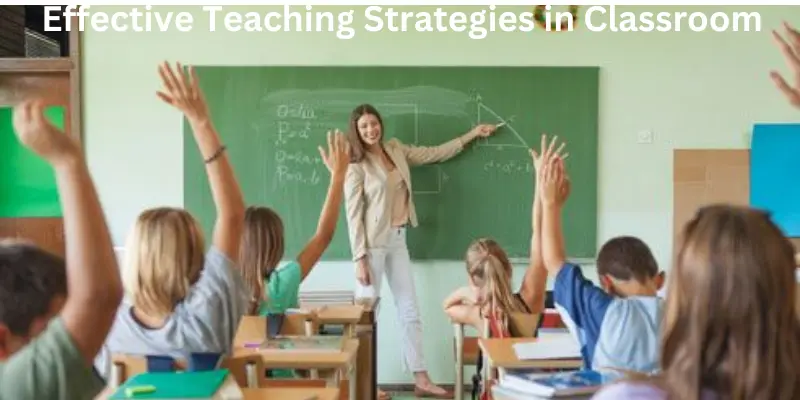
In India, classroom teaching is changing as the education system moves toward competency-based, experiential, student-centered, inclusive, and technology-supported learning. The National Education Policy 2020 emphasizes holistic development, critical thinking, creativity, communication, collaboration, experiential learning, formative assessment, technology integration, and competency development. Teachers remain central to these changes because classroom implementation depends heavily on their knowledge, skills, planning, and teaching practices.
Teachers who understand effective classroom strategies can create lessons that are more engaging without sacrificing academic quality. These strategies do not always require expensive technology or sophisticated infrastructure. Clear learning objectives, effective questioning, group activities, real-life examples, differentiated instruction, formative assessment, constructive feedback, and reflective teaching can significantly improve classroom learning.
What Are Effective Teaching Strategies in Classroom?
Effective Teaching Strategies in Classroom are planned teaching methods that help students understand concepts, develop skills, participate actively, apply knowledge, and demonstrate learning. A strategy becomes effective when it is connected to a specific learning objective and responds to the needs of students.
Effective teaching is not measured only by how much content a teacher covers. A lesson may be successful when students can explain a concept in their own words, solve a problem, apply knowledge in a new situation, compare ideas, communicate their reasoning, or demonstrate a practical skill.
Teachers can combine direct instruction with active learning instead of relying entirely on one method. A short explanation can provide foundational knowledge, followed by discussion, practice, problem-solving, or assessment.
For a broader understanding of educators and their responsibilities, readers can also explore Teaching Faculty Meaning: Roles, Responsibilities, Qualifications, and Importance.
Why Effective Teaching Strategies Matter in Indian Classrooms
Indian classrooms can contain students with different academic abilities, languages, learning needs, interests, confidence levels, and educational experiences. A single teaching approach may not be equally effective for every learner.
Effective Teaching Strategies in Classroom allow teachers to provide multiple opportunities for students to understand and apply knowledge. Students can learn through discussion, demonstration, experiments, projects, storytelling, questioning, peer interaction, practice, and reflection.
The National Education Policy 2020 places importance on competency-based education, experiential learning, formative assessment, inclusion, multilingualism, technology, and holistic development. These priorities make classroom pedagogy an important part of India’s ongoing education transformation.
Teachers can learn more about these changes in NEP 2020 for Teachers: Complete Guide to New Education Policy, Roles, Changes, Benefits & Implementation, which explains changes in classroom practices, teacher responsibilities, competency-based education, digital learning, assessment, and professional development.
Set Clear Learning Objectives Before Every Lesson
One of the most practical Effective Teaching Strategies in Classroom is setting clear learning objectives before instruction begins.
A learning objective should explain what students are expected to know, understand, or do by the end of the lesson. Objectives can focus on knowledge, application, analysis, communication, creativity, problem-solving, or practical skills.
Instead of writing an objective such as “Students will study fractions,” a teacher can establish an objective such as “Students will compare two fractions and explain which fraction is greater.”
Clear objectives help teachers choose appropriate activities and assessment methods. They also help students understand what they are expected to achieve.
A science teacher may ask students to identify parts of a plant and explain their functions. A mathematics teacher may ask students to solve percentage problems related to shopping. A social science teacher may ask students to compare two historical events. An English teacher may ask students to construct an argument supported by evidence.
Use Student-Centered Teaching Strategies
Student-centered teaching gives learners a more active role in the classroom. The teacher remains responsible for planning, explanation, guidance, questioning, assessment, and feedback, but students participate directly in the learning process.
Student-centered classroom strategies can include group discussions, think-pair-share activities, problem-solving tasks, student presentations, peer teaching, debates, case studies, role-play, projects, demonstrations, and learning stations.
A student-centered classroom does not mean eliminating teacher explanations. Direct instruction remains useful when students need background information or clarification. The goal is to balance teacher instruction with opportunities for students to think, practice, communicate, and apply knowledge.
The role of teaching faculty is also changing as classrooms become more learner-focused. The article Teaching Faculty: Roles, Responsibilities, Skills, and Importance in Modern Education explains how modern teachers need classroom management, technological, communication, problem-solving, and mentoring skills.
Apply Active Learning in Daily Lessons
Active learning requires students to do something with the information they receive. Listening to a teacher can introduce a concept, but students often need opportunities to discuss, practice, question, apply, and evaluate.
A teacher explaining a mathematical formula can follow the explanation with a practical problem. A science teacher discussing evaporation can ask students to observe drying water under different conditions. A language teacher can ask students to use newly learned vocabulary in a conversation.
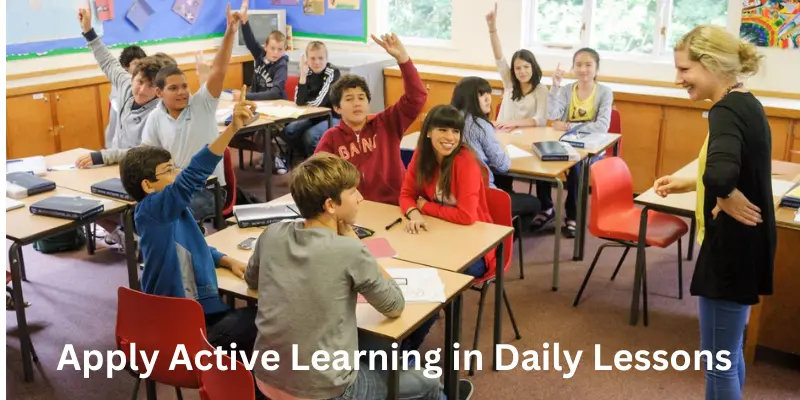
Active learning does not require expensive resources. Paper-based questions, pair discussions, classroom demonstrations, oral questioning, student explanations, and board activities can create meaningful participation.
Use Experiential Learning for Deeper Understanding
Experiential learning is an important approach for Effective Teaching Strategies in Classroom because it connects academic concepts with practical experiences.
The Ministry of Education identifies hands-on learning, storytelling-based pedagogy, art-integrated education, and sports-integrated learning as components of experiential learning.
Teachers can use experiments, observations, projects, field activities, simulations, storytelling, demonstrations, and practical problem-solving tasks.
A mathematics lesson can involve measuring objects in the classroom. A science lesson can include an observation activity. A geography lesson can use local maps. A business lesson can involve a budgeting exercise.
The purpose is to help students connect classroom knowledge with experiences rather than simply memorize information.
Introduce Cooperative Learning Activities
Cooperative learning allows students to work together toward a shared learning objective. It can develop communication, teamwork, listening, responsibility, and problem-solving skills.
Teachers can divide students into small groups and assign clear responsibilities. One student can lead the discussion, another can record ideas, another can present the group’s answer, and another can review the work.
Group activities should have a clear purpose. Simply placing students into groups does not automatically produce effective cooperative learning.
Examples include group problem-solving, science projects, peer review, classroom debates, poster creation, collaborative presentations, and research activities.
Teachers should monitor participation so that one student does not complete the entire task while others remain passive.
Use Differentiated Instruction for Different Learners
Students do not enter classrooms with identical knowledge, skills, interests, or learning needs. Differentiated instruction allows teachers to adjust activities, resources, support, or assessment according to student requirements.
A teacher may provide additional examples to students who need support while giving extension problems to students who are ready for greater challenge.
Differentiation can involve different levels of questions, visual and written resources, additional practice, peer support, flexible grouping, extension activities, and different presentation formats.
Differentiated instruction does not require teachers to create a completely different lesson for every student. It means providing reasonable learning pathways that help different students reach the intended outcome.
Improve Classroom Questioning Techniques
Questioning is one of the simplest and most powerful Effective Teaching Strategies in Classroom.
Teachers can ask questions before, during, and after instruction. Questions should not focus entirely on memorized facts. Students should also be asked to explain, compare, predict, justify, analyze, and apply.
Examples include:
Why do you think this happened?
What evidence supports your answer?
Can you explain this concept in your own words?
What would happen if this condition changed?
Can you give an example from daily life?
How are these two ideas different?
Teachers should provide sufficient thinking time after asking questions. Pair discussions and written responses can give quieter students an opportunity to develop an answer before speaking publicly.
Connect Lessons With Real-Life Situations
Real-life examples can make abstract concepts easier to understand. Students often become more interested when they can see how a lesson relates to their environment, family, community, future career, or everyday decisions.
A mathematics teacher can connect percentages with discounts and household budgets. A science teacher can connect environmental concepts with water conservation and pollution. A social science teacher can connect civic concepts with community responsibilities.
Connecting classroom knowledge with real situations can also support problem-solving and critical thinking.
Use Storytelling as a Teaching Method
Storytelling can support attention, memory, language development, and emotional engagement. It can be used in many subjects.
History teachers can introduce events through the experiences of individuals. Science teachers can explain discoveries through the stories behind them. Language teachers can use stories to develop vocabulary, grammar, speaking, and writing.
Storytelling should remain connected to the learning objective rather than becoming entertainment without educational purpose.
Apply Project-Based Learning
Project-based learning allows students to explore a question or problem through an extended activity. Students may research information, collect observations, organize data, create a product, and present their findings.
Possible classroom projects include local environmental surveys, water conservation plans, community history projects, school waste audits, simple business plans, science experiments, biodiversity documentation, and reading projects.
The teacher should establish learning outcomes, provide guidance, set deadlines, and assess both the learning process and final result.
Use Competency-Based Learning
Competency-based learning focuses on what students can demonstrate rather than only what they can remember.
This approach is closely connected with the educational direction of NEP 2020. Students are expected to understand, apply, analyze, create, communicate, and solve problems rather than depend entirely on memorization.
For a detailed explanation, see Competency-Based Education Under NEP 2020: Meaning, Benefits, Assessment & Implementation. The article explains how competency-based education focuses on application, critical thinking, practical skills, communication, collaboration, and problem-solving.
A competency-based classroom may ask students to apply mathematical reasoning to a practical problem, interpret scientific results, or communicate an argument using evidence.
Use Formative Assessment During Lessons
Formative assessment helps teachers understand student learning while instruction is still taking place.
Teachers can use short quizzes, exit tickets, oral questions, one-minute explanations, demonstrations, peer review, short written responses, concept maps, and classroom polls.
An exit ticket can ask:
What did you learn?
What remains confusing?
What question do you still have?
The responses can help teachers decide whether to continue with a new topic or provide additional explanation.
For a deeper discussion of assessment under NEP 2020, see Competency-Based Assessment Under NEP 2020: Meaning, Benefits, Methods & Implementation. The article explains how assessment can measure students’ knowledge, skills, abilities, practical application, and competencies.
Provide Specific and Constructive Feedback
Feedback should tell students what they did well, what needs improvement, and what they can do next.
“Good work” provides encouragement but limited instructional information.
“Your explanation identifies the main cause correctly. Add one piece of evidence to support your conclusion” provides more useful guidance.
Feedback can be written, verbal, individual, peer-based, or delivered to the whole class when several students have the same misconception.
Strengthen Classroom Management
Classroom management is an essential component of Effective Teaching Strategies in Classroom because learning becomes difficult when expectations are unclear or classroom behavior repeatedly interrupts instruction.
Effective classroom management begins with clear rules, consistent routines, respectful communication, and predictable consequences.
Teachers can establish routines for entering the classroom, submitting assignments, forming groups, asking questions, using devices, changing activities, and ending lessons.
Rules should be understandable and limited in number. Students should also understand the reason behind important classroom expectations.

Create an Inclusive Classroom Environment
An effective classroom should provide meaningful learning opportunities for students with different abilities, backgrounds, languages, and circumstances.
NEP 2020 places equity and inclusion at the center of educational development. Teachers can support inclusion by using accessible materials, encouraging respectful peer interaction, monitoring participation, using clear language, and allowing appropriate flexibility in demonstrating learning.
Students who need additional support should not automatically be isolated. Classroom activities can be designed so that students contribute according to their abilities while working toward shared learning outcomes.
Use Multilingual and Local Contexts
India’s linguistic and cultural diversity can become an educational resource. Teachers can use familiar examples, local situations, regional experiences, stories, and languages where appropriate to support comprehension.
A difficult concept can be introduced through a familiar local example before students move toward formal academic terminology.
This can be particularly useful when students are learning academic concepts through a language that differs from the language they commonly use at home.
Integrate Arts and Sports Into Learning
Arts and sports can support learning beyond dedicated arts or physical education periods.
Students can create diagrams, posters, models, performances, visual presentations, or stories related to academic subjects. Sports-related data can be used to teach mathematics, statistics, health, teamwork, and measurement.
The activity should remain connected to the learning objective rather than being added simply for entertainment.
Use Digital Teaching Methods Carefully
Digital teaching methods for teachers can improve access to resources, visual explanations, interactive activities, assessment tools, and learning materials.
Teachers can use presentations, educational videos, digital quizzes, simulations, online assignments, virtual demonstrations, and learning platforms when these tools directly support the lesson.
Technology should support pedagogy rather than replace good teaching.
A short digital activity that encourages students to solve a problem or demonstrate understanding can be more useful than a long video that students watch passively.
Use Low-Tech Strategies When Resources Are Limited
Effective Teaching Strategies in Classroom do not depend on smartboards, tablets, expensive software, or high-speed internet.
Teachers can use chalkboard questioning, flashcards, printed worksheets, student-created diagrams, pair discussions, role-play, storytelling, classroom demonstrations, peer teaching, and locally available materials.
A low-resource classroom can still be active, collaborative, experiential, inclusive, and competency-focused.
Develop Teaching Skills for New Teachers
Teaching skills for new teachers include lesson planning, communication, questioning, classroom management, assessment, feedback, time management, technology use, student engagement, and reflective practice.
New teachers can begin by mastering a manageable number of reliable strategies rather than trying to use every teaching method at once.
A practical lesson-planning approach can ask five questions:
What should students learn?
What will I explain?
What will students do?
How will I know whether they understood?
What will I change if they did not understand?
The changing expectations of teachers are also connected with professional development and future career requirements. Teachers interested in this area can read Future of Teaching Careers in India After NEP 2020: Scope, Skills & Opportunities. The article discusses digital skills, competency-based pedagogy, assessment, teacher training, multidisciplinary education, and changing teacher responsibilities.
Plan Lessons With the 5E Approach
The 5E instructional model can provide a useful structure for selected lessons.
Engage: Introduce a question, problem, image, demonstration, or situation.
Explore: Allow students to investigate or discuss.
Explain: Clarify the concept and address misconceptions.
Elaborate: Ask students to apply the concept in another context.
Evaluate: Check what students understand.
The approach can be particularly useful for inquiry-based learning and science instruction, although individual elements can be adapted to other subjects.
Encourage Critical Thinking and Problem Solving
Critical thinking should be deliberately included in classroom activities.
Instead of asking students only to recall information, teachers can present problems requiring evidence, comparison, reasoning, and judgment.
A social science teacher can provide two viewpoints and ask students to compare them. A science teacher can give an experimental result and ask students to identify possible explanations. A mathematics teacher can ask students to find more than one solution to a problem.
Students should also be encouraged to explain how they reached an answer.
Build Communication and Collaboration Skills
Education is not limited to academic content. Students also need communication, cooperation, teamwork, resilience, and problem-solving abilities.
Teachers can develop these skills through presentations, group projects, peer review, debates, collaborative problem-solving, and classroom discussions.
Every student should have opportunities to speak, listen, write, present, and respond.
Make Lessons Engaging Without Losing Academic Focus
Engagement does not mean constant entertainment. Students can become engaged through meaningful questions, challenging tasks, relevant examples, practical activities, choice, discussion, and opportunities to demonstrate competence.
A lesson can remain academically rigorous while being interactive.
The teacher’s responsibility is to maintain a balance between participation and learning objectives.
Encourage Reflective Teaching
Teachers can improve their practice by reflecting after lessons.
Useful questions include:
- Which students participated?
- Which students remained quiet?
- Which concept caused confusion?
- Did the activity support the learning objective?
- Was the lesson too fast or too slow?
- Did students apply the concept?
- What evidence showed learning?
- What should be changed next time?
Reflection can be recorded in a teacher journal or lesson-planning document.
How Effective Teaching Strategies Support NEP 2020
NEP 2020 provides an important policy context for modern classroom teaching in India. The policy emphasizes holistic development, competency-based learning, experiential learning, formative assessment, technology, inclusion, multilingualism, and professional development.
The article How NEP 2020 Is Transforming School Education in India: Key Changes, Benefits & Challenges provides additional information about how the policy is changing practical education, digital learning, skill development, and student-focused classroom practices.
Teachers can also review Key Features of the National Education Policy 2020 Explained for a broader overview of the policy’s focus on flexible, inclusive, skill-oriented, and multidisciplinary education.
The implementation of these reforms can involve challenges related to teacher preparation, infrastructure, resources, assessment, class size, and technology access. EducationBeacon’s Challenges of NEP 2020 and Practical Solutions discusses these issues and explains why continuous, practical, classroom-oriented teacher training is important.
A Practical Classroom Strategy for Indian Teachers
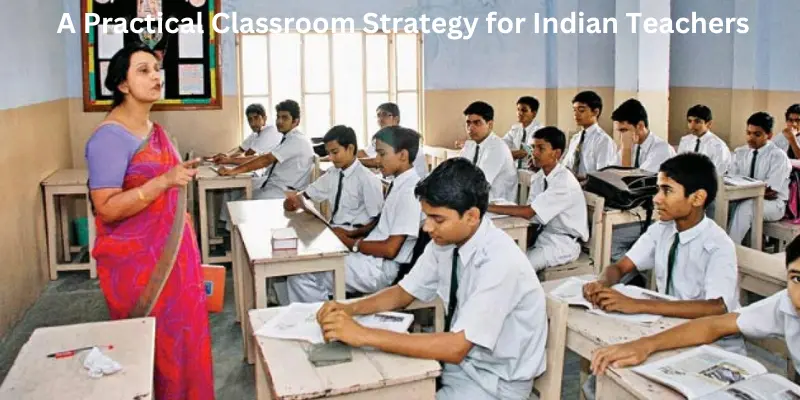
A teacher who wants to improve classroom instruction can begin with a simple lesson structure.
Start with a clear learning objective. Introduce the topic through a question or familiar example. Provide a concise explanation. Give students an opportunity to discuss or practice. Introduce an activity connected with real life. Check understanding through questions or a short assessment. Provide feedback. End with a reflection or exit ticket.
This structure can be adapted for primary, middle, secondary, and senior secondary classrooms.
Teachers do not need to redesign every lesson immediately. One new strategy can be tested, evaluated, and improved before another is introduced.
10 Effective Teaching Strategies to Start Using Today
The following Effective Teaching Strategies in Classroom can be implemented without major changes to school infrastructure:
- Set measurable learning objectives.
- Use student-centered classroom activities.
- Ask higher-order questions.
- Include experiential learning.
- Use cooperative group work.
- Apply differentiated instruction.
- Conduct formative assessments.
- Give specific feedback.
- Connect lessons with real-life situations.
- Reflect on teaching practice after the lesson.
These strategies can be combined rather than used separately.
Frequently Asked Questions
What are the most effective teaching strategies in classroom?
The most useful strategies include student-centered learning, active learning, experiential learning, cooperative learning, differentiated instruction, formative assessment, questioning, project-based learning, real-life applications, and constructive feedback.
How can teachers make classroom teaching more effective?
Teachers can improve classroom teaching by setting clear objectives, involving students in activities, checking understanding frequently, giving useful feedback, adapting instruction to learner needs, and reflecting on lesson outcomes.
Which teaching strategy is best for new teachers?
New teachers can begin with clear lesson planning, active questioning, guided practice, formative assessment, cooperative activities, and consistent classroom management.
How does NEP 2020 affect classroom teaching strategies?
NEP 2020 encourages competency-based learning, experiential learning, formative assessment, technology integration, inclusion, multilingualism, holistic development, and student-centered educational practices.
What is experiential learning in the classroom?
Experiential learning allows students to connect academic concepts with practical experiences. Activities may include experiments, projects, observations, storytelling, art integration, sports integration, and real-life problem-solving.
How can teachers use technology effectively in the classroom?
Teachers can use digital tools for visual explanations, interactive quizzes, simulations, educational videos, online resources, digital assignments, and collaboration. Technology should have a clear learning purpose.
Why is formative assessment important?
Formative assessment provides evidence of student understanding during the learning process. Teachers can use the results to identify misconceptions and adjust instruction before final assessment.
How can teachers handle different learning levels in one classroom?
Teachers can use differentiated instruction, flexible grouping, additional support, extension tasks, varied resources, peer learning, and different ways for students to demonstrate understanding.
You May Also Read
NEP 2020 for Teachers: Complete Guide — useful for understanding how NEP 2020 changes teaching roles and classroom practices.
Competency-Based Education Under NEP 2020 — useful for understanding competency-focused teaching and practical learning.
Future of Teaching Careers in India After NEP 2020 — useful for teachers interested in developing skills for the changing education system.
Conclusion
Effective Teaching Strategies in Classroom are based on purposeful teaching, active student participation, clear learning outcomes, useful assessment, inclusion, and continuous improvement.
Indian teachers can combine traditional instructional strengths with student-centered, experiential, competency-based, collaborative, and technology-supported approaches. NEP 2020 provides strong support for many of these practices and places teachers at the center of educational transformation.
The most effective classroom is not necessarily the one with the most technology or the greatest number of activities. It is the classroom where students understand what they are learning, participate meaningfully, receive useful feedback, apply knowledge, communicate their ideas, and gradually become independent learners.
For teachers in India, improving classroom practice can begin with small changes: one better question, one active learning task, one real-life example, one formative assessment, and one reflective review after each lesson. Over time, these practices can create a more engaging, inclusive, practical, and competency-focused learning environment.
Authoritative External Resources
National Education Policy 2020 — Ministry of Education
Experiential Learning and Curriculum & Pedagogic Reform — Ministry of Education
CBSE Teacher Resources and Manuals
National Curriculum Framework for School Education 2023 — NCERT




- Be Respectful
- Stay Relevant
- Stay Positive
- True Feedback
- Encourage Discussion
- Avoid Spamming
- No Fake News
- Don't Copy-Paste
- No Personal Attacks
- Be Respectful
- Stay Relevant
- Stay Positive
- True Feedback
- Encourage Discussion
- Avoid Spamming
- No Fake News
- Don't Copy-Paste
- No Personal Attacks
